Review
. 2020 Mar 25;12(4):784.
doi: 10.3390/cancers12040784.

Role of BET Inhibitors in Triple Negative Breast Cancers

Affiliations
Review

Role of BET Inhibitors in Triple Negative Breast Cancers

Durga Khandekar et al. Cancers (Basel). .

Abstract

Bromodomain and extraterminal domain (BET) proteins have evolved as key multifunctional super-regulators that control gene expression. These proteins have been shown to upregulate transcriptional machinery leading to over expression of genes involved in cell proliferation and carcinogenesis. Based on favorable preclinical evidence of BET inhibitors in various cancer models; currently, 26 clinical trials are underway in various stages of study on various hematological and solid organ cancers. Unfortunately, preliminary evidence for these clinical studies does not support the application of BET inhibitors as monotherapy in cancer treatment. Furthermore, the combinatorial efficiency of BET inhibitors with other chemo-and immunotherapeutic agents remain elusive. In this review, we will provide a concise summary of the molecular basis and preliminary clinical outcomes of BET inhibitors in cancer therapy, with special focus on triple negative breast cancer.

Keywords: breast cancer; bromodomains; cancer biology; drug discovery; immunotherapy.


Conflict of interest statement

The authors declare no conflict of interest.

Figures

Figure 1
Figure 1
General structure and mechanism of action of BET inhibitors. (A) Generic domain structure of the BET protein family. Each BET protein (BRD2, 3, 4 and BRDT) contains two bromodomains (BrD1 and BrD2) and an extra-terminal (ET) domain. An additional carboxy-terminal motif (CTM) is present in BRD4 and BRDT—BET proteins. (B) Acetylation of lysine moieties on histones leads to conversion of inactive heterochromatin to active euchromatin. (C) BET proteins through their interaction of bromodomain (BRD) motifs with acetylated histones activates transcriptional machinery leading to gene expression and carcinogenesis.
Figure 2
Figure 2
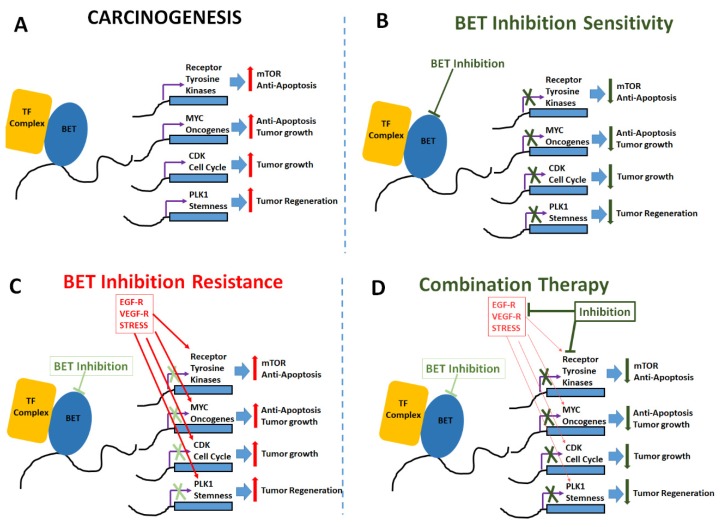
Mechanisms of BET inhibitor activity, resistance and combinatorial application. (A) Carcinogenic changes mediated by upregulation of tumorigenic transcription factors, anti-apoptotic genes, oncogenes and cell cycle inducers following epigenetic enhancement by BET proteins. (B) BET inhibitors induce anti-tumor effect by enhancing apoptosis and reducing cell proliferation. (C) Cell adaptation mechanisms to overcome BET inhibition by upregulation of receptors for epidermal growth factor (EGF-R), vascular endothelial growth factor (VEGF-R) and other stress mediated factors such as HIF1α etc. (D) Combinatorial treatment with addition of drugs targeted at mTOR pathway and other oncogenic pathways along with BET inhibition to enhance anti-cancer impact.

References

    1. Kim M., Costello J. DNA methylation: An epigenetic mark of cellular memory. Exp. Mol. Med. 2017;49:e322. doi: 10.1038/emm.2017.10. - DOI - PMC - PubMed
    1. Wang K.C., Chang H.Y. Epigenomics: Technologies and Applications. Circ. Res. 2018;122:1191–1199. doi: 10.1161/CIRCRESAHA.118.310998. - DOI - PMC - PubMed
    1. Kanwal R., Gupta S. Epigenetic modifications in cancer. Clin. Genet. 2012;81:303–311. doi: 10.1111/j.1399-0004.2011.01809.x. - DOI - PMC - PubMed
    1. Chen C., Yue D., Lei L., Wang H., Lu J., Zhou Y., Liu S., Ding T., Guo M., Xu L. Promoter-Operating Targeted Expression of Gene Therapy in Cancer: Current Stage and Prospect. Mol. Nucleic Acids. 2018;11:508–514. doi: 10.1016/j.omtn.2018.04.003. - DOI - PMC - PubMed
    1. Bradner J.E., Hnisz D., Young R.A. Transcriptional Addiction in Cancer. Cell. 2017;168:629–643. doi: 10.1016/j.cell.2016.12.013. - DOI - PMC - PubMed

LinkOut - more resources