. 2020 Mar 26;10(1):5551.
doi: 10.1038/s41598-020-62077-w.

Acute Restraint Stress Evokes Anxiety-Like Behavior Mediated by Telencephalic Inactivation and GabAergic Dysfunction in Zebrafish Brains

Affiliations

Acute Restraint Stress Evokes Anxiety-Like Behavior Mediated by Telencephalic Inactivation and GabAergic Dysfunction in Zebrafish Brains

Nadyme Assad et al. Sci Rep. .

Abstract

Acute stress is an important factor in the development of anxiety disorders. Zebrafish are an organism model widely used by studies that aim to describe the events in the brain that control stress-elicited anxiety. The goal of the current study was to evaluate the pattern of cell activation in the telencephalon of adult zebrafish and the role of the GABAergic system on the modulation of anxiety-like behavior evoked by acute restraint stress. Zebrafish that underwent acute restraint stress presented decreased expression of the c-fos protein in their telencephalon as well as a significant decrease in GABA release. The data also supports that decreased GABA levels in zebrafish brains have diminished the activation of GABAA receptors eliciting anxiety-like behavior. Taken together these findings have helped clarify a neurochemical pathway controlling anxiety-like behavior evoked by acute stress in zebrafish while also opening the possibility of new perspective opportunities to use zebrafish as an animal model to test anxyolitic drugs that target the GABAergic system.


Conflict of interest statement

The authors declare no competing interests.

Figures
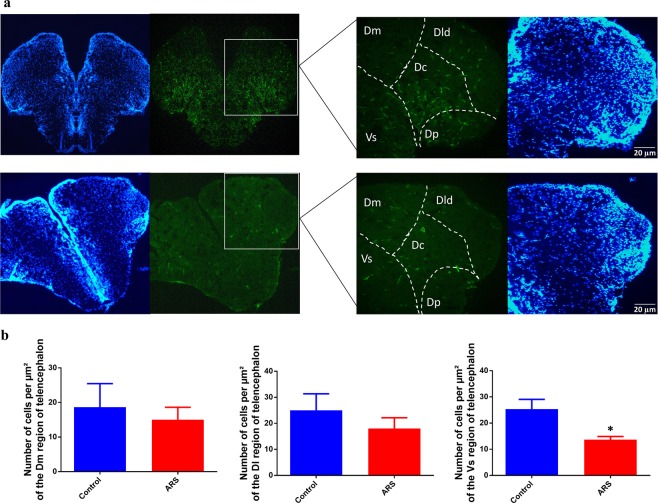
Figure 1
Figure 1
Cell activation in zebrafish brain submitted to ARS. (a) Imunofluorescence of dorsal telencephalon region of zebrafish brain. Top images shows DAPI staining (blue) and c-Fos staining (green) of control group and bottom images represents ARS group. Dm: dorsomedial telencephalon; Dl: dorsolateral telencephalon. Objective: 20x. (b) Counting of the cells marked with c-Fos in the telencephalic region of zebrafish brain. Values showed as MEAN ± S.E.M. (Student’s T test. *p < 0,05).
Figure 2
Figure 2
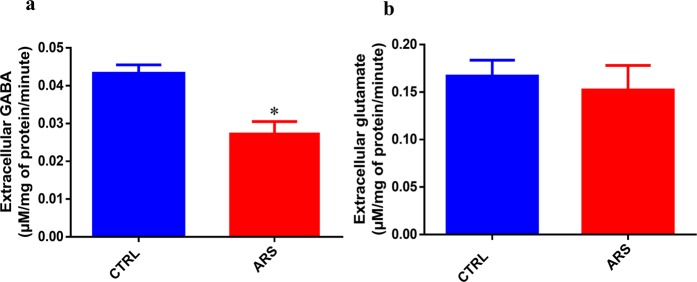
Extracellular levels of GABA (a) and glutamate (b) in the brain of zebrafish submitted to ARS. Values showed as MEAN ± S.E.M. (Student’s T test. *p < 0,05).
Figure 3
Figure 3
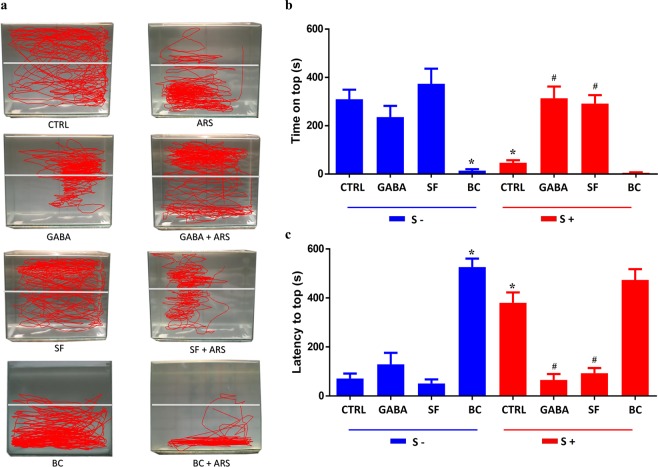
Effects of GABA, bicuculline and saclofen in locomotion (a) and behavior parameters of zebrafish: time spent on top in seconds (b) and latency to top in seconds. (c) Animals that did not went through the ARS are represented as S- and those who were submitted to ARS are represented as S+. Values showed as MEAN ± S.E.M. (ANOVA one way, Tukey post test. *Compared to control (S−) #compared to control (S+) p < 0,05).
Figure 4
Figure 4
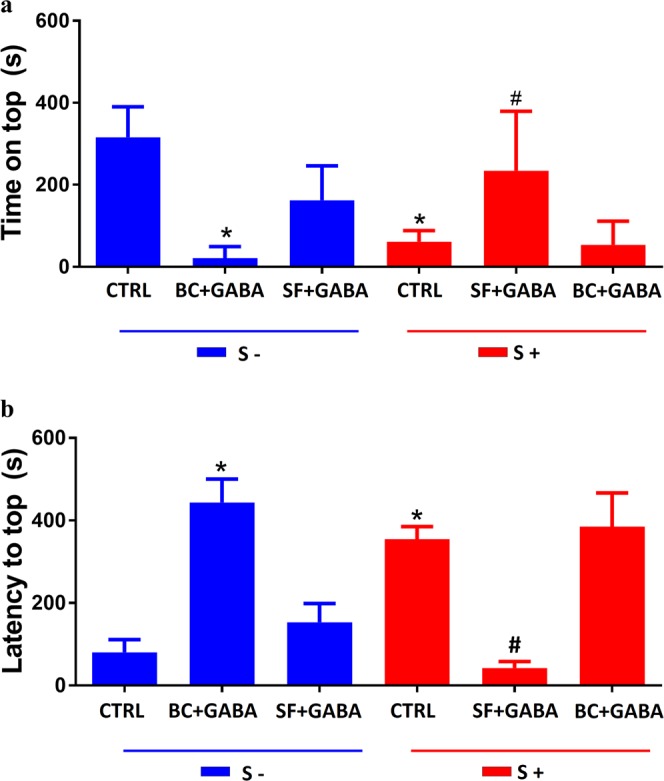
Effects of co-treatment of GABA, bicuculline and saclofen in behavior parameters of zebrafish: time spent on top in seconds (a) and latency to top in seconds (b). Animals that did not went through the ARS are represented as S- and those who were submitted to ARS are represented as S+. Values showed as MEAN ± S.E.M. (ANOVA one way, Tukey post test. *Compared to control (S−) #compared to control (S+) p < 0,05).
Figure 5
Figure 5
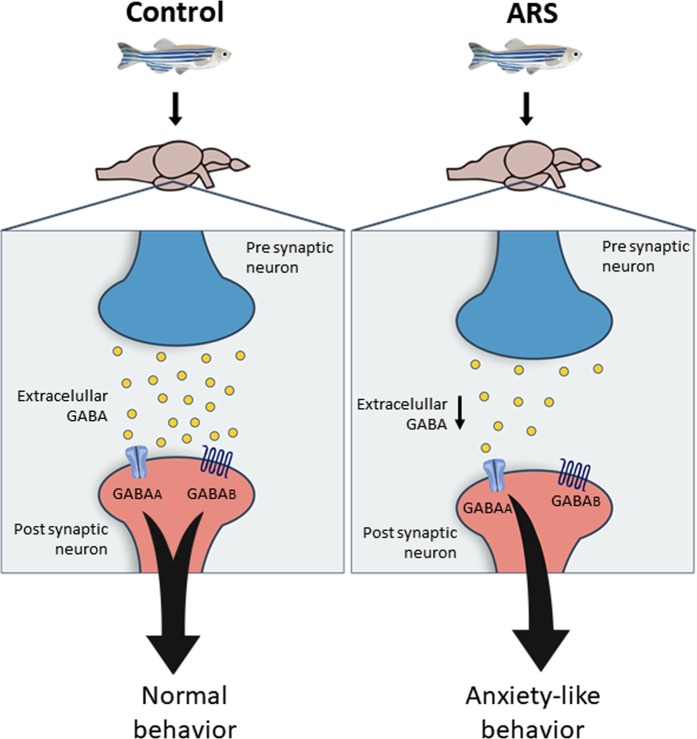
Representative image of GABAergic signaling in zebrafish brain under normal and ARS conditions.

References

    1. Viana AG, et al. Emotional clarity, anxiety sensitivity, and PTSD symptoms among trauma-exposed inpatient adolescents. Child. Psychiatry Hum. Dev. 2017;49(1):146–154. doi: 10.1007/s10578-017-0736-x. - DOI - PubMed
    1. Hovens JG, Giltay EJ, Spinhoven P, van Hemert AM, Penninx BW. Impact of childhood life events and childhood trauma on the onset and recurrence of depressive and anxiety disorders. J. Clin. Psychiatry. 2015;76(7):931–938. doi: 10.4088/JCP.14m09135. - DOI - PubMed
    1. Price M, Van Stolk-cooke K. Examination of the interrelations between the factors of PTSD, major depression, and generalized anxiety disorder in a heterogeneous trauma-exposed sample using DSM 5 criteria. J. Affect. Disord. 2015;186:149–155. doi: 10.1016/j.jad.2015.06.012. - DOI - PubMed
    1. Larsson MR, Bäckström M, Johanson A. The interaction between baseline trait anxiety and trauma exposure as predictor of post-trauma symptoms of anxiety and insomnia. Scand. J. Psychol. 2008;49(5):447–450. doi: 10.1111/j.1467-9450.2008.00649.x. - DOI - PubMed
    1. Fontana BD, Mezzomo NJ, Kalueff AV, Rosemberg DB. The developing utility of zebrafish models of neurological and neuropsychiatric disorders: A critical review. Exp. Neurol. 2018;299(Pt A):157–171. doi: 10.1016/j.expneurol.2017.10.004. - DOI - PubMed

Publication types

LinkOut - more resources