


Effect of Angle of View and Partial Sleep Deprivation on Distance Perception
- PMID: 32218750
- PMCID: PMC7078342
- DOI: 10.3389/fpsyg.2020.00201
Effect of Angle of View and Partial Sleep Deprivation on Distance Perception
Abstract
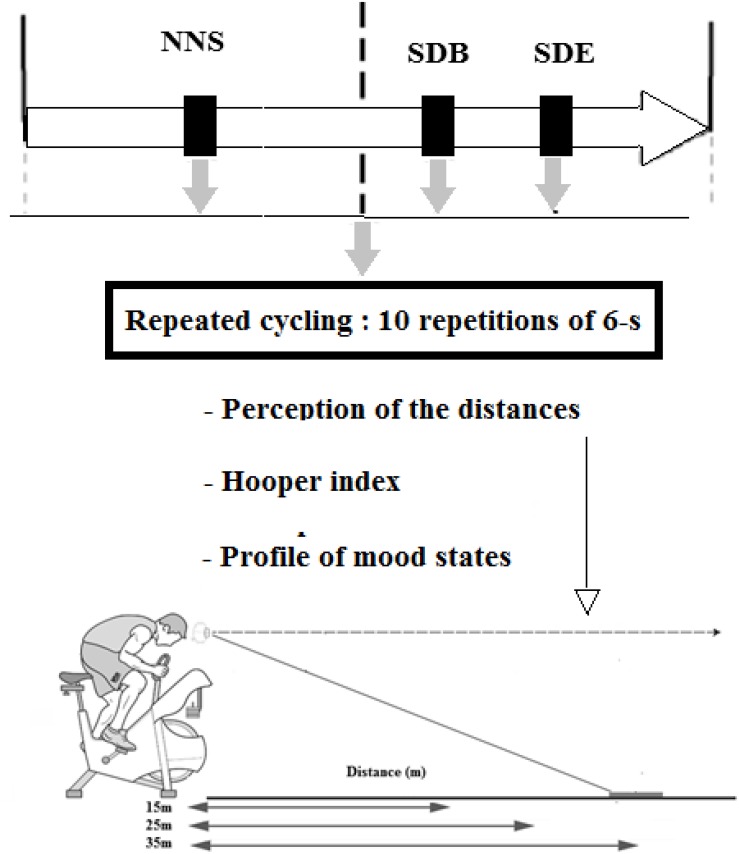
The present study aimed to investigate the effects of intensive effort on egocentric distance perception according to different angles of view after sleep deprivation at the beginning (SDB) or at the end (SDE) of the night and after a normal sleep night (NNS). Ten male students soccer players (age 22.8 ± 1.3 years; body mass 72.0 ± 10.4 kg; body height 180.0 ± 3.0 cm) performed a repeated cycling (RS) exercise (10 × 6 s maximal cycling with 24 s in between) after SDB, SDE, and NNS. They were asked to estimate three distances (i.e. 15, 25, and 35 m) before and after RS from different angles of view [i.e. in front (0°) and in side (45° left and 45° right)]. For 35 m, distance estimation was better during NNS compared to SDB and SDE for the front and the two side angles either before or after RS (p < 0.05). Concerning 25 m, distance estimation was better after compared to before RS for the front angle during the NNS session (p < 0.05). For 15 m, distance estimation was better during NNS than SDB and SDE for the front and both side angles after RS (p < 0.05). We concluded that partial sleep deprivation negatively affected the estimation of the egocentric distance for the three angles of view either at rest or after RS exercise.
Keywords: angle of view; perception; performance; repeated sprint; sleep.
Copyright © 2020 Baati, Chtourou, Moalla, Jarraya, Nikolaidis, Rosemann and Knechtle.
Figures
References
-
- Abedelmalek S., Souissi N., Chtourou H., Denguezli M., Aouichaoui C., Ajina M., et al. (2013b). Effects of partial sleep deprivation on proinflammatory cytokines, growth hormone, and steroid hormone concentrations during repeated brief sprint interval exercise. Chronobiol. Int. 30 502–509. 10.3109/07420528.2012.742102 - DOI - PubMed
-
- Blumert P. A., Crum A. J., Ernstring M., Volek J. S., Hollander D. B., Haff E. E., et al. (2007). The acute effects of twenty four hours of sleep loss on the performance of national-caliber male collegiate weightlifters. J. Strength Cond. Res. 21 1146–1154. 10.1519/00124278-200711000-00028 - DOI - PubMed
LinkOut - more resources
Full Text Sources
