


Regulation of the intestinal barrier by nutrients: The role of tight junctions
- PMID: 32219956
- PMCID: PMC7187240
- DOI: 10.1111/asj.13357
Regulation of the intestinal barrier by nutrients: The role of tight junctions
Abstract
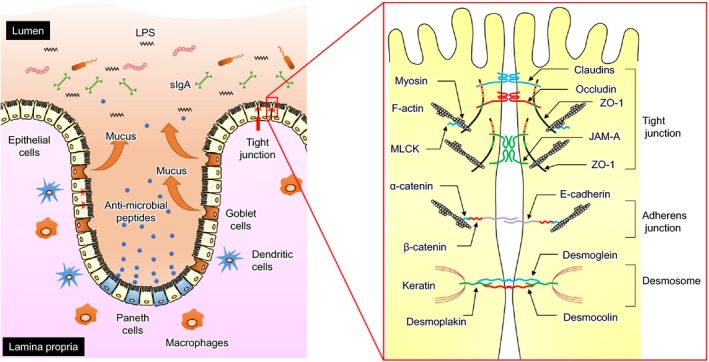
Tight junctions (TJs) play an important role in intestinal barrier function. TJs in intestinal epithelial cells are composed of different junctional molecules, such as claudin and occludin, and regulate the paracellular permeability of water, ions, and macromolecules in adjacent cells. One of the most important roles of the TJ structure is to provide a physical barrier to luminal inflammatory molecules. Impaired integrity and structure of the TJ barrier result in a forcible activation of immune cells and chronic inflammation in different tissues. According to recent studies, the intestinal TJ barrier could be regulated, as a potential target, by dietary factors to prevent and reduce different inflammatory disorders, although the precise mechanisms underlying the dietary regulation remain unclear. This review summarizes currently available information on the regulation of the intestinal TJ barrier by food components.
Keywords: intestinal barrier; intestinal permeability; nutrient; tight junction.
© 2020 The Authors. Animal Science Journal published by John Wiley & Sons Australia, Ltd on behalf of Japanese Society of Animal Science.
Figures
References
-
- Araki, Y. , Katoh, T. , Ogawa, A. , Bamba, S. , Andoh, A. , Koyama, S. , … Bamba, T. (2005). Bile acid modulates transepithelial permeability via the generation of reactive oxygen species in the Caco‐2 cell line. Free Radical Biology & Medicine, 39, 769–780. 10.1016/j.freeradbiomed.2005.04.026 - DOI - PubMed
Publication types
MeSH terms
Substances
Grants and funding
LinkOut - more resources
Full Text Sources
Other Literature Sources
