


Environmental temperature and growth faltering in African children: a cross-sectional study
- PMID: 32220673
- PMCID: PMC7232952
- DOI: 10.1016/S2542-5196(20)30037-1
Environmental temperature and growth faltering in African children: a cross-sectional study
Abstract
Background: Child growth faltering persists in sub-Saharan Africa despite the scale-up of nutrition, water, and sanitation interventions over the past 2 decades. High temperatures have been hypothesised to contribute to child growth faltering via an adaptive response to heat, reduced appetite, and the energetic cost of thermoregulation. We did a cross-sectional study to assess whether child growth faltering is related to environmental temperature in sub-Saharan Africa.
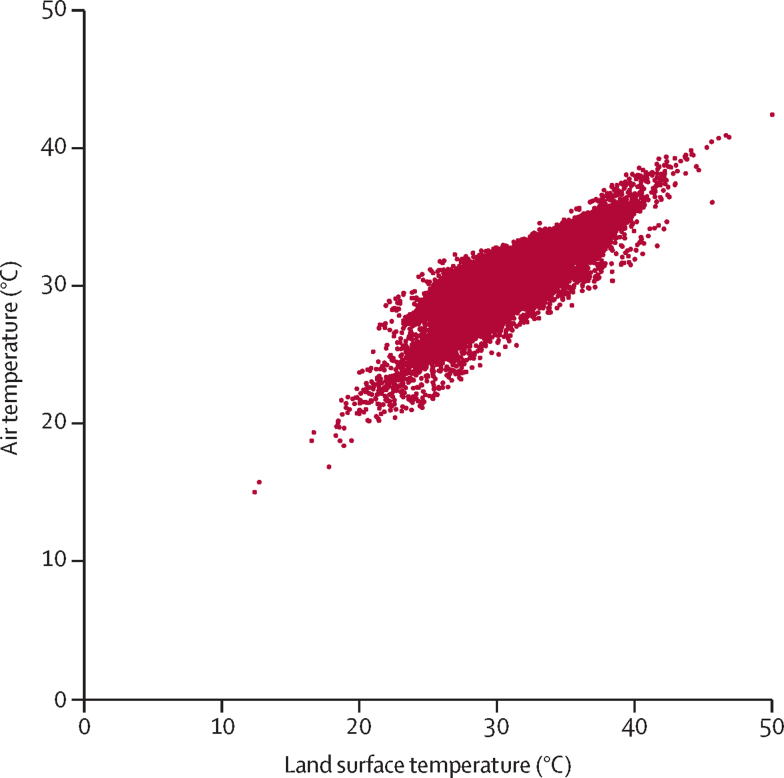
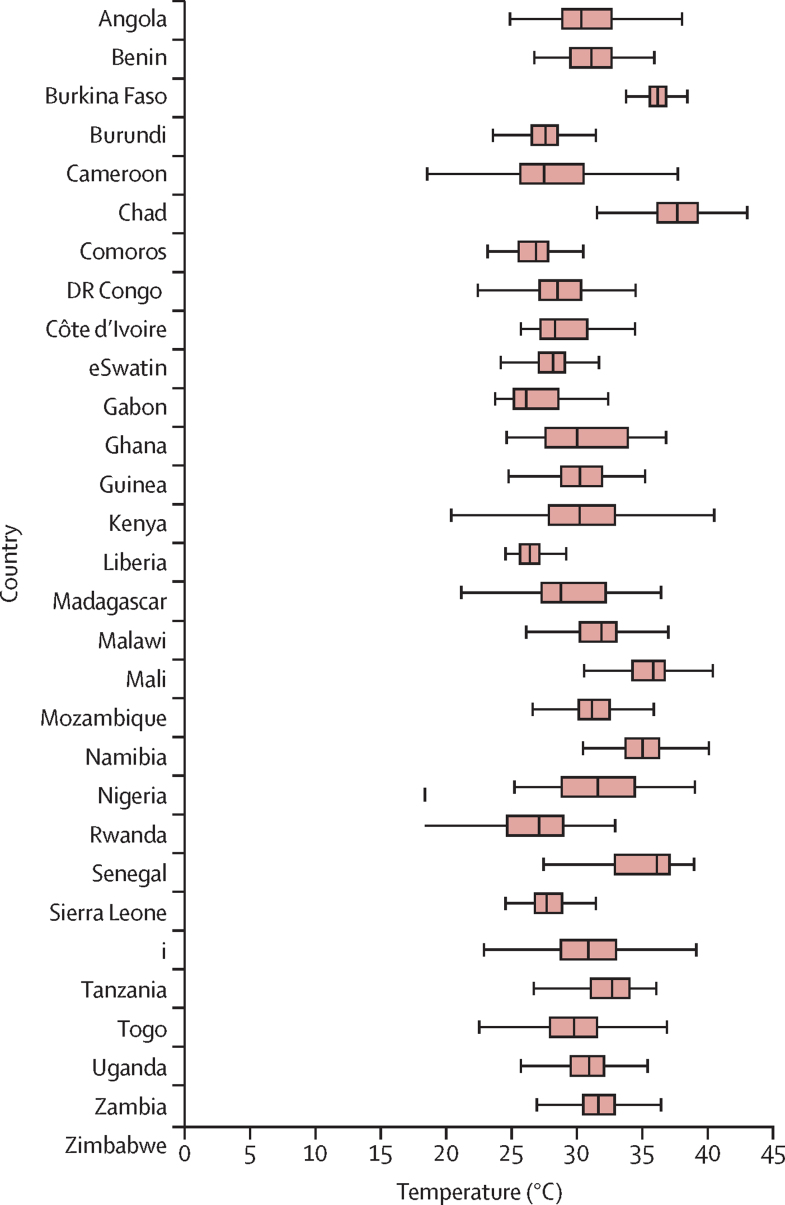
Methods: Data were extracted from 52 Demographic and Heath Surveys, dating from 2003 to 2016, that recorded anthropometric data in children aged 0-5 years, and were linked with remotely sensed monthly mean daytime land surface temperature for 2000-16. The odds of stunting (low height-for-age), wasting (low weight-for-height), and underweight (low weight-for-age) relative to monthly mean daytime land surface temperature were determined using multivariable logistic regression.
Findings: The study population comprised 656 107 children resident in 373 012 households. Monthly mean daytime land surface temperature above 35°C was associated with increases in the odds of wasting (odds ratio 1·27, 95% CI 1·16-1·38; p<0·0001), underweight (1·09, 1·02-1·16; p=0·0073), and concurrent stunting with wasting (1·23, 1·07-1·41; p=0·0037), but a reduction in stunting (0·90, 0·85-0·96; p=0·00047) compared with a monthly mean daytime land surface temperature of less than 30°C.
Interpretation: Children living in hotter parts of sub-Saharan Africa are more likely to be wasted, underweight, and concurrently stunted and wasted, but less likely to be stunted, than in cooler areas. Studies are needed to further investigate the relationship between temperature and child growth, including whether there is a direct effect not mediated by food security, regional wealth, and other environmental variables. Rising temperature, linked to anthropogenic climate change, might increase child growth faltering in sub-Saharan Africa.
Funding: UK Medical Research Council and UK Global Challenges Research Fund.
Copyright © 2020 The Author(s). Published by Elsevier Ltd. This is an Open Access article under the CC BY 4.0 license. Published by Elsevier Ltd.. All rights reserved.
Figures
References
-
- Black RE, Victora CG, Walker SP. Maternal and child undernutrition and overweight in low-income and middle-income countries. Lancet. 2013;382:427–451. - PubMed
-
- Bhutta ZA, Das JK, Rizvi A. Evidence-based interventions for improvement of maternal and child nutrition: what can be done and at what cost? Lancet. 2013;382:452–477. - PubMed
Publication types
MeSH terms
Grants and funding
LinkOut - more resources
Full Text Sources
Medical
Miscellaneous
