. 2020 May 19;86(11):e00356-20.
doi: 10.1128/AEM.00356-20. Print 2020 May 19.

Microbial Residents of the Atlantis Massif's Shallow Serpentinite Subsurface

Affiliations

Microbial Residents of the Atlantis Massif's Shallow Serpentinite Subsurface

Shahrzad Motamedi et al. Appl Environ Microbiol. .

Abstract

The Atlantis Massif rises 4,000 m above the seafloor near the Mid-Atlantic Ridge and consists of rocks uplifted from Earth's lower crust and upper mantle. Exposure of the mantle rocks to seawater leads to their alteration into serpentinites. These aqueous geochemical reactions, collectively known as the process of serpentinization, are exothermic and are associated with the release of hydrogen gas (H2), methane (CH4), and small organic molecules. The biological consequences of this flux of energy and organic compounds from the Atlantis Massif were explored by International Ocean Discovery Program (IODP) Expedition 357, which used seabed drills to collect continuous sequences of shallow (<16 m below seafloor) marine serpentinites and mafic assemblages. Here, we report the census of microbial diversity in samples of the drill cores, as measured by environmental 16S rRNA gene amplicon sequencing. The problem of contamination of subsurface samples was a primary concern during all stages of this project, starting from the initial study design, continuing to the collection of samples from the seafloor, handling the samples shipboard and in the lab, preparing the samples for DNA extraction, and analyzing the DNA sequence data. To distinguish endemic microbial taxa of serpentinite subsurface rocks from seawater residents and other potential contaminants, the distributions of individual 16S rRNA gene sequences among all samples were evaluated, taking into consideration both presence/absence and relative abundances. Our results highlight a few candidate residents of the shallow serpentinite subsurface, including uncultured representatives of the Thermoplasmata, Acidobacteria, Acidimicrobia, and ChloroflexiIMPORTANCE The International Ocean Discovery Program Expedition 357-"Serpentinization and Life"-utilized seabed drills to collect rocks from the oceanic crust. The recovered rock cores represent the shallow serpentinite subsurface of the Atlantis Massif, where reactions between uplifted mantle rocks and water, collectively known as serpentinization, produce environmental conditions that can stimulate biological activity and are thought to be analogous to environments that were prevalent on the early Earth and perhaps other planets. The methodology and results of this project have implications for life detection experiments, including sample return missions, and provide a window into the diversity of microbial communities inhabiting subseafloor serpentinites.

Keywords: Atlantis Massif; contamination; serpentinization.


Figures

FIG 1
FIG 1
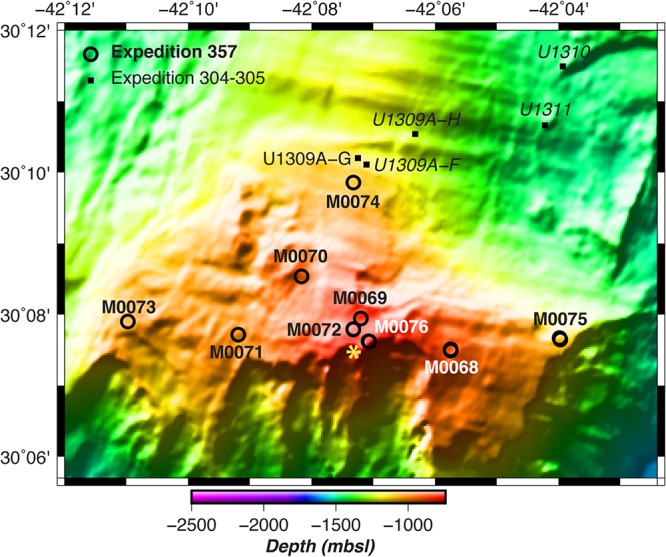
Multibeam bathymetry of the Atlantis Massif, with water depth in meters below sea level (mbsl) in color scale per legend. Drilled sites are shown as black circles. The yellow star is the location of the Lost City hydrothermal field. The distance between the most western site (M0073) and the most eastern site (M0075) is approximately 13 km. (Adapted from reference with permission of the publisher.)
FIG 2
FIG 2
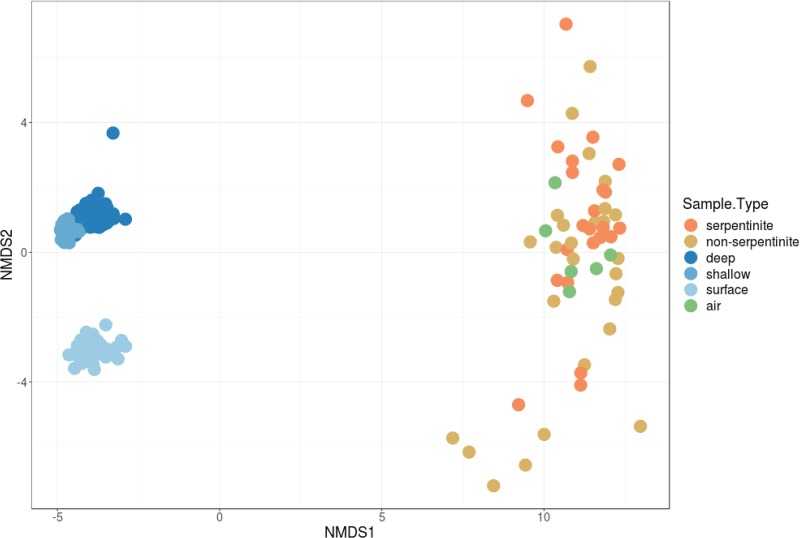
A nonmetric multidimensional scaling plot shows general patterns in the 16S rRNA gene microbial community compositions of all types of samples. Each data point represents the microbial community composition of a sample of seawater (deep, shallow, or surface), rock core (serpentinite versus nonserpentinite), or laboratory air. The distances between the data points represent the Morisita-Horn dissimilarities among the microbial communities.
FIG 3
FIG 3
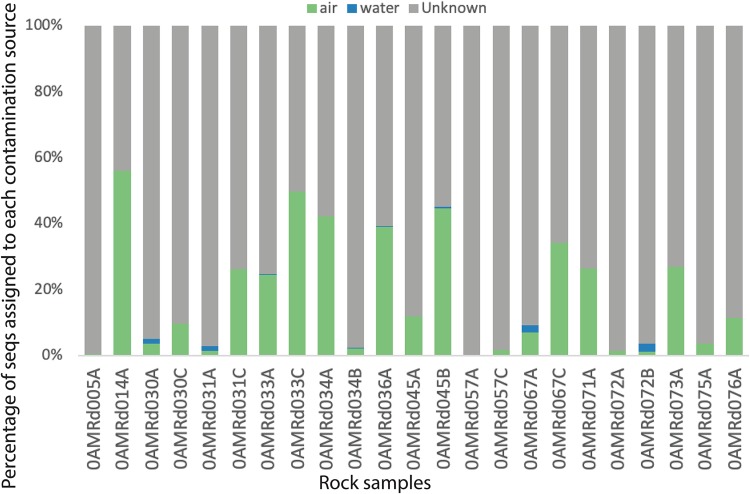
Assessment of potential 16S rRNA gene library contamination in serpentinite samples with SourceTracker2. Each bar on this plot shows the percentage of ASVs from each source of contamination into each serpentinite sample. Green, lab air; blue, seawater samples; gray, undetermined.
FIG 4
FIG 4
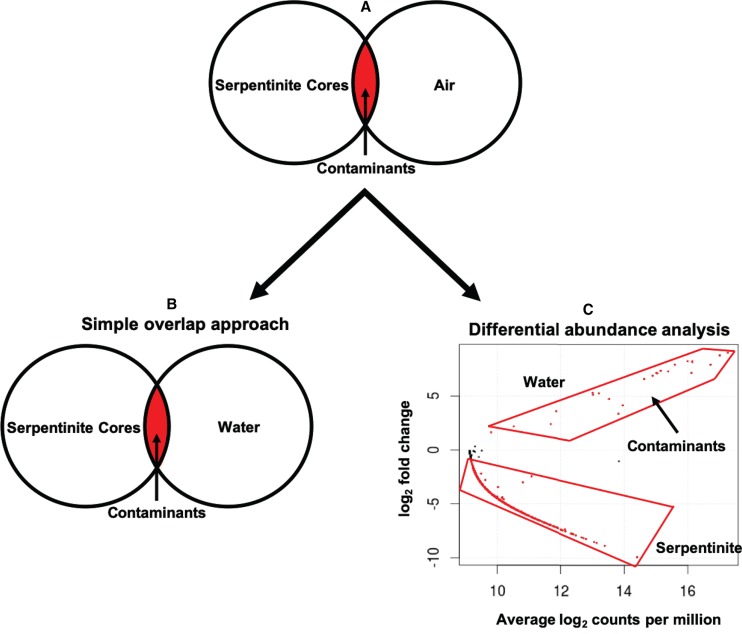
Workflow for identifying DNA sequence contaminants. (A) All ASVs detected in air samples were removed from the data set. (B) The simple overlap (SO) approach was used to remove all ASVs detected in water samples. (C) The differential abundance (DA) approach was used to remove only ASVs that were significantly more abundant in water samples compared to serpentinite samples. Differentially abundant ASVs are shown as red data points in the plot. The significance threshold was a false detection rate of 0.05. Only one of the comparisons is shown here (deep water samples versus serpentinite samples). Shallow and surface water samples were compared in separate analyses not shown here.
FIG 5
FIG 5
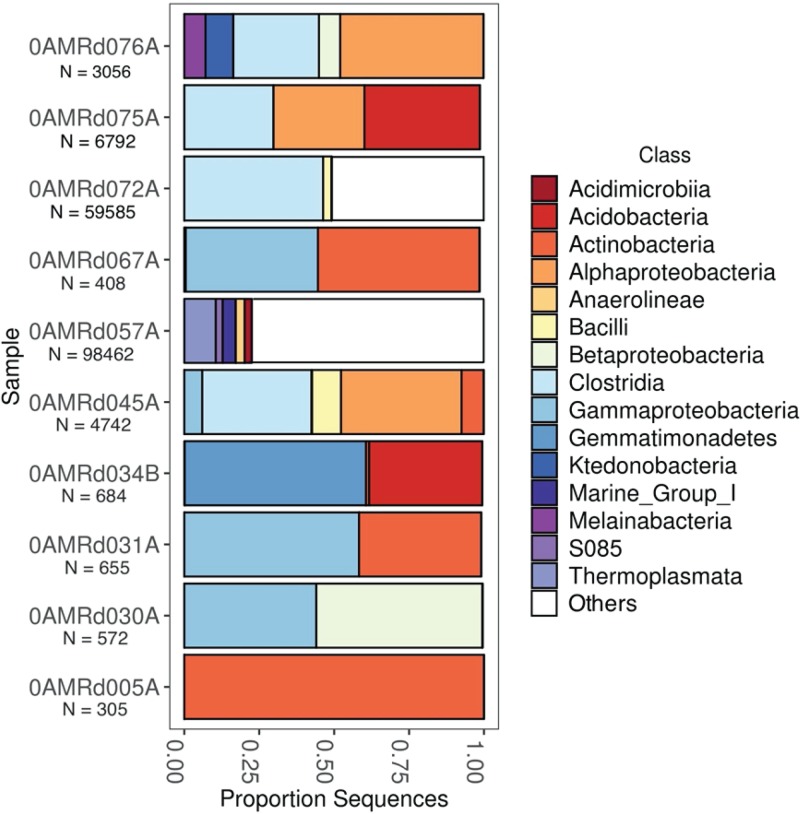
Taxonomic summary of ASVs detected in serpentinite samples after contaminant removal. For clarity, only the top 50 ASVs among all samples (Data Set S7) are shown here. N is the total ASV counts for each sample after excluding rare ASVs. Samples 0AMRd076A, -075A, -072A, and -067A were collected from hole M0076B. Samples 0AMRd031A and -030A were collected from hole M0071B. No other samples in this figure were collected from the same hole.
FIG 6
FIG 6
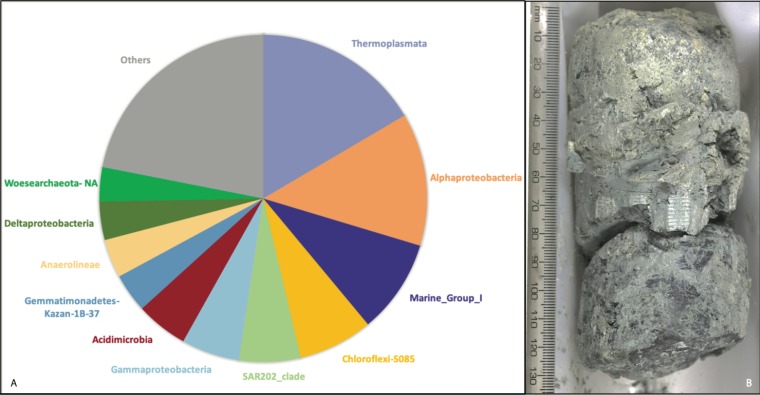
(A) Taxonomic summary of serpentinite sample 0AMRd057 (357-75A-1R-CC,0-4cm). The relative abundance of each taxonomic group is its proportion of 103,229 total sequence counts among the final 331 ASVs identified by the differential abundance (DA) approach. (B) This sample was recovered from the core catcher section of the core from borehole M0075A. The scale is presented in millimeters (74).

References

    1. Whitman WB, Coleman DC, Wiebe WJ. 1998. Prokaryotes: the unseen majority. Proc Natl Acad Sci U S A 95:6578–6583. doi:10.1073/pnas.95.12.6578. - DOI - PMC - PubMed
    1. Bar-On YM, Phillips R, Milo R. 2018. The biomass distribution on Earth. Proc Natl Acad Sci U S A 115:6506–6511. doi:10.1073/pnas.1711842115. - DOI - PMC - PubMed
    1. Lipp JS, Morono Y, Inagaki F, Hinrichs K-U. 2008. Significant contribution of Archaea to extant biomass in marine subsurface sediments. Nature 454:991–994. doi:10.1038/nature07174. - DOI - PubMed
    1. Kallmeyer J, Pockalny R, Adhikari RR, Smith DC, D’Hondt S. 2012. Global distribution of microbial abundance and biomass in subseafloor sediment. Proc Natl Acad Sci U S A 109:16213–16216. doi:10.1073/pnas.1203849109. - DOI - PMC - PubMed
    1. Orcutt BN, Sylvan JB, Knab NJ, Edwards KJ. 2011. Microbial ecology of the dark ocean above, at, and below the seafloor. Microbiol Mol Biol Rev 75:361–422. doi:10.1128/MMBR.00039-10. - DOI - PMC - PubMed

Publication types

LinkOut - more resources