. 2020 Mar 27;10(1):5573.
doi: 10.1038/s41598-020-62265-8.

A retrospective qualitative report of symptoms and safety from transcranial focused ultrasound for neuromodulation in humans

Affiliations

A retrospective qualitative report of symptoms and safety from transcranial focused ultrasound for neuromodulation in humans

Wynn Legon et al. Sci Rep. .

Abstract

Low intensity transcranial focused ultrasound (LIFU) is a promising method of non-invasive neuromodulation that uses mechanical energy to affect neuronal excitability. LIFU confers high spatial resolution and adjustable focal lengths for precise neuromodulation of discrete regions in the human brain. Before the full potential of low intensity ultrasound for research and clinical application can be investigated, data on the safety of this technique is indicated. Here, we provide an evaluation of the safety of LIFU for human neuromodulation through participant report and neurological assessment with a comparison of symptomology to other forms of non-invasive brain stimulation. Participants (N = 120) that were enrolled in one of seven human ultrasound neuromodulation studies in one laboratory at the University of Minnesota (2015-2017) were queried to complete a follow-up Participant Report of Symptoms questionnaire assessing their self-reported experience and tolerance to participation in LIFU research (Isppa 11.56-17.12 W/cm2) and the perceived relation of symptoms to LIFU. A total of 64/120 participant (53%) responded to follow-up requests to complete the Participant Report of Symptoms questionnaire. None of the participants experienced serious adverse effects. From the post-hoc assessment of safety using the questionnaire, 7/64 reported mild to moderate symptoms, that were perceived as 'possibly' or 'probably' related to participation in LIFU experiments. These reports included neck pain, problems with attention, muscle twitches and anxiety. The most common unrelated symptoms included sleepiness and neck pain. There were initial transient reports of mild neck pain, scalp tingling and headache that were extinguished upon follow-up. No new symptoms were reported upon follow up out to 1 month. The profile and incidence of symptoms looks to be similar to other forms of non-invasive brain stimulation.


Conflict of interest statement

The authors declare no competing interests.

Figures
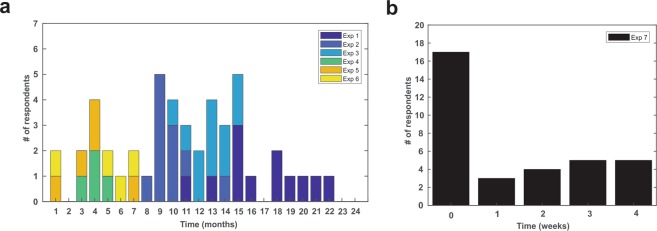
Figure 1
Figure 1
Timeline of respondent follow-up. Bar graph (a) of the time of questionnaire response of participants from experiments one through six (N = 47) broken down by experiment number. (b) Bar graph of response time for experiment 7. Seventeen participants took the questionnaire the day of the experiment (Time = 0) and responded to the questionnaire again at one of four time points out to one month.
Figure 2
Figure 2
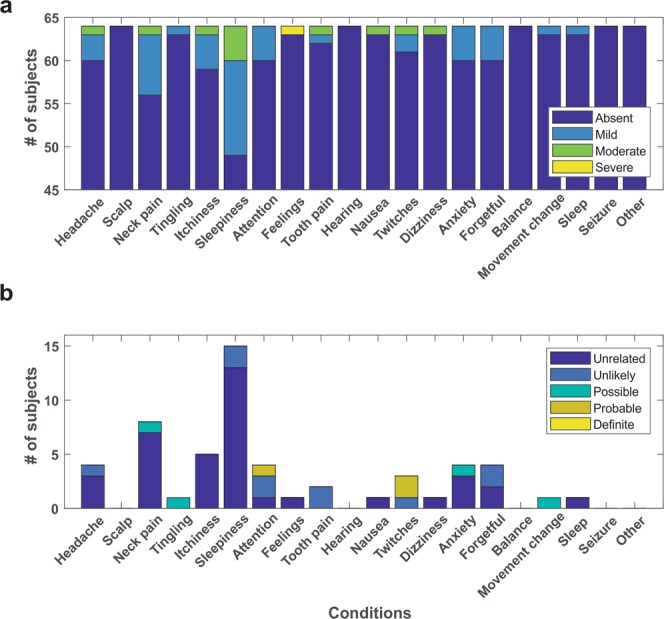
Group report of symptoms. (a) Total number of responses for all participants (N = 64) collapsed across all experiments (1–7) coded by the severity of the symptom. (b) Total number of responses from all participants (N = 64) collapsed across all experiments coded by the subjective relation of the symptom to the ultrasound neuromodulation intervention. Note: Feelings refers to the question asking about experiencing any unusual feelings, attitudes or emotions.
Figure 3
Figure 3
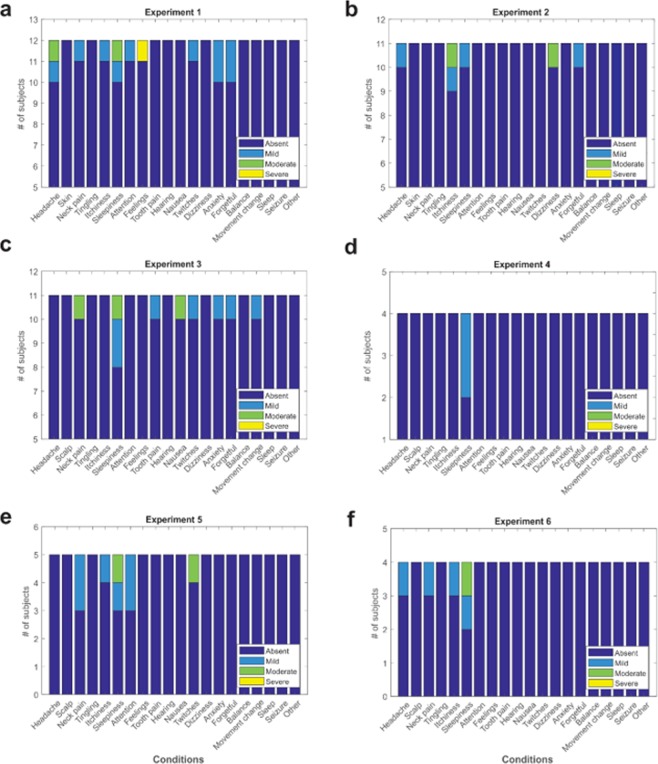
Individual report of symptoms for experiments 1–6.
Figure 4
Figure 4
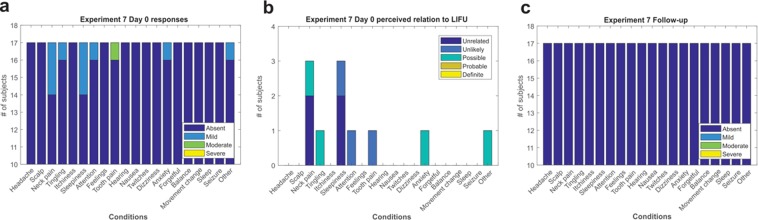
Experiment 7 report of symptoms. (a) Report of symptoms immediately after completion of ultrasound experiment. (b) Perceived relation of immediate symptom to the ultrasound intervention. (c) No new or persistent symptoms were reported at follow-up.
Figure 5
Figure 5
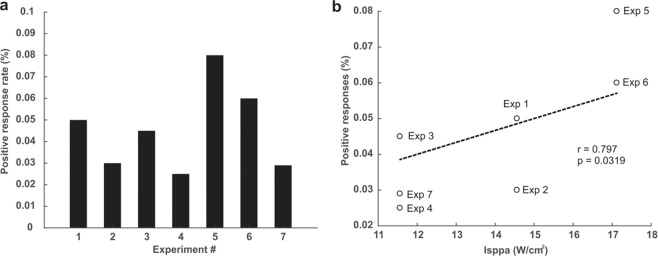
Symptom response rates across experiments. (a) Symptom response rate for each of the seven experiments regardless of perceived relation to the intervention. (b) Relation of the response rate to the intensity (Isppa).

References

    1. Tufail Y, et al. Transcranial pulsed ultrasound stimulates intact brain circuits. Neuron. 2010;66:681–694. doi: 10.1016/j.neuron.2010.05.008. - DOI - PubMed
    1. Mehic E, et al. Increased anatomical specificity of neuromodulation via modulated focused ultrasound. PLoS One. 2014;9:e86939. doi: 10.1371/journal.pone.0086939. - DOI - PMC - PubMed
    1. King RL, Brown JR, Newsome WT, Pauly KB. Effective parameters for ultrasound-induced in vivo neurostimulation. Ultrasound Med. Biol. 2013;39:312–331. doi: 10.1016/j.ultrasmedbio.2012.09.009. - DOI - PubMed
    1. Kim H, Chiu A, Lee SD, Fischer K, Yoo SS. Focused ultrasound-mediated non-invasive brain stimulation: examination of sonication parameters. Brain Stimul. 2014;7:748–756. doi: 10.1016/j.brs.2014.06.011. - DOI - PMC - PubMed
    1. Min BK, et al. Focused ultrasound-mediated suppression of chemically-induced acute epileptic EEG activity. BMC Neurosci. 2011;12:23-2202–12-23. doi: 10.1186/1471-2202-12-23. - DOI - PMC - PubMed