


Occurrence and pathogenicity of Corinectria spp. - an emerging canker disease of Abies sibirica in Central Siberia
- PMID: 32221468
- PMCID: PMC7101354
- DOI: 10.1038/s41598-020-62566-y
Occurrence and pathogenicity of Corinectria spp. - an emerging canker disease of Abies sibirica in Central Siberia
Abstract
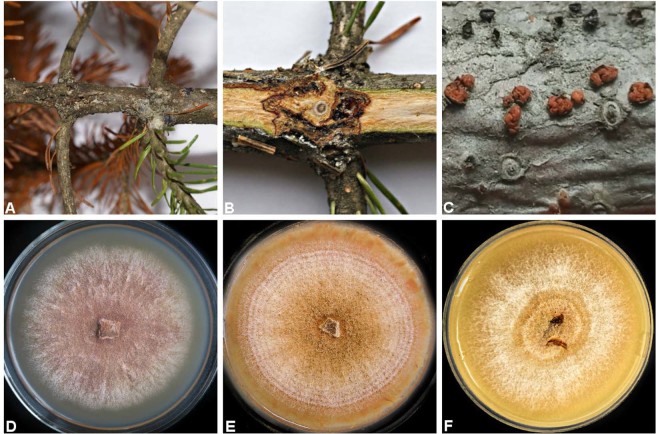
During recent years, a new disease of Siberian fir (A. sibirica) emerged in Central Siberia, exhibiting symptoms of stem/branch deformation, cambium necrosis, and dieback of branches and twigs, the causal agent remaining unknown. The aim was to identify agent of the disease and to investigate its pathogenicity to A. sibirica and Norway spruce (Picea abies). Symptomatic tissues of fir were subjected to pure culture isolation of anticipated pathogen(s). Obtained isolates were subjected to molecular identification, phylogenetic analyses, and pathogenicity tests with A. sibirica saplings, and seeds and seedlings of A. sibirica and P. abies. The study demonstrated that, (i) most commonly isolated fungus from canker wounds of A. sibirica exhibited Acremonium-like anamorphs; (ii) phylogeny demonstrated that investigated fungi belong to genus Corinectria, but are genetically well separated from other worldwide known Corinectria spp.; (iii) one species of isolated fungi has the capacity to cause the disease and kill A. sibirica saplings and seedlings, but also seedlings of P. abies. Guidelines for future research were defined in order to generate needed information on species description, its origin and ecology, and estimation of potential risks upon the eventual invasion of the pathogen to new geographic areas, in particular of Europe.
Conflict of interest statement
The authors declare no competing interests.
Figures



References
-
- Tolmachev, A. I. Flora of the North-East of European part of the USSR. (1974).
-
- González CD, Chaverri P. Corinectria, a new genus to accommodate Neonectria fuckeliana and C. constricta sp. nov. from Pinus radiata in Chile. Mycol. Prog. 2017;16:1015–1027. doi: 10.1007/s11557-017-1343-8. - DOI
-
- Ramsfield TD, Power MWP, Kimberley MO. The relationship between pruning and the incidence of Neonectria fuckeliana in Pinus radiata. NZ J. Forestry Sci. 2013;43:13.
-
- Pavlov IN. Biotic and abiotic factors as causes of coniferous forests die-back in Siberia and Far East. Contemp. Probl. Ecol. 2015;8:440–456. doi: 10.1134/S1995425515040125. - DOI
-
- Pavlov, I. N. et al. Mass reproduction of Polygraphus proximus Blandford in fir forests of Siberia infected with root and stem pathogens: monitoring, patterns, biological control. Contemp Probl Ecol In Press (2020).
Publication types
MeSH terms
LinkOut - more resources
Full Text Sources
Miscellaneous
