


Particle therapy in Europe
- PMID: 32223048
- PMCID: PMC7332216
- DOI: 10.1002/1878-0261.12677
Particle therapy in Europe
Abstract
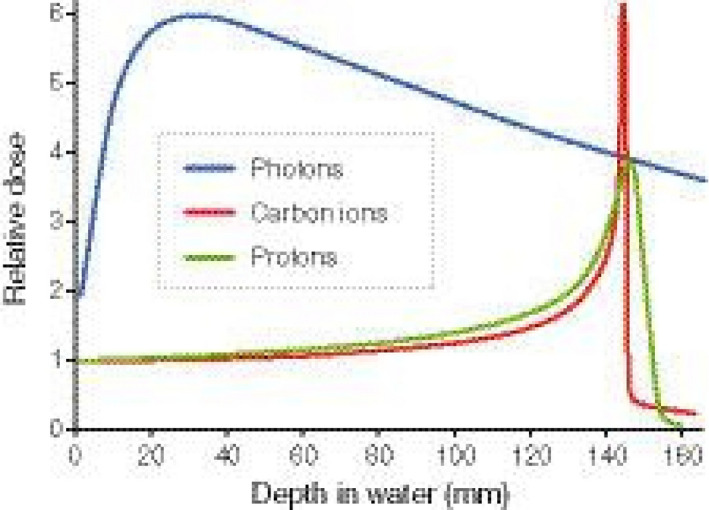
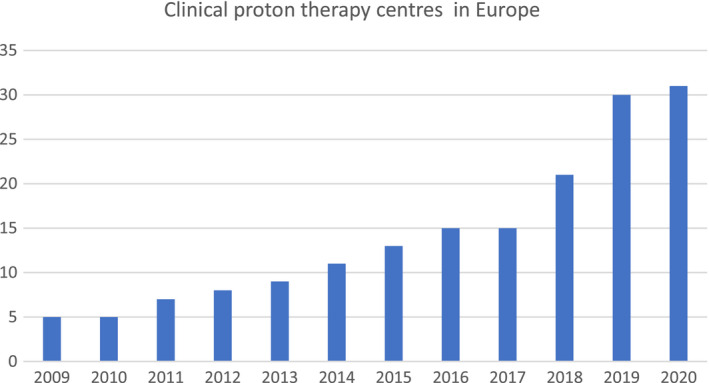
Particle therapy using protons or heavier ions is currently the most advanced form of radiotherapy and offers new opportunities for improving cancer care and research. Ions deposit the dose with a sharp maximum - the Bragg peak - and normal tissue receives a much lower dose than what is delivered by X-ray therapy. Particle therapy has also biological advantages due to the high linear energy transfer of the charged particles around the Bragg peak. The introduction of particle therapy has been slow in Europe, but within the last decade, more than 20 clinical facilities have opened and facilitated access to this frontline therapy. In this review article, the basic concepts of particle therapy are reviewed along with a presentation of the current clinical indications, the European clinical research, and the established networks.
Keywords: cancer; ion beam therapy; particle therapy; proton therapy; radiation; radiotherapy.
© 2020 The Authors. Published by FEBS Press and John Wiley & Sons Ltd.
Conflict of interest statement
The authors declare no conflict of interest.
Figures
References
-
- Beck N, van Brakel TJ, Smit HJM, van Klaveren D, Wouters M and Schreurs WH (2019) Pneumonectomy for lung cancer treatment in the Netherlands: between‐hospital variation and outcomes. World J Surg 44, 285–294. - PubMed
-
- Bolsi A, Peroni M, Amelio D, Dasu A, Stock M, Toma‐Dasu I, Nystrom PW and Hoffmann A (2018) Practice patterns of image guided particle therapy in Europe: a 2016 survey of the European Particle Therapy Network (EPTN). Radiother Oncol 128, 4–8. - PubMed
-
- Christianen ME, van der Schaaf A, van der Laan HP, Verdonck‐de Leeuw IM, Doornaert P, Chouvalova O, Steenbakkers RJ, Leemans CR, Oosting SF, van der Laan BF et al (2016) Swallowing sparing intensity modulated radiotherapy (SW‐IMRT) in head and neck cancer: clinical validation according to the model‐based approach. Radiother Oncol 118, 298–303. - PubMed
-
- Dosanjh M, Amaldi U, Mayer R, Poetter R and Network E (2018a) ENLIGHT: European network for light ion hadron therapy. Radiother Oncol 128, 76–82. - PubMed
-
- Dosanjh M, Jones B, Pawelke J, Pruschy M and Sorensen BS (2018b) Overview of research and therapy facilities for radiobiological experimental work in particle therapy. Report from the European Particle Therapy Network radiobiology group. Radiother Oncol 128, 14–18. - PubMed
Publication types
MeSH terms
LinkOut - more resources
Full Text Sources
Medical
