Comparative Study
. 2020 Mar 26;21(7):2308.
doi: 10.3390/ijms21072308.

Added Value of Clinical Sequencing: WGS-Based Profiling of Pharmacogenes

Affiliations
Comparative Study

Added Value of Clinical Sequencing: WGS-Based Profiling of Pharmacogenes

Sylvan M Caspar et al. Int J Mol Sci. .

Abstract

Although several pharmacogenetic (PGx) predispositions affecting drug efficacy and safety are well established, drug selection and dosing as well as clinical trials are often performed in a non-pharmacogenetically-stratified manner, ultimately burdening healthcare systems. Pre-emptive PGx testing offers a solution which is often performed using microarrays or targeted gene panels, testing for common/known PGx variants. However, as an added value, whole-genome sequencing (WGS) could detect not only disease-causing but also pharmacogenetically-relevant variants in a single assay. Here, we present our WGS-based pipeline that extends the genetic testing of Mendelian diseases with PGx profiling, enabling the detection of rare/novel PGx variants as well. From our in-house WGS (PCR-free 60× PE150) data of 547 individuals we extracted PGx variants with drug-dosing recommendations of the Dutch Pharmacogenetics Working Group (DPWG). Furthermore, we explored the landscape of DPWG pharmacogenes in gnomAD and our in-house cohort as well as compared bioinformatic tools for WGS-based structural variant detection in CYP2D6. We show that although common/known PGx variants comprise the vast majority of detected DPWG pharmacogene alleles, for better precision medicine, PGx testing should move towards WGS-based approaches. Indeed, WGS-based PGx profiling is not only feasible and future-oriented but also the most comprehensive all-in-one approach without generating significant additional costs.

Keywords: CYP2D6; DPWG; PGx; gnomAD; next-generation sequencing; pharmacogenetics; precision medicine; whole-genome sequencing.


Conflict of interest statement

The authors declare no conflict of interest. The funders had no role in the design of the study; in the collection, analyses, or interpretation of data; in the writing of the manuscript, or in the decision to publish the results.

Figures
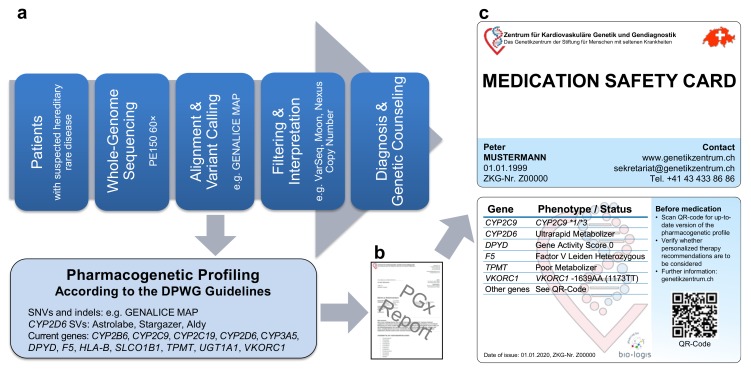
Figure 1
Figure 1
Our whole-genome sequencing (WGS)-based pharmacogenetic (PGx) profiling. (a) Pipeline from whole-genome sequencing data to (b) PGx report and (c) individualized PGx profile in credit card format (Medication Safety Card). Abbreviations: DPWG, Dutch Pharmacogenetic Working Group; indels, insertions/deletions; SNVs, single nucleotide variants; SVs, structural variants.
Figure 2
Figure 2
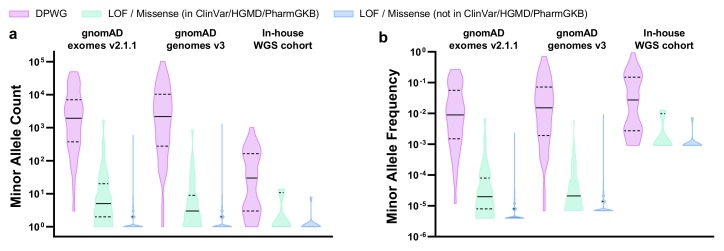
Violin plots showing the distributions of (a) minor allele counts and (b) minor allele frequencies in 11 DPWG genes (CYP2B6, CYP2C9, CYP2C19, CYP2D6, CYP3A5, DPYD, F5, SLCO1B1, TPMT, UGT1A1, VKORC1) and an HLA-B*5701 tagging variant in gnomAD exomes v2.1.1, gnomAD genomes v3, and our in-house WGS cohort. Horizontal lines indicate median, horizontal dashed lines indicate quartiles. Plots were generated using Graphpad Prism 8 (Graphpad Software, CA, USA). Abbreviations: DPWG, Dutch Pharmacogenetics Working Group; LOF, loss of function.
Figure 3
Figure 3
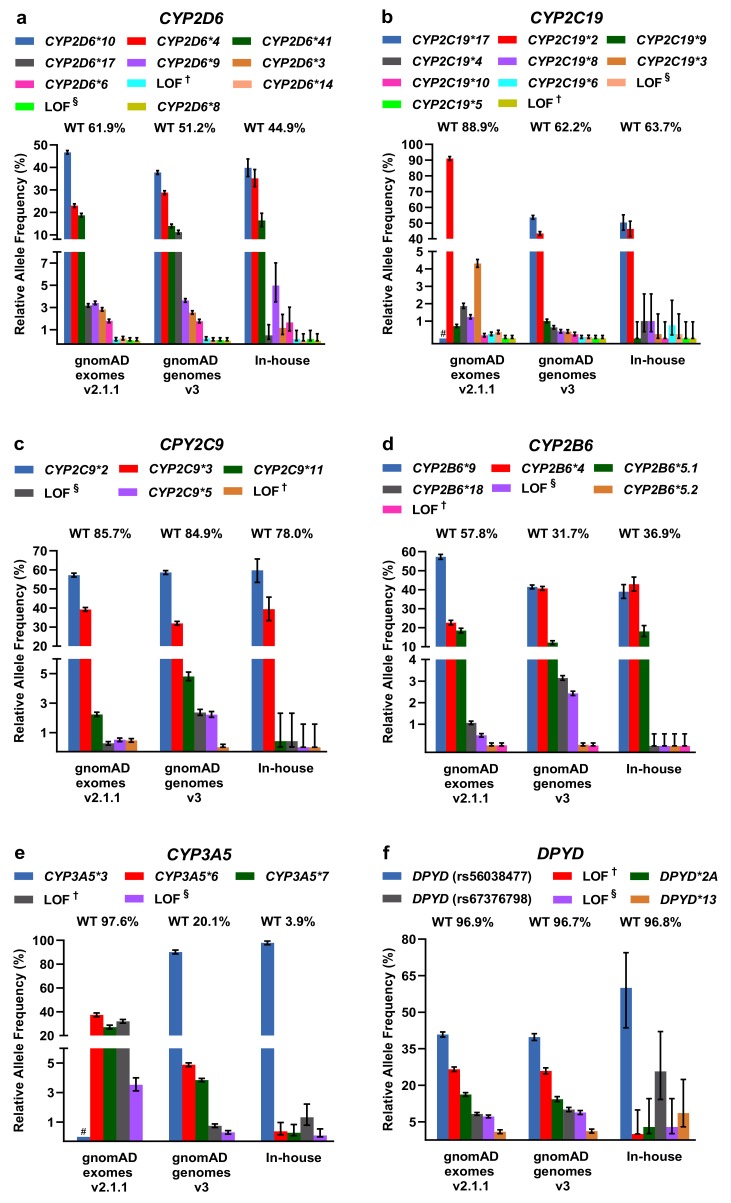
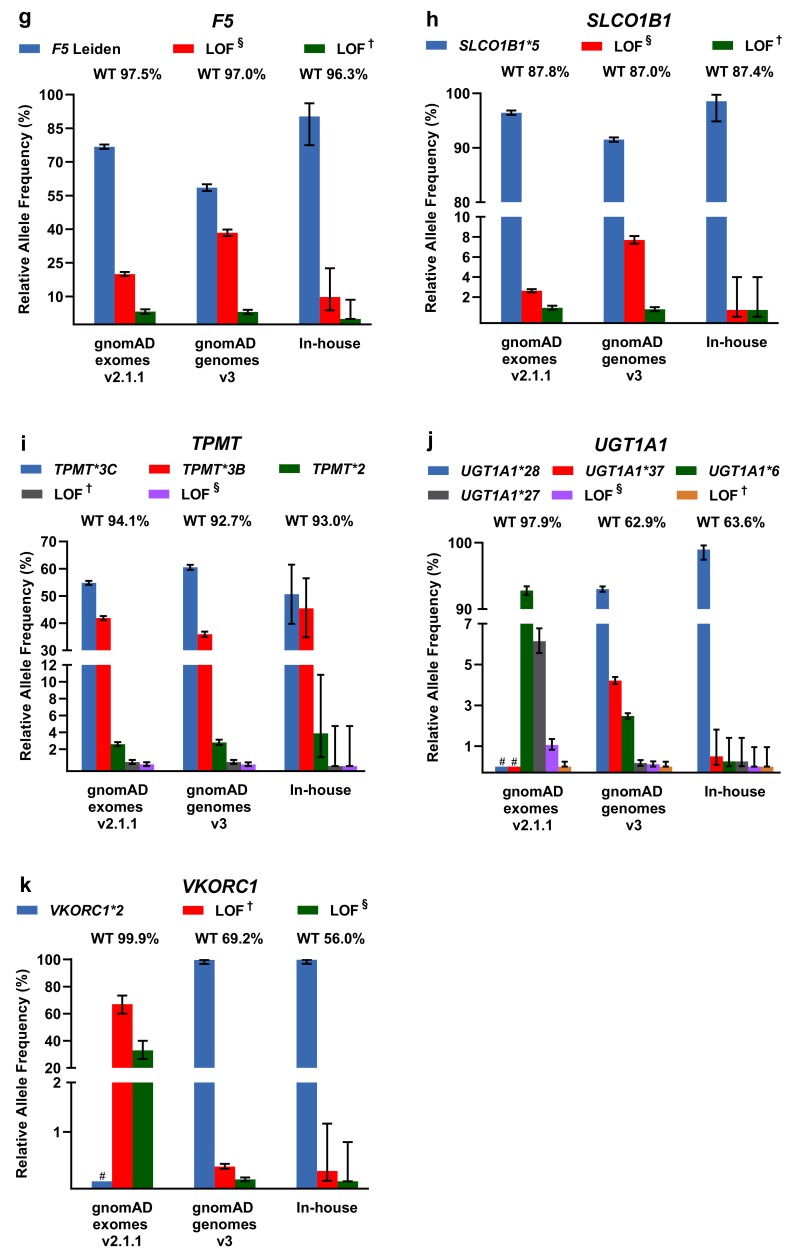
(ak) Relative allele frequencies of pharmacogenetically-relevant variants in gnomAD exomes and genomes as well as in our in-house WGS cohort. The percentage of corresponding wildtype (WT) alleles is denoted. Note that wildtype status was inferred under the assumption that the listed variants detected in the same gene occur in trans and that no additional pharmacogenetically- relevant variant occurs at the wildtype allele. Note that some of the DPWG variants are not covered in gnomAD exomes (denoted with # in the graphs of CYP2C19*17, CYP3A5*3, UGT1A1*28,*37, and VKORC1*2). Error bars indicate 95% confidence intervals. Loss-of-function (LOF) variants listed in HGMD, ClinVar, or PharmGKB. § LOF variants not listed in HGMD, ClinVar, or PharmGKB in the context of drug response.
Figure 3
Figure 3
(ak) Relative allele frequencies of pharmacogenetically-relevant variants in gnomAD exomes and genomes as well as in our in-house WGS cohort. The percentage of corresponding wildtype (WT) alleles is denoted. Note that wildtype status was inferred under the assumption that the listed variants detected in the same gene occur in trans and that no additional pharmacogenetically- relevant variant occurs at the wildtype allele. Note that some of the DPWG variants are not covered in gnomAD exomes (denoted with # in the graphs of CYP2C19*17, CYP3A5*3, UGT1A1*28,*37, and VKORC1*2). Error bars indicate 95% confidence intervals. Loss-of-function (LOF) variants listed in HGMD, ClinVar, or PharmGKB. § LOF variants not listed in HGMD, ClinVar, or PharmGKB in the context of drug response.

References

    1. Relling M.V., Klein T.E. CPIC: Clinical Pharmacogenetics Implementation Consortium of the Pharmacogenomics Research Network. Clin. Pharmacol. Ther. 2011;89:464–467. doi: 10.1038/clpt.2010.279. - DOI - PMC - PubMed
    1. Dowden H., Munro J. Trends in clinical success rates and therapeutic focus. Nat. Rev. Drug Discov. 2019;18:495–496. doi: 10.1038/d41573-019-00074-z. - DOI - PubMed
    1. DiMasi J.A., Grabowski H.G., Hansen R.W. Innovation in the pharmaceutical industry: New estimates of R&D costs. J. Health Econ. 2016;47:20–33. doi: 10.1016/j.jhealeco.2016.01.012. - DOI - PubMed
    1. Strengthening Pharmacovigilance to Reduce Adverse Effects of Medicines. [(accessed on 24 January 2020)]; Available online: Europa.eu/rapid/press-release_MEMO-08-782_de.htm?locale=en.
    1. Watanabe J.H., McInnis T., Hirsch J.D. Cost of Prescription Drug–Related Morbidity and Mortality. Ann. Pharmacother. 2018;52:829–837. doi: 10.1177/1060028018765159. - DOI - PubMed

MeSH terms

Substances