


Not typical angina and mortality in women with obstructive coronary artery disease: Results from the Women's Ischemic Syndrome Evaluation study (WISE)
- PMID: 32226820
- PMCID: PMC7093808
- DOI: 10.1016/j.ijcha.2020.100502
Not typical angina and mortality in women with obstructive coronary artery disease: Results from the Women's Ischemic Syndrome Evaluation study (WISE)
Erratum in
-
Erratum regarding missing Declaration of Competing Interest statements in previously published articles.Int J Cardiol Heart Vasc. 2020 Nov 18;31:100676. doi: 10.1016/j.ijcha.2020.100676. eCollection 2020 Dec. Int J Cardiol Heart Vasc. 2020. PMID: 33364333 Free PMC article.
Abstract
Background: Women frequently present with symptoms not typical of angina (NTA) making ischemic heart disease recognition, diagnosis and treatment challenging. We compared mortality in women with obstructive coronary artery disease (CAD) with NTA vs typical angina (TA).
Methods: We studied 326 Women's Ischemia Syndrome Evaluation (WISE) participants undergoing coronary angiography for suspected myocardial ischemia with core-lab measured obstructive CAD. TA was defined as sub-sternal chest pain precipitated by physical exertion or emotional stress and relieved with rest or nitroglycerin; NTA did not meet criteria for TA. The women were followed for non-fatal events and death for a median of 5.9 and 9.6 years respectively. Multivariate cox proportional hazards regression determined relations to events.
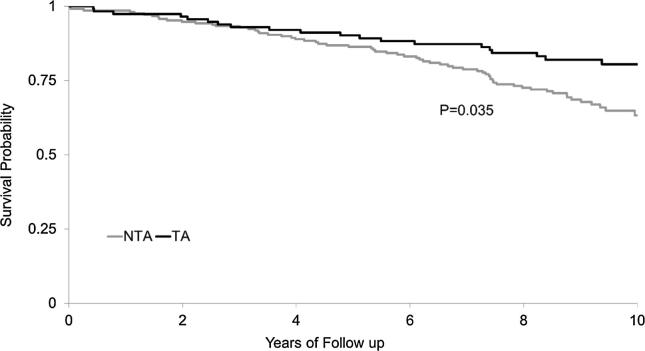
Results: Overall, 115 (35%) of the women had TA. Baseline demographics, risk factors or additional symptom characteristics were similar between the two angina groups. Non-fatal events did not differ between groups. Women with NTA had a higher mortality compared to TA women (36% vs 26%, respectively, p = 0.047). Despite adjustment for additional major risk variables, NTA was an independent predictor of mortality compared to TA with a hazard ratio of 1.73 (95% Confidence interval: 1.04, 2.89).
Conclusions: Among women with suspected ischemia undergoing coronary angiography with obstructive CAD, NTA was more common than TA, and predicted a higher longer-term mortality. Further investigation is needed to confirm these results, and investigate potential explanations for the higher mortality observed in women with NTA women, including lower recognition or action in the setting of obstructive CAD.
Keywords: Angina; Coronary artery disease; Mortality.
© 2020 Published by Elsevier B.V.
Figures
References
-
- Johnson B.D., Shaw L.J., Pepine C.J., Reis S.E., Kelsey S.F., Sopko G., Rogers W.J., Mankad S., Sharaf B.L., Bittner V. Persistent chest pain predicts cardiovascular events in women without obstructive coronary artery disease: results from the NIH-NHLBI-sponsored Women's Ischaemia Syndrome Evaluation (WISE) study. Eur. Heart J. 2006;27:1408–1415. - PubMed
-
- Diamond G.A., Staniloff H.M., Forrester J.S., Pollock B.H., Swan H. Computer-assisted diagnosis in the noninvasive evaluation of patients with suspected coronary artery disease. J. Am. Coll. Cardiol. 1983;1:444–455. - PubMed
-
- Cheng V.Y., Berman D.S., Rozanski A., Dunning A.M., Achenbach S., Al-Mallah M., Budoff M.J., Cademartiri F., Callister T.Q., Chang H.-J. Performance of the traditional age, sex, and angina typicality-based approach for estimating pretest probability of angiographically significant coronary artery disease in patients undergoing coronary computed tomographic angiography results from the multinational coronary CT angiography evaluation for clinical outcomes: an international multicenter registry (CONFIRM) Circulation. 2011;124:2423–2432. - PMC - PubMed
-
- Pepine C.J., Abrams J., Marks R.G., Morris J.J., Scheidt S.S. Handberg E and investigators T. Characteristics of a contemporary population with angina pectoris. Am. J. Cardiol. 1994;74:226–231. - PubMed
-
- Diamond G.A. A clinically relevant classification of chest discomfort. J. Am. Coll. Cardiol. 1983;1:574–575. - PubMed
Grants and funding
- N01 HV068161/HV/NHLBI NIH HHS/United States
- R03 AG032631/AG/NIA NIH HHS/United States
- T32 HL069751/HL/NHLBI NIH HHS/United States
- P30 DK079626/DK/NIDDK NIH HHS/United States
- UL1 TR000124/TR/NCATS NIH HHS/United States
- UL1 TR001427/TR/NCATS NIH HHS/United States
- R01 HL033610/HL/NHLBI NIH HHS/United States
- M01 RR000425/RR/NCRR NIH HHS/United States
- UM1 HL087366/HL/NHLBI NIH HHS/United States
- K23 HL105787/HL/NHLBI NIH HHS/United States
- UL1 TR001881/TR/NCATS NIH HHS/United States
- R01 HL090957/HL/NHLBI NIH HHS/United States
- UL1 TR000064/TR/NCATS NIH HHS/United States
- N01 HV068163/HL/NHLBI NIH HHS/United States
- N01 HV068164/HV/NHLBI NIH HHS/United States
- R01 HL056921/HL/NHLBI NIH HHS/United States
- N01 HV068162/HL/NHLBI NIH HHS/United States
- R37 HL033610/HL/NHLBI NIH HHS/United States
LinkOut - more resources
Full Text Sources
Miscellaneous
