. 2020 Jul 6;71(14):4057-4068.
doi: 10.1093/jxb/eraa161.

Alternate expression of CONSTANS-LIKE 4 in short days and CONSTANS in long days facilitates day-neutral response in Rosa chinensis

Affiliations

Alternate expression of CONSTANS-LIKE 4 in short days and CONSTANS in long days facilitates day-neutral response in Rosa chinensis

Jun Lu et al. J Exp Bot. .

Abstract

Photoperiodic flowering responses are classified into three major types: long day (LD), short day (SD), and day neutral (DN). The inverse responses to daylength of LD and SD plants have been partly characterized in Arabidopsis and rice; however, the molecular mechanism underlying the DN response is largely unknown. Modern roses are economically important ornamental plants with continuous flowering (CF) features, and are generally regarded as DN plants. Here, RcCO and RcCOL4 were identified as floral activators up-regulated under LD and SD conditions, respectively, in the CF cultivar Rosa chinensis 'Old-Blush'. Diminishing the expression of RcCO or/and RcCOL4 by virus-induced gene silencing (VIGS) delayed flowering time under both SDs and LDs. Interestingly, in contrast to RcCO-silenced plants, the flowering time of RcCOL4-silenced plants was more delayed under SD than under LD conditions, indicating perturbed plant responses to day neutrality. Further analyses revealed that physical interaction between RcCOL4 and RcCO facilitated binding of RcCO to the CORE motif in the promoter of RcFT and induction of RcFT. Taken together, the complementary expression of RcCO in LDs and of RcCOL4 in SDs guaranteed flowering under favorable growth conditions regardless of the photoperiod. This finding established the molecular foundation of CF in roses and further shed light on the underlying mechanisms of DN responses.

Keywords: Rosa chinensis; Continuous flowering; day-neutral plants; long-day plants; photoperiod responses; short-day plants.


Figures

Fig. 1.
Fig. 1.
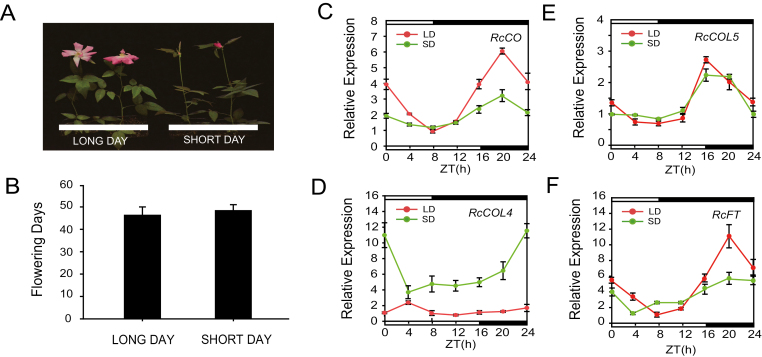
Flowering phenotype and expression levels of RcCO, RcCOL4, RcCOL5, and RcFT under LD and SD conditions. (A) Phenotypic characterization of Rosa chinensis ‘Old Blush’ under LD (16:8 h, light:dark) and SD (8:16 h, light:dark) conditions. (B) Flowering time of R. chinensis ‘Old Blush’ under LD and SD conditiona. Error bars indicate ± the standard deviation (n=10). (C–F) Relative expression of RcCO (C), RcCOL4 (D), RcCOL5 (E), and RcFT (F) of ‘Old Blush’ under LD and SD conditions. Error bars indicate ± the standard deviation (n=3).
Fig. 2.
Fig. 2.
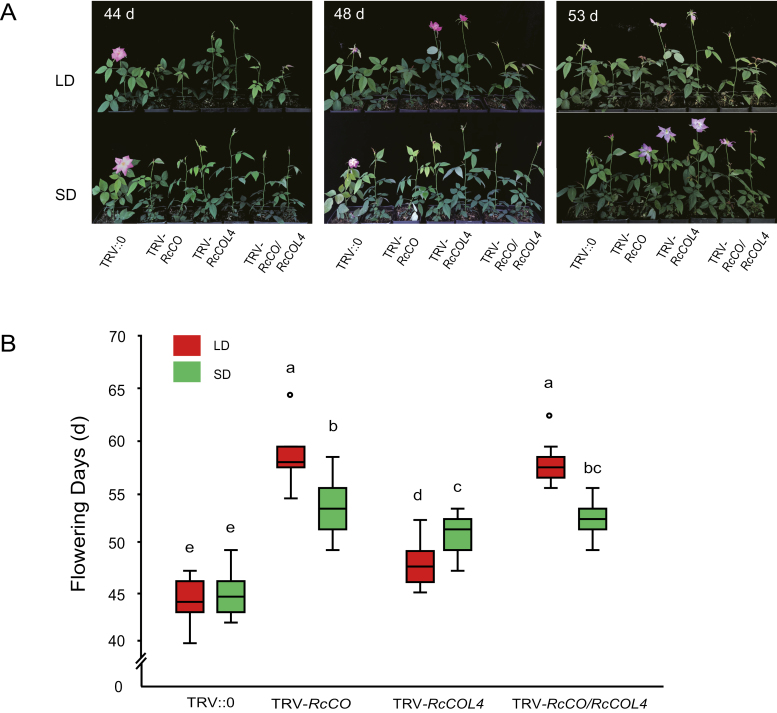
Flowering phenotype of TRV-RcCO and TRV-RcCOL4 plants under LD and SD conditions. (A) Time-course of the flowering phenotype of TRV-RcCO and TRV-RcCOL4 Rosa chinensis ‘Old Blush’ under LD and SD conditions. (B) Flowering time of TRV-silenced R. chinensis ‘Old Blush’ under LD and SD conditions. Error bars indicate ± the standard deviation (n=10). Different letters above the columns denote significant differences as determined by Kruskal–Wallis test (P<0.05).
Fig. 3.
Fig. 3.
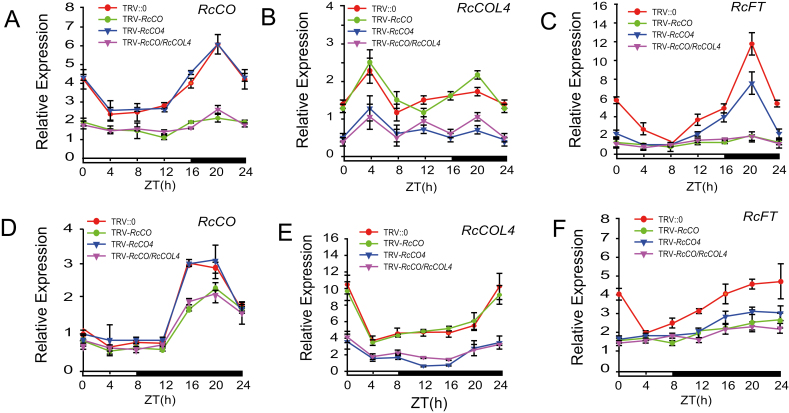
Time-course expression levels of RcCO, RcCOL4, and RcFT in TRV-RcCO and TRV-RcCOL4 plants under LD and SD conditions. (A–C) Relative expression of RcCO (A), RcCOL4 (B), and RcFT (C) in TRV-silenced Rosa chinensis ‘Old Blush’ under LDs. Error bars indicate ± the standard deviation (n=3). (D–F) Relative expression of RcCO (D), RcCOL4 (E), and RcFT (F) in TRV-silenced R. chinensis ‘Old Blush’ under SDs. Error bars indicate ± the standard deviation (n=3). The uppermost young leaves from 40-day-old plants propagated from cuttings were harvested and the total RNAs were extracted. RT-qPCR was then performed with RcGAPDH as reference gene. Every experiment was conducted with three replicates each with three technical repeats. The bar below the graphs indicates the light conditions, with day and night denoted in white and black, respectively.
Fig. 4.
Fig. 4.
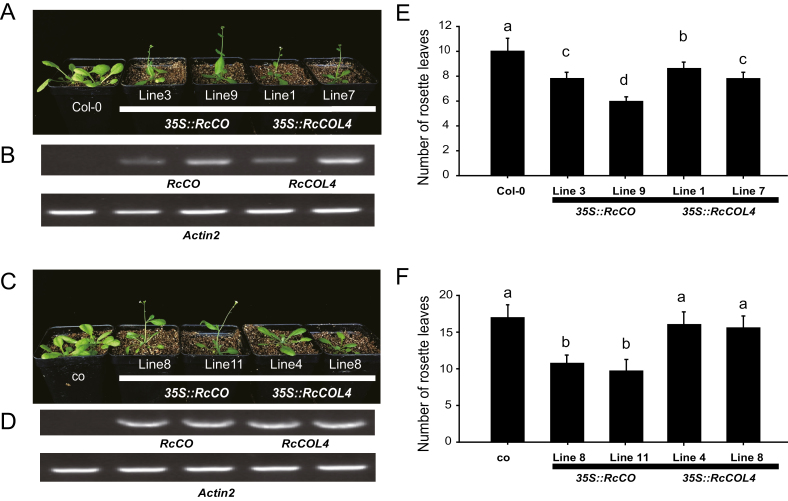
Flowering phenotype of RcCO- and RcCOL4-overexpressing Arabidopsis in the Col and co background. (A and E) Flowering phenotypes and rosette leaf numbers of RcCO- and RcCOL4-overexpressing plants in the Col background. (B and D) Expression of RcCO and RcCOL4 measured by semi-quantitative RT-PCR in Arabidopsis. Actin2 was used as reference gene. (C and F) Flowering phenotypes and rosette leaf numbers of RcCO- and RcCOL4-overexpressing plants in the co mutant background. Error bars indicate ± the standard deviation (n=3). Different letters above the columns denote significant differences at P<0.05.
Fig. 5.
Fig. 5.
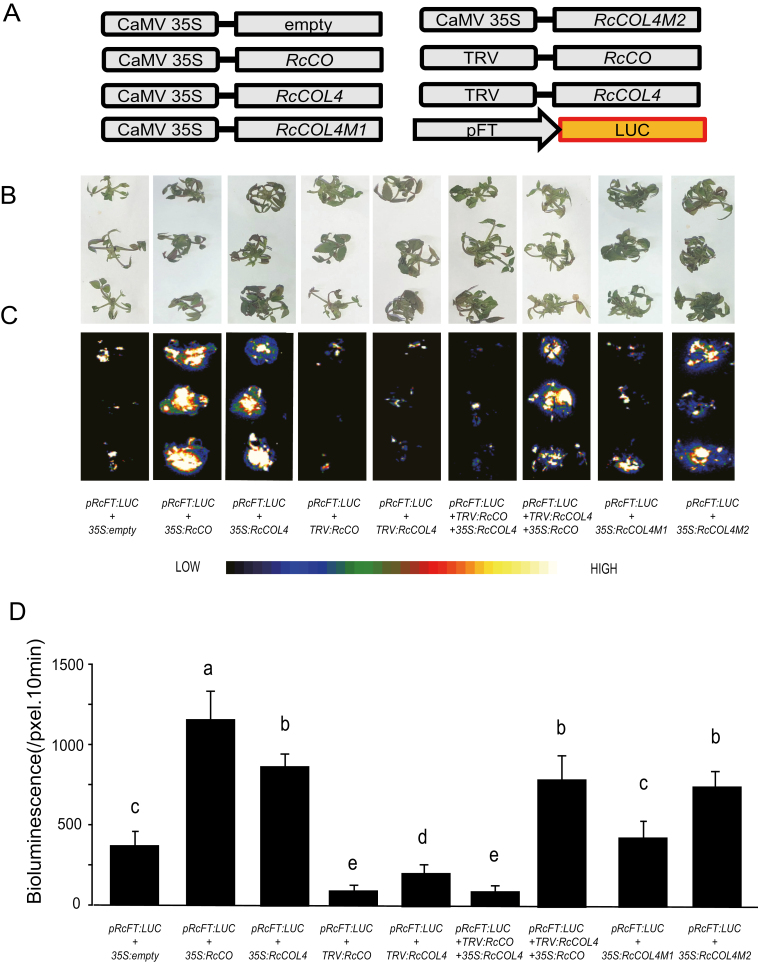
Transient transformation analysis of transcriptional activation of RcFT by RcCO and RcCOL4. (A) Schematic diagram of the reporter and effectors used in the Rosa chinensis ‘Old Blush’ transient transformation assays. (B and C) Representative images of transient expression assays in R. chinensis ‘Old Blush’ displayed by bright field (B) and dark field (C) of rose shoots expressing pRcFT-LUC together with 35S:empty, 35S:RcCO, 35S:RcCOL4, TRV-CO, TRV-COL4, TRV-CO+35S:RcCOL4, TRV-COL4+ 35S:RcCO, mutated RcCOL4-M1, and RcCOL4-M2. (D) Intensities of the LUC bioluminescence presented in (C) using Andor Solis image analysis software. Data are means ± SE (n=10). Different letters above the columns denote significant differences at P<0.05.
Fig. 6.
Fig. 6.
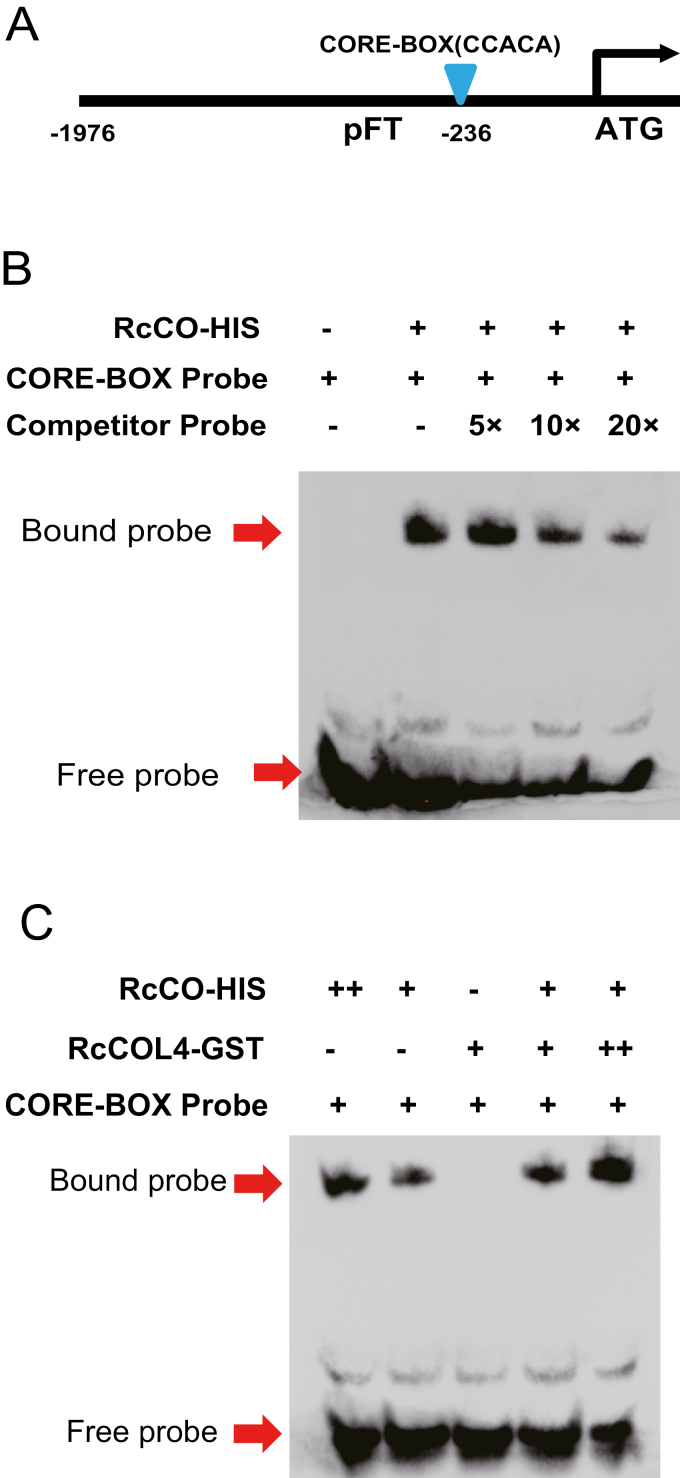
RcCOL4 facilitates the binding of RcCO to the CORE motif in the promoter of RcFT. (A) Location of the CORE motif in the promoter of RcFT. (B) Direct binding of RcCO to the CORE motif of the RcFT promoter in in vitro EMSA. Biotin-labeled probes were incubated with RcCO-HIS protein, and the free and bound probes were separated on an acrylamide gel. 5×, 10×, and 20× represent the dilution multiples of the competitor probe. (C) RcCOL4 enhances the binding ability of RcCO to the CORE motif in the promoter of RcFT. Biotin-labeled probes were incubated with RcCO-HIS alone or together with RcCOL4–GST protein, and the free and bound probes were separated on an acrylamide gel.
Fig. 7.
Fig. 7.
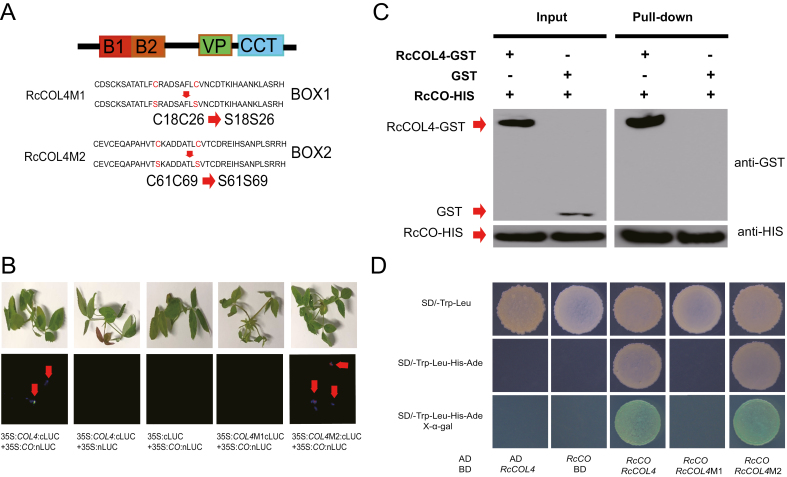
The Box1 motif of RcCOL4 is indispensable for the RcCO–RcCOL4 protein interaction. (A) Schematic representation of the amino acid sequences and mutations of the B-box motif in RcCOL4. (B) Representative images of the spilt luciferase complementation assays in Rosa chinensis ‘Old Blush’ displayed by bright field and dark field of rose seedlings co-expressing RcCO and RcCOL4, and RcCO and mutated RcCOL4. (C) Pull-down assays prove the interaction between RcCOL4 and RcCO. The purified RcCO-HIS fusion protein was incubated with immobilized GST and RcCOL4–GST fusion proteins in pull-down buffer and the interaction was determined by western blot. (D) Yeast two-hybrid assay verifies the interaction between RcCOL4 and RcCO, and of RcCOL4-M2, but not RcCOL4-M1, and RcCO.
Fig. 8.
Fig. 8.
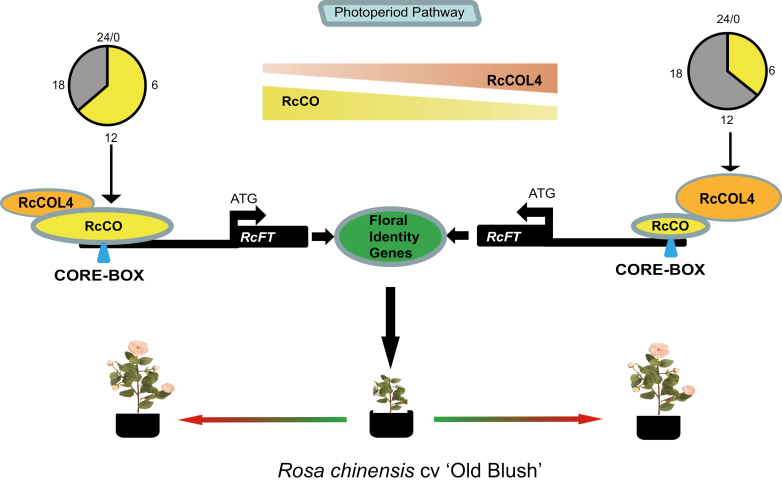
Simplified schematic model of flowering time regulation by RcCOL4RcCO in Rose chinensis under different daylengths. Under LD conditions, RcCO is expressed more highly and plays a prominent role in flowering promotion via direct binding to the promoter of RcFT to activate its expression; under SD conditions, RcCO is down-regulated while RcCOL4 increases and accelerates flowering via physically interacting with RcCO to enhance its binding to FT. Consequently, R. chinensis ‘Old Blush’ could flower under both LDs and SDs.

Comment in

References

    1. Bendahmane M, Dubois A, Raymond O, Bris ML. 2013. Genetics and genomics of flower initiation and development in roses. Journal of Experimental Botany 64, 847–857. - PMC - PubMed
    1. Cao S, Kumimoto RW, Gnesutta N, Calogero AM, Mantovani R, Holt BF. 2014. A distal CCAAT/NUCLEAR FACTOR Y complex promotes chromatin looping at the FLOWERING LOCUS T promoter and regulates the timing of flowering in Arabidopsis. The Plant Cell 26, 1009–1017. - PMC - PubMed
    1. Chailakhyan MK. 1937. Hormonal theory of plant development. Comptes Rendus (Doklady) de l’Academie des Sciences des l’URSS 13, 79–83
    1. Chang MM, Li A, Feissner R, Ahmad T. 2016. RT-qPCR demonstrates light-dependent AtRBCS1A and AtRBCS3B mRNA expressions in Arabidopsis thaliana leaves. Biochemistry & Molecular Biology Education 44, 405–411. - PubMed
    1. Cheng XF, Wang ZY. 2005. Overexpression of COL9, a CONSTANS-LIKE gene, delays flowering by reducing expression of CO and FT in Arabidopsis thaliana. The Plant Journal 43, 758–768. - PubMed

Publication types