


Hippocampal radiotherapy dose constraints for predicting long-term neurocognitive outcomes: mature data from a prospective trial in young patients with brain tumors
- PMID: 32227185
- PMCID: PMC7690355
- DOI: 10.1093/neuonc/noaa076
Hippocampal radiotherapy dose constraints for predicting long-term neurocognitive outcomes: mature data from a prospective trial in young patients with brain tumors
Abstract
Background: Hippocampus is considered to be the seat for neurocognitive functions. Avoidance of hippocampus during radiotherapy to brain may serve to preserve various domains of neurocognition. We aimed to derive radiotherapy dose constraints to hippocampi for preserving neurocognition in young patients with brain tumors by measuring various neurocognitive parameters.
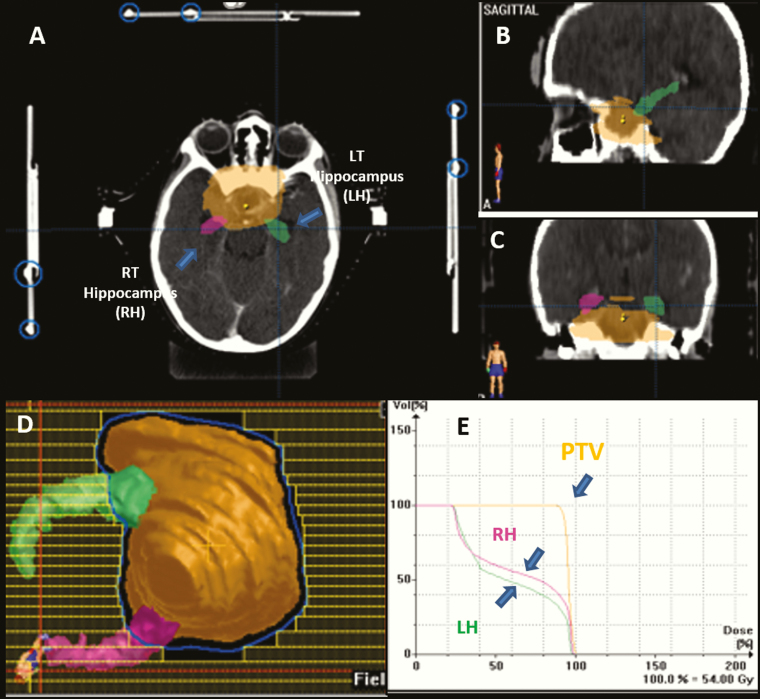
Methods: Forty-eight patients with residual/progressive benign or low-grade brain tumors treated with stereotactic conformal radiotherapy (SCRT) to a dose of 54 Gy in 30 fractions underwent prospective neuropsychological assessments at baseline before SCRT and at 6 months and 2, 3, 4, and 5 years. Hippocampi were drawn as per the Radiation Therapy Oncology Group atlas. Longitudinal change in intelligence quotient scores was correlated with hippocampal doses.
Results: Mean volume of bilateral hippocampi was 4.35 cc (range: 2.12-8.41 cc). Craniopharyngioma was the commonest histologic subtype. A drop of >10% in mean full-scale intelligence quotient (FSIQ) scores at 3 and 5 years post SCRT was observed in patients in whom left hippocampus received a mean dose of 30.7 Gy (P = 0.04) and 31 Gy (P = 0.04), respectively. Mean performance quotient (PQ) scores dropped > 10% at 5 years when the left hippocampus received a dose of > 32 Gy (P = 0.03). There was no significant correlation of radiotherapy doses with verbal quotient, or with doses received by the right hippocampus. Multivariate analysis revealed young age (<13 y) and left hippocampus dose predicted for clinically relevant decline in certain neurocognitive domains.
Conclusions: A mean dose of ≤30 Gy to the left hippocampus as a dose constraint for preserving intelligence quotient is suggested.
Key points: 1. Children and young adults with benign and low-grade gliomas survive long after therapy.2. Higher dose to the hippocampi may result in long-term neurocognitive impairment.3. Mean dose of <30 Gy to left hippocampus could be used as a pragmatic dose constraint to prevent long-term neurocognitive decline.
Keywords: brain tumors; conformal radiotherapy; dose constraints; hippocampus; neurocognitive function.
© The Author(s) 2020. Published by Oxford University Press on behalf of the Society for Neuro-Oncology. All rights reserved. For permissions, please e-mail: journals.permissions@oup.com.
Figures
Comment in
-
Impact of radiotherapy dosimetric parameters on neurocognitive function in brain tumor patients.Neuro Oncol. 2020 Nov 26;22(11):1559-1561. doi: 10.1093/neuonc/noaa208. Neuro Oncol. 2020. PMID: 32875338 Free PMC article. No abstract available.
References
-
- Marcus KJ, Goumnerova L, Billett AL, et al. Stereotactic radiotherapy for localized low-grade gliomas in children: final results of a prospective trial. Int J Radiat Oncol Biol Phys. 2005;61(2):374–379. - PubMed
-
- Jalali R, Mallick I, Dutta D, et al. Factors influencing neurocognitive outcomes in young patients with benign and low-grade brain tumors treated with stereotactic conformal radiotherapy. Int J Radiat Oncol Biol Phys. 2010;77(4):974–979. - PubMed
Publication types
MeSH terms
LinkOut - more resources
Full Text Sources
Medical
