


Predictors of institutional delivery service utilization among women of reproductive age in Gambia: a cross-sectional analysis
- PMID: 32228501
- PMCID: PMC7106584
- DOI: 10.1186/s12884-020-02881-4
Predictors of institutional delivery service utilization among women of reproductive age in Gambia: a cross-sectional analysis
Abstract
Background: Over the last two decades, Gambia has made noticeable progress in the reducing the high maternal mortality rates and improving child survival rates. Nonetheless, numerous infrastructural and financial constraints continue to restrict access to institutional delivery care, a key component of achieving the maternal and child health related Sustainable Development Goals (SDG 3.1). This study assesses factors that predict women's choice of mode and place of delivery in urban and rural Gambia.
Methods: Cross-sectional data from the latest round of Gambia Demographic and Health Survey (2013) on women aged 15-49 years (n = 5351) were analyzed. The outcome measures were place (home vs health facility) and mode of delivery (caesarean vs normal) in urban and rural Gambia. Data were analyzed using descriptive and multivariate regression methods.
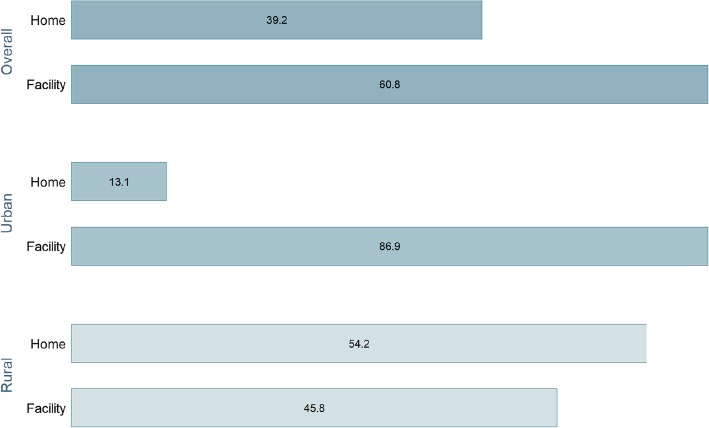
Results: About three-fifth (60.8%) of the participants had their last childbirth at a health facility and 39.2% at their home. There was a significant urban-rural difference in the prevalence of facility delivery with 86.9% of the urban women choosing health facility over home compared with 45.8% among the rural women. In the regression analysis, place of residence, education of participants and the husband, employment, parity and use of antenatal care were significantly associated with the use of health facility delivery services. For instance, having secondary [OR = 1.657, 95%CI = 1.337,2.053] and higher education [OR-2.451, 95%CI = 1.166,5.150] showed higher odds for using facility delivery services; and women from the richest wealth quintile had significantly higher [OR = 2.239, 95%CI = 1.525,3.289] odds of using facility delivery compared with those in the lowest quintile.
Conclusion: Our findings suggest a sub-optimal use of professional childbirth services among Gambian women which appears to be driven by various geographical, educational, wealth inequality, parity and low use of ANC services. Addressing the socioeconomic and demographic inequalities may lead to a more widespread usage of maternity services in Gambia.
Keywords: C-section; Gambia, global health; Health facility delivery; Health service utilization; Maternal health; women’s health.
Conflict of interest statement
The authors declare that they have no competing interests.
Figures
References
-
- Williams JR, Manfredi P, Melegaro A. The potential impact of the demographic transition in the Senegal-Gambia region of sub-Saharan Africa on the burden of infectious disease and its potential synergies with control programmes: the case of hepatitis B. BMC Med. 2018;16:1. doi: 10.1186/s12916-018-1100-0. - DOI - PMC - PubMed
-
- African Health Observatory. African Health Observatory. http://www.aho.afro.who.int/fr. Accessed 27 May 2019.
MeSH terms
LinkOut - more resources
Full Text Sources
Medical
