


A systematic review of the factors - enablers and barriers - affecting e-learning in health sciences education
- PMID: 32228560
- PMCID: PMC7106784
- DOI: 10.1186/s12909-020-02007-6
A systematic review of the factors - enablers and barriers - affecting e-learning in health sciences education
Abstract
Background: Recently, much attention has been given to e-learning in higher education as it provides better access to learning resources online, utilising technology - regardless of learners' geographical locations and timescale - to enhance learning. It has now become part of the mainstream in education in the health sciences, including medical, dental, public health, nursing, and other allied health professionals. Despite growing evidence claiming that e-learning is as effective as traditional means of learning, there is very limited evidence available about what works, and when and how e-learning enhances teaching and learning. This systematic review aimed to identify and synthesise the factors - enablers and barriers - affecting e-learning in health sciences education (el-HSE) that have been reported in the medical literature.
Methods: A systemic review of articles published on e-learning in health sciences education (el-HSE) was performed in MEDLINE, EMBASE, Allied & Complementary Medicine, DH-DATA, PsycINFO, CINAHL, and Global Health, from 1980 through 2019, using 'Textword' and 'Thesaurus' search terms. All original articles fulfilling the following criteria were included: (1) e-learning was implemented in health sciences education, and (2) the investigation of the factors - enablers and barriers - about el-HSE related to learning performance or outcomes. Following the PRISMA guidelines, both relevant published and unpublished papers were searched. Data were extracted and quality appraised using QualSyst tools, and synthesised performing thematic analysis.
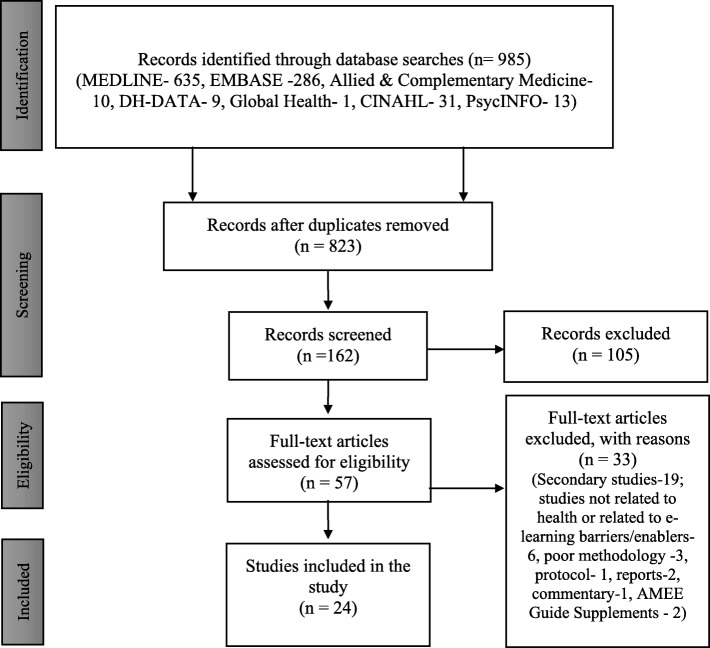
Results: Out of 985 records identified, a total of 162 citations were screened, of which 57 were found to be of relevance to this study. The primary evidence base comprises 24 papers, with two broad categories identified, enablers and barriers, under eight separate themes: facilitate learning; learning in practice; systematic approach to learning; integration of e-learning into curricula; poor motivation and expectation; resource-intensive; not suitable for all disciplines or contents, and lack of IT skills.
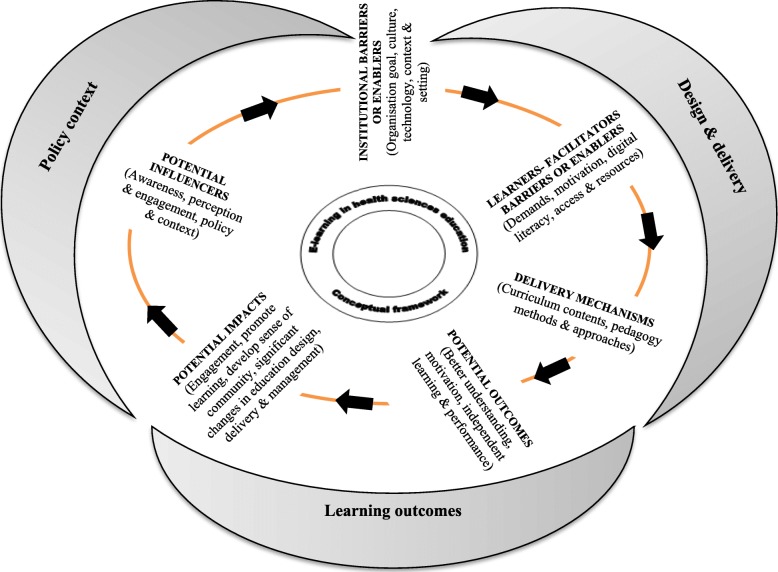
Conclusions: This study has identified the factors which impact on e-learning: interaction and collaboration between learners and facilitators; considering learners' motivation and expectations; utilising user-friendly technology; and putting learners at the centre of pedagogy. There is significant scope for better understanding of the issues related to enablers and facilitators associated with e-learning, and developing appropriate policies and initiatives to establish when, how and where they fit best, creating a broader framework for making e-learning effective.
Keywords: Barriers; E-learning; Enablers; Health sciences; Lifelong learning; Widening participation.
Conflict of interest statement
The authors declare that they have no competing interests.
Figures
References
-
- Holmes B, Garder J. E-learning: concepts and practice. London: Sage; 2006.
-
- Sandars J. E-learning. In: Walsh A, editor. Oxford textbook of medical education. Oxford: Oxford University Press; 2013. pp. 174–185.
-
- Golband F, Hosseini AF, Mojtahedzadeh R, Mirhosseini F, Bigdeli S. The correlation between effective factors of e-learning and demographic variables in a post-graduate program of virtual medical education in Tehran University of medical sciences. Acta Med Iran. 2014;52:860–864. - PubMed
Publication types
MeSH terms
LinkOut - more resources
Full Text Sources
Medical
