. 2020 Mar 30;18(1):144.
doi: 10.1186/s12967-020-02311-1.

An integrated prognosis model of pharmacogenomic gene signature and clinical information for diffuse large B-cell lymphoma patients following CHOP-like chemotherapy

Affiliations

An integrated prognosis model of pharmacogenomic gene signature and clinical information for diffuse large B-cell lymphoma patients following CHOP-like chemotherapy

Jinglei Hu et al. J Transl Med. .

Abstract

Background: As the most common form of lymphoma, diffuse large B-cell lymphoma (DLBCL) is a clinical highly heterogeneous disease with variability in therapeutic outcomes and biological features. It is a challenge to identify of clinically meaningful tools for outcome prediction. In this study, we developed a prognosis model fused clinical characteristics with drug resistance pharmacogenomic signature to identify DLBCL prognostic subgroups for CHOP-based treatment.

Methods: The expression microarray data and clinical characteristics of 791 DLBCL patients from two Gene Expression Omnibus (GEO) databases were used to establish and validate this model. By using univariate Cox regression, eight clinical or genetic signatures were analyzed. The elastic net-regulated Cox regression analysis was used to select the best prognosis related factors into the predictive model. To estimate the prognostic capability of the model, Kaplan-Meier curve and the area under receiver operating characteristic (ROC) curve (AUC) were performed.

Results: A predictive model comprising 4 clinical factors and 2 pharmacogenomic gene signatures was established after 1000 times cross validation in the training dataset. The AUC of the comprehensive risk model was 0.78, whereas AUC value was lower for the clinical only model (0.68) or the gene only model (0.67). Compared with low-risk patients, the overall survival (OS) of DLBCL patients with high-risk scores was significantly decreased (HR = 4.55, 95% CI 3.14-6.59, log-rank p value = 1.06 × 10⁻¹⁵). The signature also enables to predict prognosis within different molecular subtypes of DLBCL. The reliability of the integrated model was confirmed by independent validation dataset (HR = 3.47, 95% CI 2.42-4.97, log rank p value = 1.53 × 10⁻¹¹).

Conclusions: This integrated model has a better predictive capability to ascertain the prognosis of DLBCL patients prior to CHOP-like treatment, which may improve the clinical management of DLBCL patients and provide theoretical basis for individualized treatment.

Keywords: CHOP-like chemotherapy; Diffuse large B-cell lymphoma; Pharmacogenomic signature; Survival.


Conflict of interest statement

None of the authors has any conflict of interest regarding this study.

Figures
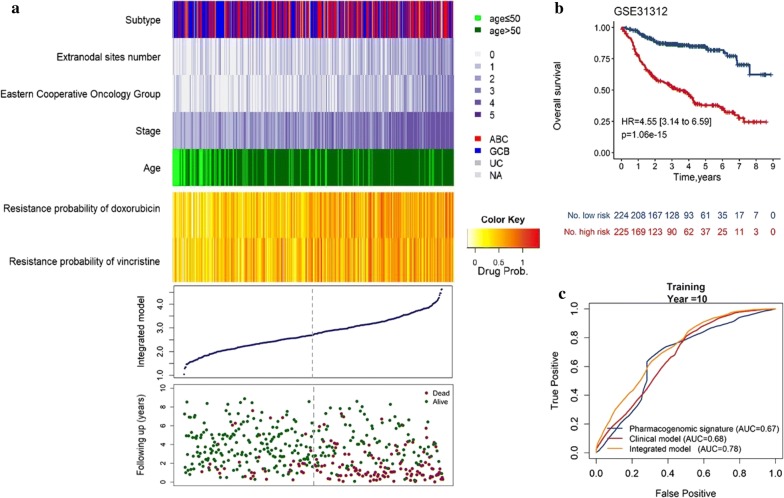
Fig. 1
Fig. 1
Integrated model analysis for OS of patients in the training dataset. Patients’ survival and disease progress status and risk score generated with integrated model were analyzed in the training set patients (GSE31312, n = 449). a The distribution plot, patients’ overall survival status and time and heatmap of the integrated model profiles. Rows represent clinical information and drug resistance probability, and columns represent patients. The grey dotted line represents the median integrated model risk score cutoff dividing patients into low- and high-score groups. Kaplan–Meier analysis for OS (b) of DLBLC patients using the integrated model in the training dataset. The ROC curves of the pharmacogenomic gene signature, clinical only model and integrated model for prediction of OS (c)
Fig. 2
Fig. 2
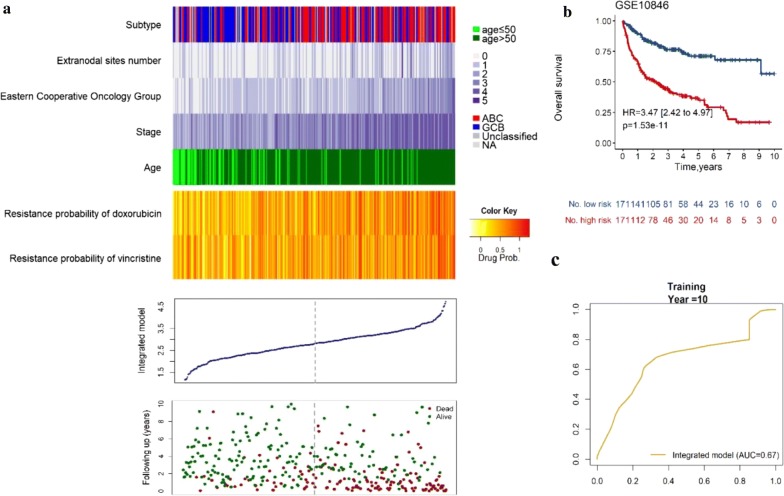
Performance evaluation of the integrated model for OS of DLBCL patients treated with CHOP-based chemotherapy in the validating dataset. Patients’ overall survival status and risk score generated with integrated model in the validating dataset (GSE10846, n = 342). a The distribution plot, patients’ overall survival status and time and heatmap of the integrated model profiles. Rows represent clinical information and drug resistance probability, and columns represent patients. The grey dotted line represents the median integrated model risk score cutoff dividing patients into low- and high-score groups. b The Kaplan–Meier curves for patients in the validating dataset. The two-sided Log-rank test was performed to test the difference for OS between the high-risk and low-risk groups determined based on the median risk score from the validating set patients. The number of patients at risk was listed below the survival curves. The tick marks on the Kaplan–Meier curves represents the censored subjects. c The ROC curve had an AUC of 0.67
Fig. 3
Fig. 3
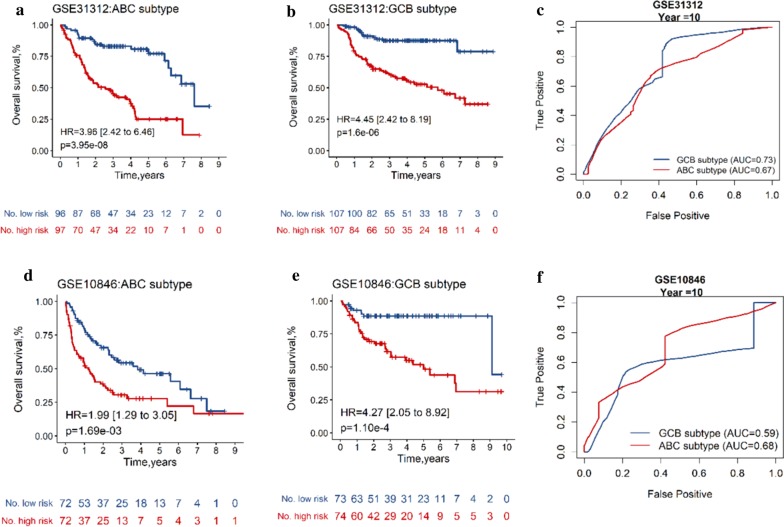
Integrated model performance for OS in ABC and GCB molecular subtypes. Kaplan–Meier curves with hazard ratio (HR), 95% confidence interval (CI) and log-rank p value for overall survival in the training cohort (a, b) and validating dataset (d, e) stratified by integrated model for OS into high and low risk. The ROC curves of the integrated model for prediction of OS in molecular subtypes in training dataset (c) and validating dataset (f)

References

    1. Morton LM, Wang SS, Devesa SS, Hartge P, Weisenburger DD, Linet MS. Lymphoma incidence patterns by WHO subtype in the United States, 1992-2001. Blood. 2006;107(1):265–276. doi: 10.1182/blood-2005-06-2508. - DOI - PMC - PubMed
    1. The Non-Hodgkin’s Lymphoma Classification Project A clinical evaluation of the International Lymphoma Study Group classification of non-Hodgkin’s lymphoma. Blood. 1997;89:3909–3918. doi: 10.1182/blood.V89.11.3909. - DOI - PubMed
    1. Berglund M, Enblad G, Flordal E, Lui WO, Backlin C, Thunberg U, et al. Chromosomal imbalances in diffuse large B-cell lymphoma detected by comparative genomic hybridization. Mod Pathol. 2002;15(8):807–816. doi: 10.1097/01.MP.0000024375.04135.2B. - DOI - PubMed
    1. Lossos IS, Morgensztern D. Prognostic biomarkers in diffuse large B-cell lymphoma. J Clin Oncol. 2006;24(6):995–1007. doi: 10.1200/JCO.2005.02.4786. - DOI - PubMed
    1. Habermann TM, Weller EA, Morrison VA, Gascoyne RD, Cassileth PA, Cohn JB, et al. Rituximab-CHOP versus CHOP alone or with maintenance rituximab in older patients with diffuse large B-cell lymphoma. J Clin Oncol. 2006;24(19):3121–3127. doi: 10.1200/JCO.2005.05.1003. - DOI - PubMed

Publication types

MeSH terms