


Haploidentical donor is preferred over matched sibling donor for pre-transplantation MRD positive ALL: a phase 3 genetically randomized study
- PMID: 32228710
- PMCID: PMC7106867
- DOI: 10.1186/s13045-020-00860-y
Haploidentical donor is preferred over matched sibling donor for pre-transplantation MRD positive ALL: a phase 3 genetically randomized study
Abstract
Background: Previous reports suggest a benefit associated with haploidentical donor transplantation (HIDT) compared to matched sibling donor transplantation (MSDT) in certain contexts, and the choice of optimal candidates warrants further investigation.
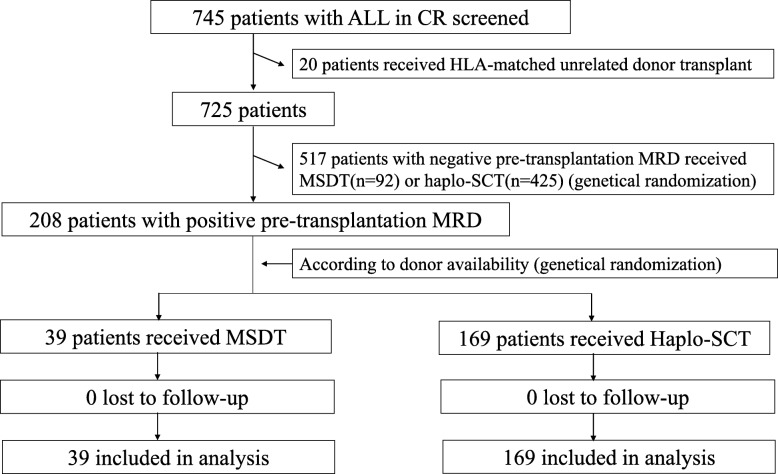
Methods: We designed a prospective genetically randomized study to evaluate donor options between acute lymphoblastic leukemia (ALL) patients positive for measurable residual disease (MRD) pre-transplantation who underwent HIDT (n = 169) or MSDT (n = 39).
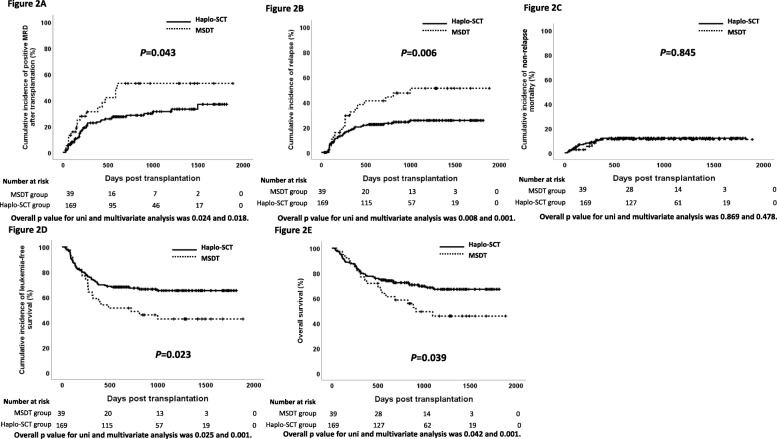
Results: The cumulative incidence of positive MRD post-transplantation was 26% (95% CI, 19-33%) and 44% (95% CI, 28-60%) for HIDT and MSDT, respectively (P = 0.043). Compared to the HIDT cohort, the MSDT cohort had a higher 3-year cumulative incidence of relapse (CIR; 47%, 95% CI, 31-63% vs. 23%, 95% CI, 17-29%; P = 0.006) and lower 3-year probability of leukemia-free survival (LFS; 43%, 95% CI, 27-59% vs. 65%, 95% CI, 58-72%; P = 0.023) and overall survival (OS; 46%, 95% CI, 30-62% vs. 68%, 95% CI, 61-75%; P = 0.039), without a difference in non-relapse-mortality (10%, 95% CI, 1-19% vs. 11%, 95% CI, 6-16%; P = 0.845). Multivariate analysis showed that HIDT is associated with a low CIR (HR = 0.364; 95% CI, 0.202-0.655; P = 0.001) and better LFS (HR = 0.414; 95% CI, 0.246-0.695; P = 0.001) and OS (HR = 0.380; 95% CI, 0.220-0.656; P = 0.001).
Conclusions: HIDT is better than MSDT in view of favorable anti-leukemia activity for patients with pre-transplantation MRD positive ALL. The current study paves the way to determine that haploidentical donors are the preferred choice regardless of available matched sibling donors in a subgroup population.
Trial registration: ClinicalTrials.gov Identifier: NCT02185261. Registered July 9, 2014. https://clinicaltrials.gov/ct2/show/NCT02185261?term=NCT02185261&draw=2&rank=1.
Keywords: Acute lymphoblastic leukemia; Donor selection; Haploidentical donor transplantation; Matched sibling donor transplantation; Measurable residual disease.
Conflict of interest statement
The authors declared that they have no competing interests.
Figures
References
-
- Wang Y, Liu QF, Xu LP, Liu KY, Zhang XH, Ma X, et al. Haploidentical versus matched-sibling transplant in adults with Philadelphia-negative high-risk acute lymphoblastic leukemia: a biologically phase III randomized study. Clin Cancer Res. 2016;22:3467–3476. doi: 10.1158/1078-0432.CCR-15-2335. - DOI - PubMed
-
- Shouval R, Fein JA, Labopin M, Kroger N, Duarte RF, Bader P, et al. Outcomes of allogeneic haematopoietic stem cell transplantation from HLA-matched and alternative donors: a European Society for Blood and Marrow Transplantation registry retrospective analysis. Lancet Haematol. 2019;6:e573–ee84. doi: 10.1016/S2352-3026(19)30158-9. - DOI - PubMed
Publication types
MeSH terms
Associated data
LinkOut - more resources
Full Text Sources
Medical
