Typhoid Outbreaks, 1989-2018: Implications for Prevention and Control
- PMID: 32228795
- PMCID: PMC7253085
- DOI: 10.4269/ajtmh.19-0624
Typhoid Outbreaks, 1989-2018: Implications for Prevention and Control
Abstract
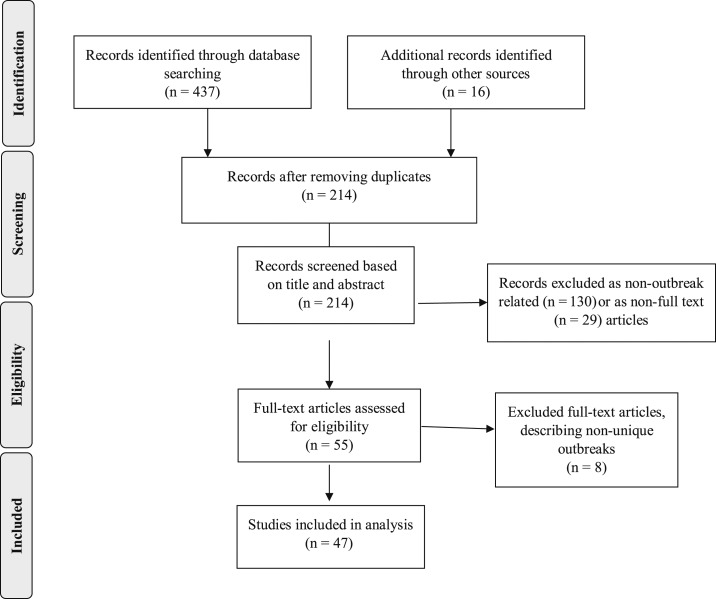
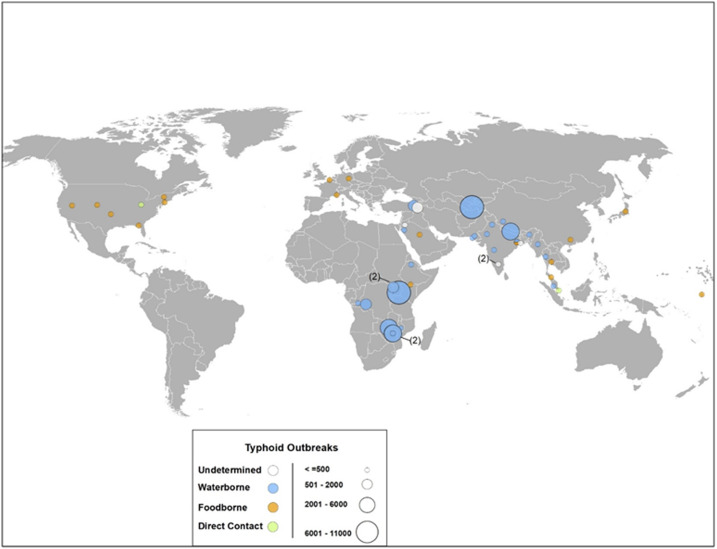
Typhoid fever remains an important public health problem in low- and middle-income countries, with large outbreaks reported from Africa and Asia. Although the WHO recommends typhoid vaccination for control of confirmed outbreaks, there are limited data on the epidemiologic characteristics of outbreaks to inform vaccine use in outbreak settings. We conducted a literature review for typhoid outbreaks published since 1990. We found 47 publications describing 45,215 cases in outbreaks occurring in 25 countries from 1989 through 2018. Outbreak characteristics varied considerably by WHO region, with median outbreak size ranging from 12 to 1,101 cases, median duration from 23 to 140 days, and median case fatality ratio from 0% to 1%. The largest number of outbreaks occurred in WHO Southeast Asia, 13 (28%), and African regions, 12 (26%). Among 43 outbreaks reporting a mode of disease transmission, 24 (56%) were waterborne, 17 (40%) were foodborne, and two (5%) were by direct contact transmission. Among the 34 outbreaks with antimicrobial resistance data, 11 (32%) reported Typhi non-susceptible to ciprofloxacin, 16 (47%) reported multidrug-resistant (MDR) strains, and one reported extensively drug-resistant strains. Our review showed a longer median duration of outbreaks caused by MDR strains (148 days versus 34 days for susceptible strains), although this difference was not statistically significant. Control strategies focused on water, sanitation, and food safety, with vaccine use described in only six (13%) outbreaks. As typhoid conjugate vaccines become more widely used, their potential role and impact in outbreak control warrant further evaluation.
Conflict of interest statement
Disclosure: A. D. B.-E. is a staff member of the World Health Organization.
Disclaimer: The findings and conclusions in this report are those of the authors and do not necessarily represent the official position of the Centers for Disease Control and Prevention or the views of the World Health Organization.
Figures
References
-
- Mogasale V, Maskery B, Ochiai RL, Lee JS, Mogasale VV, Ramani E, Kim YE, Park JK, Wierzba TF, 2014. Burden of typhoid fever in low-income and middle-income countries: a systematic, literature-based update with risk-factor adjustment. Lancet Glob Health 2: e570–e580. - PubMed
Publication types
MeSH terms
Substances
Grants and funding
LinkOut - more resources
Full Text Sources
Research Materials