


Biophysical forces in membrane bending and traffic
- PMID: 32229366
- PMCID: PMC7529674
- DOI: 10.1016/j.ceb.2020.02.017
Biophysical forces in membrane bending and traffic
Abstract
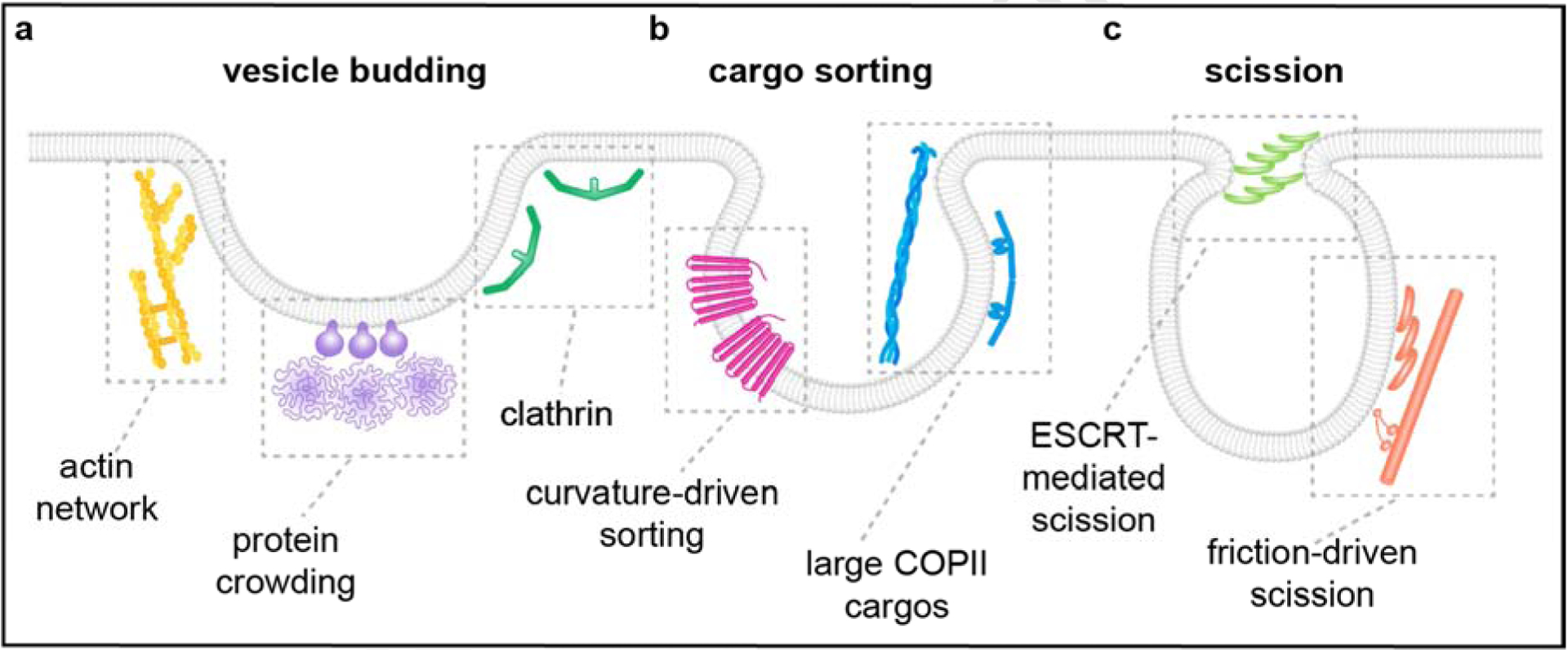
Intracellular trafficking requires extensive changes in membrane morphology. Cells use several distinct molecular factors and physical cues to remodel membranes. Here, we highlight recent advances in identifying the biophysical mechanisms of membrane curvature generation. In particular, we focus on the cooperation of molecular and physical drivers of membrane bending during three stages of vesiculation: budding, cargo selection, and scission. Taken together, the studies reviewed here emphasize that, rather than a single dominant mechanism, several mechanisms typically work in parallel during each step of membrane remodeling. Important challenges for the future of this field are to understand how multiple mechanisms work together synergistically and how a series of stochastic events can be combined to achieve a deterministic result-assembly of the trafficking vesicle.
Copyright © 2020 Elsevier Ltd. All rights reserved.
Conflict of interest statement
Conflict of interest statement Nothing declared.
Figures
References
-
- McMahon HT and Gallop JL, Membrane curvature and mechanisms of dynamic cell membrane remodelling. Nature, 2005. 438(7068): p. 590–6. - PubMed
-
- Itoh T and De Camilli P, BAR, F-BAR (EFC) and ENTH/ANTH domains in the regulation of membrane-cytosol interfaces and membrane curvature. Biochim Biophys Acta, 2006. 1761(8): p. 897–912. - PubMed
Publication types
MeSH terms
Substances
Grants and funding
LinkOut - more resources
Full Text Sources
