


Assessing Real-Time Moderation for Developing Adaptive Mobile Health Interventions for Medical Interns: Micro-Randomized Trial
- PMID: 32229469
- PMCID: PMC7157494
- DOI: 10.2196/15033
Assessing Real-Time Moderation for Developing Adaptive Mobile Health Interventions for Medical Interns: Micro-Randomized Trial
Abstract
Background: Individuals in stressful work environments often experience mental health issues, such as depression. Reducing depression rates is difficult because of persistently stressful work environments and inadequate time or resources to access traditional mental health care services. Mobile health (mHealth) interventions provide an opportunity to deliver real-time interventions in the real world. In addition, the delivery times of interventions can be based on real-time data collected with a mobile device. To date, data and analyses informing the timing of delivery of mHealth interventions are generally lacking.
Objective: This study aimed to investigate when to provide mHealth interventions to individuals in stressful work environments to improve their behavior and mental health. The mHealth interventions targeted 3 categories of behavior: mood, activity, and sleep. The interventions aimed to improve 3 different outcomes: weekly mood (assessed through a daily survey), weekly step count, and weekly sleep time. We explored when these interventions were most effective, based on previous mood, step, and sleep scores.
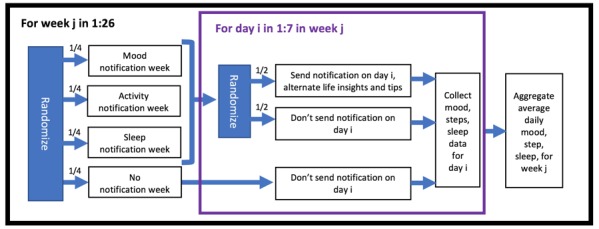
Methods: We conducted a 6-month micro-randomized trial on 1565 medical interns. Medical internship, during the first year of physician residency training, is highly stressful, resulting in depression rates several folds higher than those of the general population. Every week, interns were randomly assigned to receive push notifications related to a particular category (mood, activity, sleep, or no notifications). Every day, we collected interns' daily mood valence, sleep, and step data. We assessed the causal effect moderation by the previous week's mood, steps, and sleep. Specifically, we examined changes in the effect of notifications containing mood, activity, and sleep messages based on the previous week's mood, step, and sleep scores. Moderation was assessed with a weighted and centered least-squares estimator.
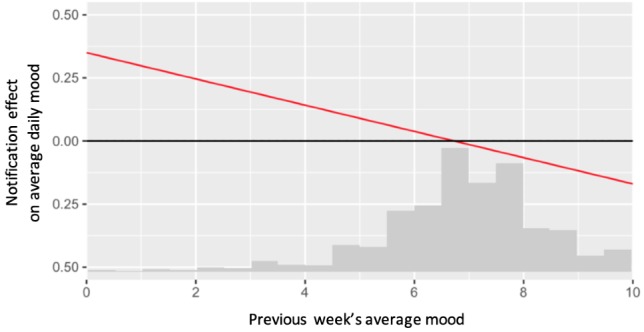
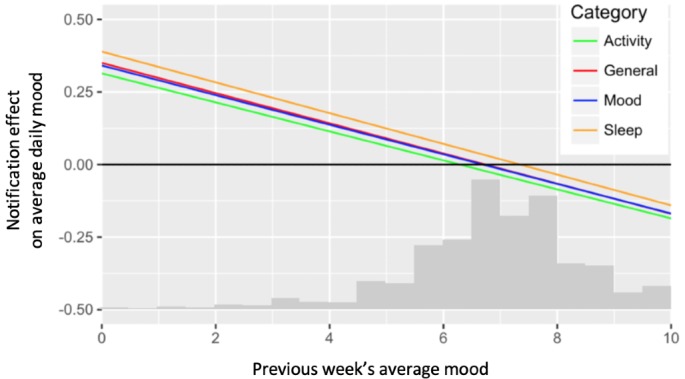
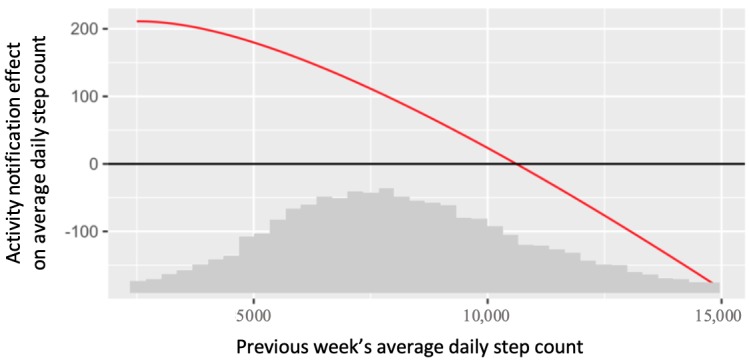
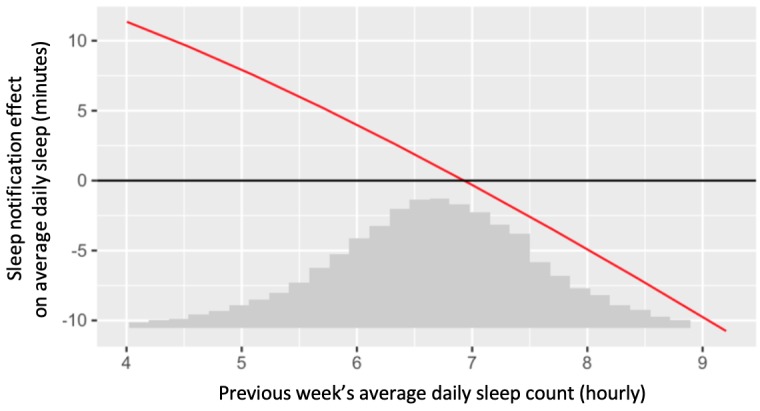
Results: We found that the previous week's mood negatively moderated the effect of notifications on the current week's mood with an estimated moderation of -0.052 (P=.001). That is, notifications had a better impact on mood when the studied interns had a low mood in the previous week. Similarly, we found that the previous week's step count negatively moderated the effect of activity notifications on the current week's step count, with an estimated moderation of -0.039 (P=.01) and that the previous week's sleep negatively moderated the effect of sleep notifications on the current week's sleep with an estimated moderation of -0.075 (P<.001). For all three of these moderators, we estimated that the treatment effect was positive (beneficial) when the moderator was low, and negative (harmful) when the moderator was high.
Conclusions: These findings suggest that an individual's current state meaningfully influences their receptivity to mHealth interventions for mental health. Timing interventions to match an individual's state may be critical to maximizing the efficacy of interventions.
Trial registration: ClinicalTrials.gov NCT03972293; http://clinicaltrials.gov/ct2/show/NCT03972293.
Keywords: depression; digital health; ecological momentary assessment; mobile health; mobile phone; moderator variables; mood; physical activity; sleep; smartphone; wearable devices.
©Timothy NeCamp, Srijan Sen, Elena Frank, Maureen A Walton, Edward L Ionides, Yu Fang, Ambuj Tewari, Zhenke Wu. Originally published in the Journal of Medical Internet Research (http://www.jmir.org), 31.03.2020.
Conflict of interest statement
Conflicts of Interest: None declared.
Figures
References
-
- World Health Organization. 2017. [2020-01-31]. Depression and Other Common Mental Disorders: Global Health Estimates https://apps.who.int/iris/bitstream/handle/10665/254610/WHO-MSD-MER-2017....
-
- Greenberg PE, Fournier A, Sisitsky T, Pike CT, Kessler RC. The economic burden of adults with major depressive disorder in the United States (2005 and 2010) J Clin Psychiatry. 2015 Mar;76(2):155–62. doi: 10.4088/JCP.14m09298. http://www.psychiatrist.com/jcp/article/pages/2015/v76n02/v76n0204.aspx - DOI - PubMed
-
- Hawkins JD, Jenson JM, Catalano R, Fraser MW, Botvin GJ, Shapiro V, Brown CH, Beardslee W, Brent D, Leslie LK, Rotheram-Borus MJ, Shea P, Shih A, Anthony E, Haggerty KP, Bender K, Gorman-Smith D, Casey E, Stone S. Unleashing the power of prevention. NAM Perspectives. 2015;5(6):1343–4. doi: 10.31478/201506c. - DOI
-
- Baucom KJ, Queen TL, Wiebe DJ, Turner SL, Wolfe KL, Godbey EI, Fortenberry KT, Mansfield JH, Berg CA. Depressive symptoms, daily stress, and adherence in late adolescents with type 1 diabetes. Health Psychol. 2015 May;34(5):522–30. doi: 10.1037/hea0000219. http://europepmc.org/abstract/MED/25798545 - DOI - PMC - PubMed
Publication types
MeSH terms
Associated data
Grants and funding
LinkOut - more resources
Full Text Sources
Medical
