


Evaluation of Nucleocapsid and Spike Protein-Based Enzyme-Linked Immunosorbent Assays for Detecting Antibodies against SARS-CoV-2
- PMID: 32229605
- PMCID: PMC7269413
- DOI: 10.1128/JCM.00461-20
Evaluation of Nucleocapsid and Spike Protein-Based Enzyme-Linked Immunosorbent Assays for Detecting Antibodies against SARS-CoV-2
Abstract
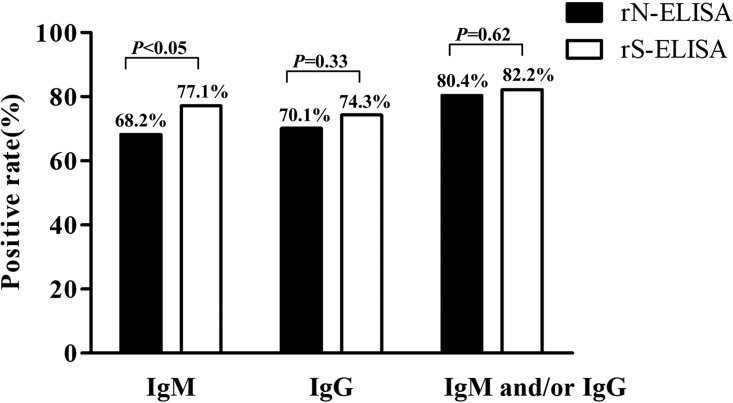
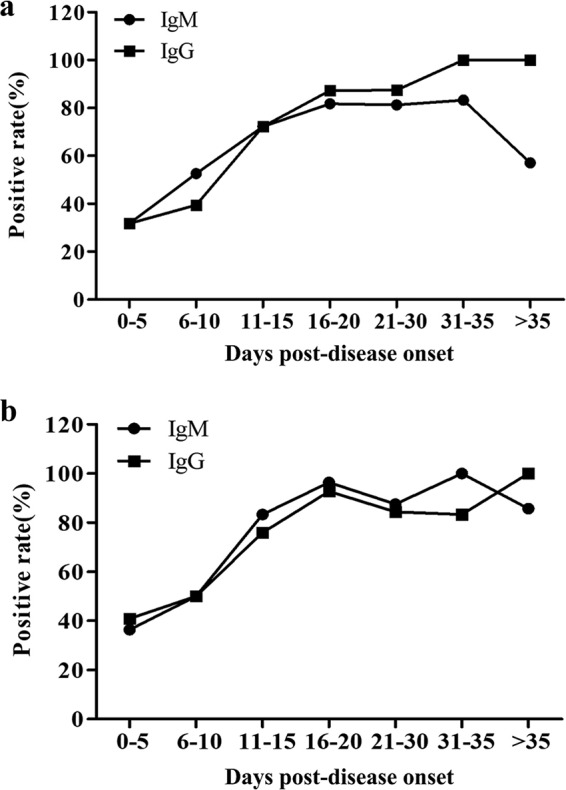
At present, PCR-based nucleic acid detection cannot meet the demands for coronavirus infectious disease (COVID-19) diagnosis. Two hundred fourteen confirmed COVID-19 patients who were hospitalized in the General Hospital of Central Theater Command of the People's Liberation Army between 18 January and 26 February 2020 were recruited. Two enzyme-linked immunosorbent assay (ELISA) kits based on recombinant severe acute respiratory syndrome coronavirus 2 (SARS-CoV-2) nucleocapsid protein (rN) and spike protein (rS) were used for detecting IgM and IgG antibodies, and their diagnostic feasibility was evaluated. Among the 214 patients, 146 (68.2%) and 150 (70.1%) were successfully diagnosed with the rN-based IgM and IgG ELISAs, respectively; 165 (77.1%) and 159 (74.3%) were successfully diagnosed with the rS-based IgM and IgG ELISAs, respectively. The positive rates of the rN-based and rS-based ELISAs for antibody (IgM and/or IgG) detection were 80.4% and 82.2%, respectively. The sensitivity of the rS-based ELISA for IgM detection was significantly higher than that of the rN-based ELISA. We observed an increase in the positive rate for IgM and IgG with an increasing number of days post-disease onset (d.p.o.), but the positive rate of IgM dropped after 35 d.p.o. The positive rate of rN-based and rS-based IgM and IgG ELISAs was less than 60% during the early stage of the illness, 0 to 10 d.p.o., and that of IgM and IgG was obviously increased after 10 d.p.o. ELISA has a high sensitivity, especially for the detection of serum samples from patients after 10 d.p.o., so it could be an important supplementary method for COVID-19 diagnosis.
Keywords: COVID-19 diagnosis; ELISA; IgG; IgM; antibody; nucleocapsid protein; spike protein.
Copyright © 2020 American Society for Microbiology.
Figures
References
-
- WHO. 2020. Coronavirus disease 2019. World Health Organization, Geneva, Switzerland: https://www.who.int/emergencies/diseases/novel-coronavirus-2019.
-
- Chan JF, Yuan S, Kok KH, To KK, Chu H, Yang J, Xing F, Liu J, Yip CC, Poon RW, Tsoi HW, Lo SK, Chan KH, Poon VK, Chan WM, Ip JD, Cai JP, Cheng VC, Chen H, Hui CK, Yuen KY. 2020. A familial cluster of pneumonia associated with the 2019 novel coronavirus indicating person-to-person transmission: a study of a family cluster. Lancet 395:514–523. doi: 10.1016/S0140-6736(20)30154-9. - DOI - PMC - PubMed
-
- Huang C, Wang Y, Li X, Ren L, Zhao J, Hu Y, Zhang L, Fan G, Xu J, Gu X, Cheng Z, Yu T, Xia J, Wei Y, Wu W, Xie X, Yin W, Li H, Liu M, Xiao Y, Gao H, Guo L, Xie J, Wang G, Jiang R, Gao Z, Jin Q, Wang J, Cao B. 2020. Clinical features of patients infected with 2019 novel coronavirus in Wuhan, China. Lancet 395:497–506. doi: 10.1016/S0140-6736(20)30183-5. - DOI - PMC - PubMed
-
- National Health Commission of the People’s Republic of China. 2020. The latest situation of novel coronavirus pneumonia as of 24:00 on March 1, 2020. http://www.nhc.gov.cn/xcs/yqtb/202003/5819f3e13ff6413ba05fdb45b55b66ba.s....
Publication types
MeSH terms
Substances
LinkOut - more resources
Full Text Sources
Other Literature Sources
Medical
Miscellaneous
