


Peak Match Demands in Young Basketball Players: Approach and Applications
- PMID: 32230798
- PMCID: PMC7177956
- DOI: 10.3390/ijerph17072256
Peak Match Demands in Young Basketball Players: Approach and Applications
Abstract
Background: The aim of this study is to describe the peak match demands and compare them with average demands in basketball players, from an external load point of view, using different time windows. Another objective is to determine whether there are differences between positions and to provide an approach for practical applications.
Methods: During this observational study, each player wore a micro technology device. We collected data from 12 male basketball players (mean ± SD: age 17.56 ± 0.67 years, height 196.17 ± 6.71 cm, body mass 90.83 ± 11.16 kg) during eight games. We analyzed intervals for different time windows using rolling averages (ROLL) to determine the peak match demands for Player Load. A separate one-way analysis of variance (ANOVA) was used to identify statistically significant differences between playing positions across different intense periods.
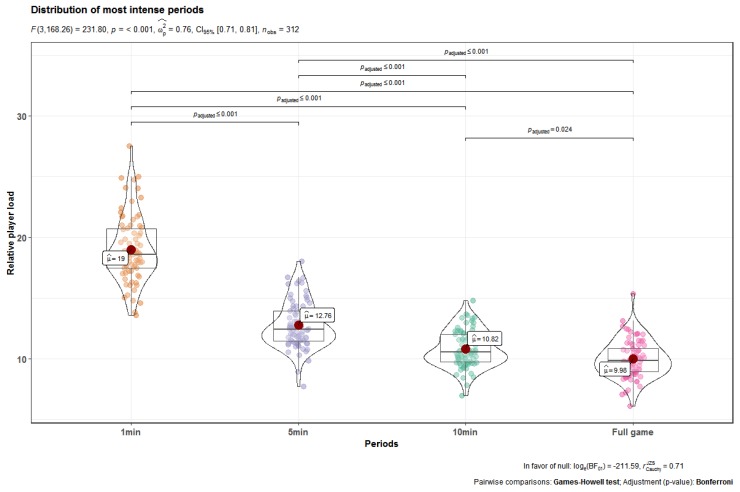
Results: Separate one-way ANOVAs revealed statistically significant differences between 1 min, 5 min, 10 min, and full game periods for Player Load, F (3,168) = 231.80, ηp2 = 0.76, large, p < 0.001. It is worth noting that guards produced a statistically significantly higher Player Load in 5 min (p < 0.01, ηp2 = -0.69, moderate), 10 min (p < 0.001, ηp2 = -0.90, moderate), and full game (p < 0.001, ηp2 = -0.96, moderate) periods than forwards.
Conclusions: The main finding is that there are significant differences between the most intense moments of a game and the average demands. This means that understanding game demands using averages drastically underestimates the peak demands of the game. This approach helps coaches and fitness coaches to prepare athletes for the most demanding periods of the game and present potential practical applications that could be implemented during training and rehabilitation sessions.
Keywords: basketball; most demanding periods; most intense passages; peak demands (PD); performance; worst case scenario (WCS).
Conflict of interest statement
The author listed in second position (N.M.) works for the manufacturing company of the devices and software used for the present research. The rest of the authors declare no conflict of interest.
Figures
References
-
- Delextrat A., Badiella A., Saavedra V., Mattew D., Schelling X., Torres-Ronda L. Match activity demands of elite Spanish female basketball players by playing position. Int. J. Perform. Anal. Sport. 2015;15:687–703. doi: 10.1080/24748668.2015.11868824. - DOI
Publication types
MeSH terms
LinkOut - more resources
Full Text Sources
