


Nutritional Composition of Apis mellifera Drones from Korea and Denmark as a Potential Sustainable Alternative Food Source: Comparison Between Developmental Stages
- PMID: 32230865
- PMCID: PMC7230812
- DOI: 10.3390/foods9040389
Nutritional Composition of Apis mellifera Drones from Korea and Denmark as a Potential Sustainable Alternative Food Source: Comparison Between Developmental Stages
Abstract
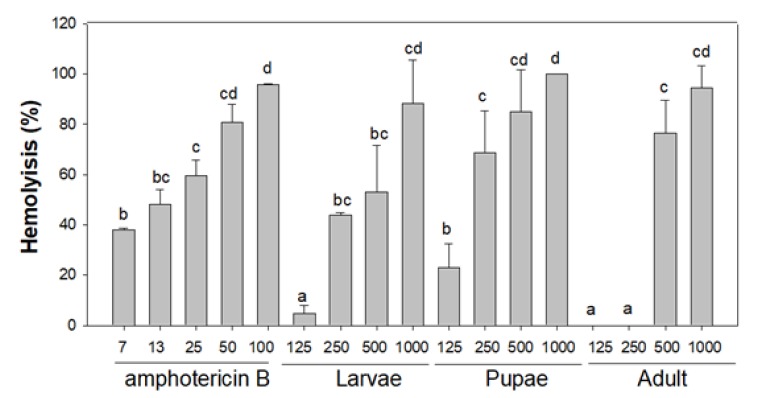
We compared nutrient compositions of honey bee (Apis mellifera) drones of different developmental stages from two different populations-the Italian honey bee reared in Korea and Buckfast bees from Denmark. Analyses included amino acid, fatty acid, and mineral content as well as evaluations of antioxidant properties and haemolysis activities. The compositions of total amino acids, and thus protein content of the insects, increased with development. A similar trend was observed for minerals presumably due to the consumption of food in the adult stage. In contrast, total fatty acid amounts decreased with development. Altogether, seventeen amino acids, including all the essential ones, except tryptophan, were determined. Saturated fatty acids dominated over monounsaturated fatty acids in the pupae, but the reverse held true for the adults. Drones were found to be rich in minerals and the particularly high iron as well as K/Na ratio was indicative of the nutritional value of these insects. Among the three developmental stages, adult Buckfast drones exhibited the highest antioxidant activity. Bearing in mind the overall high nutritional value, i.e., high amino acids, minerals and less fatty acids, late pupae and adult drones can be useful for human consumption while the larvae or early pupal stage can be recommended as feed. However, owing to their relatively high haemolysis activity, we advocate processing prior to the consumption of these insects.
Keywords: Amino acids; antimicrobial; antioxidant; fatty acids; food safety; minerals; supplement; sustainable food.
Conflict of interest statement
The authors declare no conflict of interest.
Figures
References
-
- Meyer-Rochow V.B. Can insects help to ease the problem of world food shortage? Search. 1975;6:261–262.
-
- Evans J., Alemu M.H., Flore R., Frøst M.B., Halloran A., Jensen A.B., Maciel-Vergara G., Meyer-Rochow V.B., Münke-Svendsen C., Olsen S.B., et al. ‘Entomophagy’: An evolving terminology in need of review. J. Insects Food Feed. 2015;1:293–305. doi: 10.3920/JIFF2015.0074. - DOI
-
- Bequaert J. Insects as food: How they have augmented the food supply of mankind in early and recent years. Nat. Hist. J. 1921;21:191–200.
-
- Bergier E. Peuples Entomophages et Insectes Comestibles: Étude sur les Moeurs de L’homme et de L’insecte. Imprimérie Rullière Frères; Avignon, France: 1941.
-
- Bodenheimer F.S. Insects as Human Food. W. Junk Publishers; The Hague, The Netherlands: 1951.
Grants and funding
LinkOut - more resources
Full Text Sources
Molecular Biology Databases
