. 2020 Mar 30;10(1):5685.
doi: 10.1038/s41598-020-62195-5.

Gut, oral and skin microbiome of Indian patrilineal families reveal perceptible association with age

Affiliations

Gut, oral and skin microbiome of Indian patrilineal families reveal perceptible association with age

Diptaraj S Chaudhari et al. Sci Rep. .

Abstract

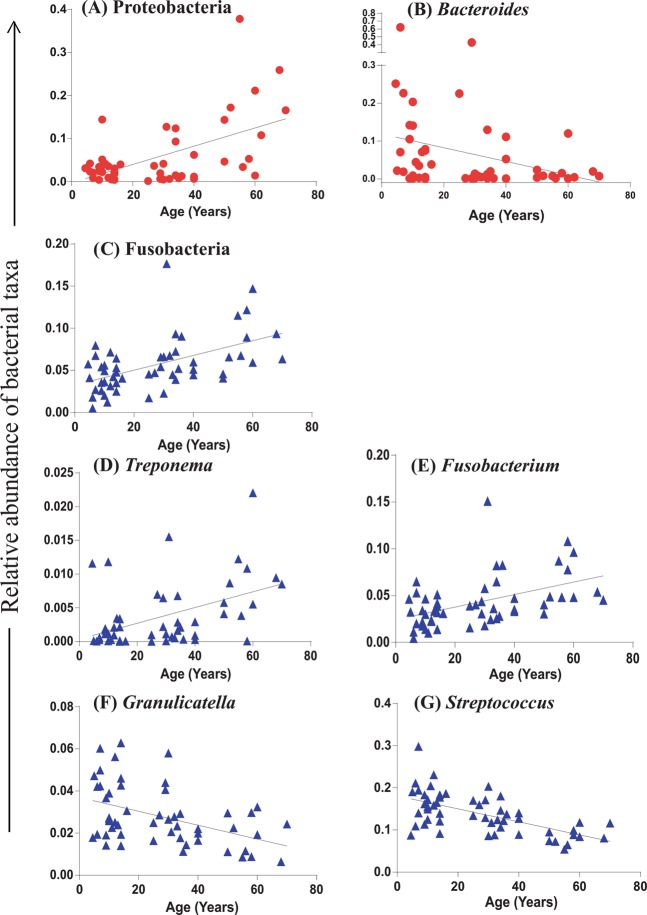
The human microbiome plays a key role in maintaining host homeostasis and is influenced by age, geography, diet, and other factors. Traditionally, India has an established convention of extended family arrangements wherein three or more generations, bound by genetic relatedness, stay in the same household. In the present study, we have utilized this unique family arrangement to understand the association of age with the microbiome. We characterized stool, oral and skin microbiome of 54 healthy individuals from six joint families by 16S rRNA gene-based metagenomics. In total, 69 (1.03%), 293 (2.68%) and 190 (8.66%) differentially abundant OTUs were detected across three generations in the gut, skin and oral microbiome, respectively. Age-associated changes in the gut and oral microbiome of patrilineal families showed positive correlations in the abundance of phyla Proteobacteria and Fusobacteria, respectively. Genera Treponema and Fusobacterium showed a positive correlation with age while Granulicatella and Streptococcus showed a negative correlation with age in the oral microbiome. Members of genus Prevotella illustrated high abundance and prevalence as a core OTUs in the gut and oral microbiome. In conclusion, this study highlights that precise and perceptible association of age with microbiome can be drawn when other causal factors are kept constant.


Conflict of interest statement

The authors declare no competing interests.

Figures
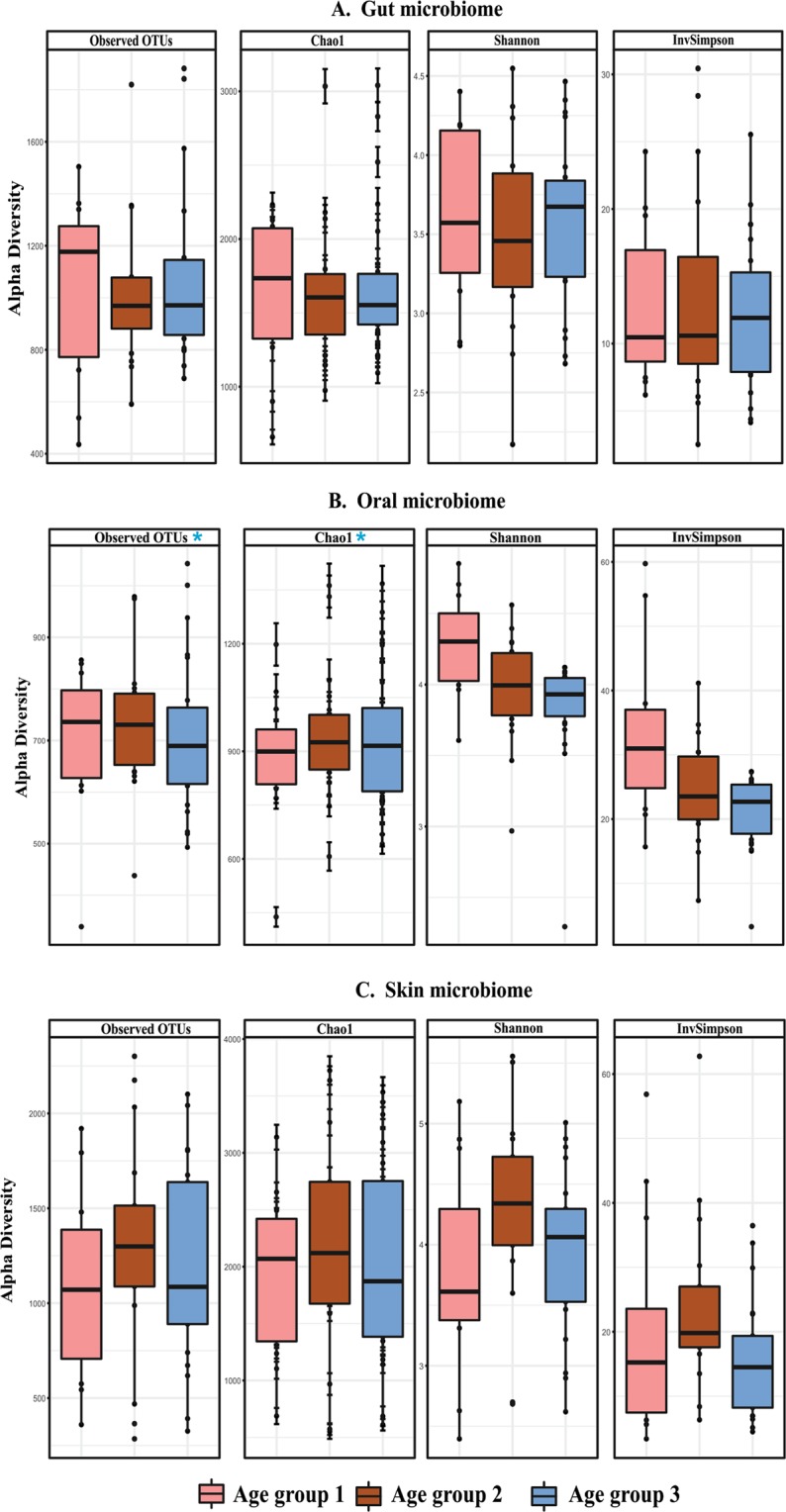
Figure 1
Figure 1
Boxplot of alpha diversity measures across the three generations (age groups) in the gut (A) oral (B) and (C) skin samples. The boxes denote interquartile ranges (IQR) with the median as a black line.
Figure 2
Figure 2
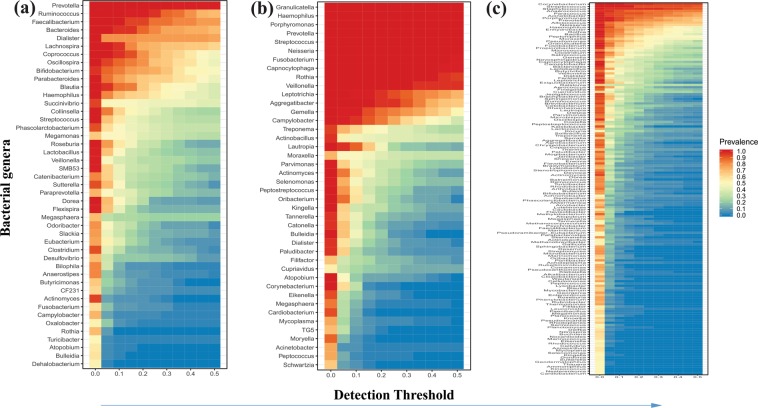
Heatmap representing the core bacterial genera detected across the gut (a), oral (b) and skin (c) microbiome samples of the EAI population.
Figure 3
Figure 3
Canonical correspondence analysis (CCA) plot of bacterial genera and age group relationship calculated for gut (a) oral (b) and skin (c) microbiome of the endogamous agriculturist Indian subpopulation.
Figure 4
Figure 4
Correlation analysis of microbiome (genus levels) and dietary consumption of carbohydrates, proteins, fats, fibers and calories for the human gut (a) and oral (b) microbiome.
Figure 5
Figure 5
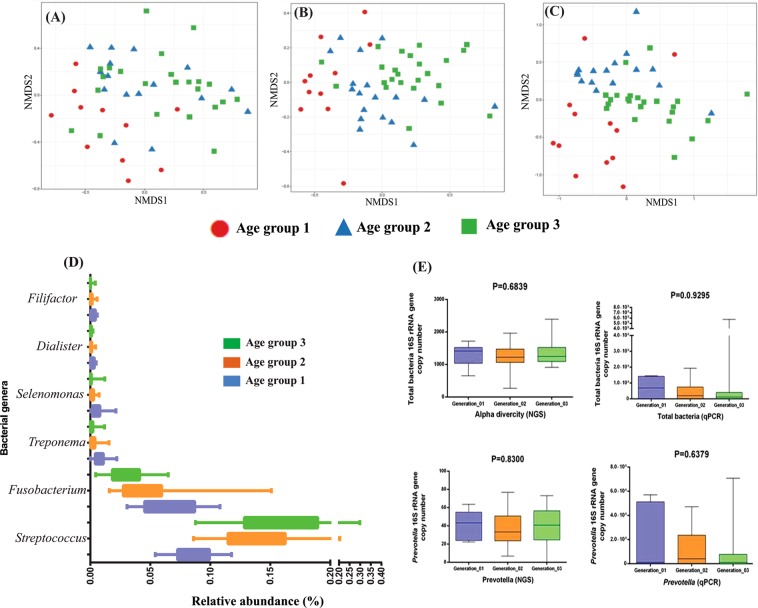
Nonmetric Multidimensional Scaling (NMDS) ordination displaying microbiome communities across the three generations in the gut (A), oral (B) and skin (C) microbiome. (D) Box plot showing differentially abundant genera in the human oral microbiome across the members from the three age groups. (E) Next-generation sequencing and qPCR results showing the abundance of Prevotella and total bacteria in the human gut microbiome across three age groups.
Figure 6
Figure 6
Correlation analysis of bacterial abundance with age, Phylum Proteobacteria (A) and Genus Bacteroides (B) of gut microbiome; Phylum Fusobacteria (C), genera Treponema (D), Fusobacterium (E), Granulicatella (F) and Streptococcus (G) of oral microbiome (p =< 0.05, r2 > 0.2 for all the correlation).

References

    1. Stebegg, M. et al. Heterochronic faecal transplantation boosts gut germinal centres in aged mice. Nature Communications10 (2019). - PMC - PubMed
    1. Biagi E, et al. Through Ageing, and Beyond: Gut Microbiota and Inflammatory Status in Seniors and Centenarians. PLoS One. 2010;5:e10667. doi: 10.1371/journal.pone.0010667. - DOI - PMC - PubMed
    1. Round JL, Mazmanian SK. The gut microbiota shapes intestinal immune responses during health and disease. Nature Reviews Immunology. 2009;9:313–323. doi: 10.1038/nri2515. - DOI - PMC - PubMed
    1. Claesson MJ, et al. Composition, variability, and temporal stability of the intestinal microbiota of the elderly. Proceedings of the National Academy of Sciences. 2010;108:4586–4591. doi: 10.1073/pnas.1000097107. - DOI - PMC - PubMed
    1. Thursby E, Juge N. Introduction to the human gut microbiota. Biochemical Journal. 2017;474:1823–1836. doi: 10.1042/BCJ20160510. - DOI - PMC - PubMed

Publication types

MeSH terms

Substances