. 2020 Dec;34(12):3161-3172.
doi: 10.1038/s41375-020-0806-0. Epub 2020 Mar 30.

Validation and refinement of the revised 2017 European LeukemiaNet genetic risk stratification of acute myeloid leukemia

Affiliations

Validation and refinement of the revised 2017 European LeukemiaNet genetic risk stratification of acute myeloid leukemia

Tobias Herold et al. Leukemia. 2020 Dec.

Abstract

The revised 2017 European LeukemiaNet (ELN) recommendations for genetic risk stratification of acute myeloid leukemia have been widely adopted, but have not yet been validated in large cohorts of AML patients. We studied 1116 newly diagnosed AML patients (age range, 18-86 years) who had received induction chemotherapy. Among 771 patients not selected by genetics, the ELN-2017 classification re-assigned 26.5% of patients into a more favorable or, more commonly, a more adverse-risk group compared with the ELN-2010 recommendations. Forty percent of the cohort, and 51% of patients ≥60 years, were classified as adverse-risk by ELN-2017. In 599 patients <60 years, estimated 5-year overall survival (OS) was 64% for ELN-2017 favorable, 42% for intermediate-risk and 20% for adverse-risk patients. Among 517 patients aged ≥60 years, corresponding 5-year OS rates were 37, 16, and 6%. Patients with biallelic CEBPA mutations or inv(16) had particularly favorable outcomes, while patients with mutated TP53 and a complex karyotype had especially poor prognosis. DNMT3A mutations associated with inferior OS within each ELN-2017 risk group. Our results validate the prognostic significance of the revised ELN-2017 risk classification in AML patients receiving induction chemotherapy across a broad age range. Further refinement of the ELN-2017 risk classification is possible.


Conflict of interest statement

KHM has received research support from Celgene, and honoraria from Celgene, Daiichi Sankyo, Astellas, Pfizer, and Otsuka Pharmaceutical. HJ is a current employee of Roche Pharma AG, Grenzach-Wyhlen, Germany. The other authors report no conflict of interest.

Figures
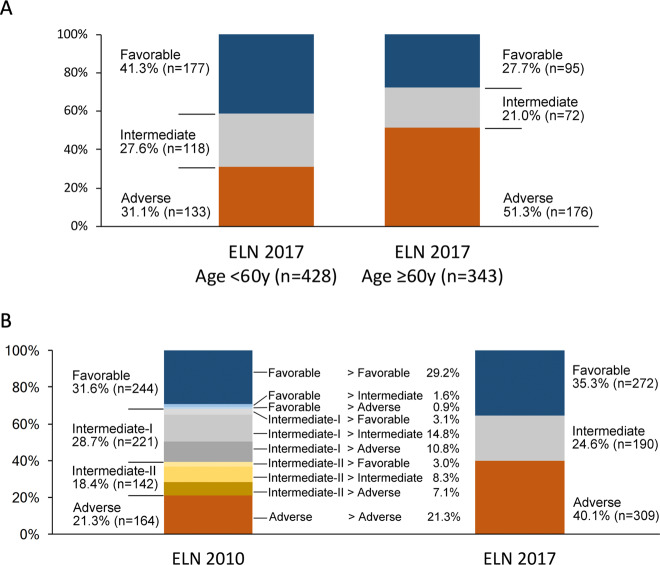
Fig. 1
Fig. 1. Distribution of ELN risk categories among intensively treated AML patients.
a Distribution of the ELN-2017 risk categories in intensively treated AML patients aged <60 years (left) and in patients aged ≥60 years (right). b Comparison of risk group assignment according to the ELN-2010 and ELN-2017 genetic groups, and re-distribution of risk categories with the updated classification.
Fig. 2
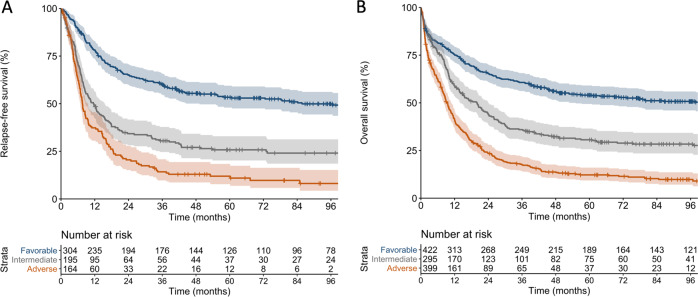
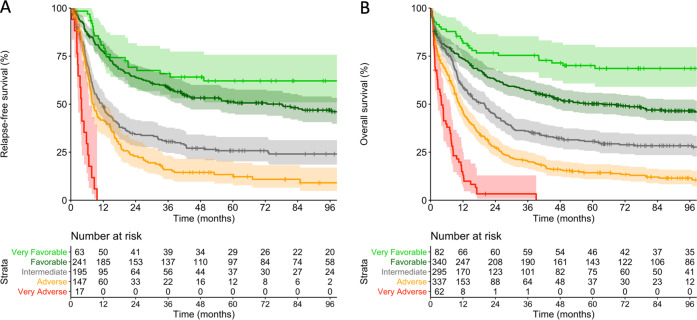
Fig. 2. Outcomes of patients according to the ELN-2017 genetic risk groups.
a Relapse-free survival and b overall survival according to the ELN-2017 categories in the entire cohort of 1116 patients (age range, 18–86 years).
Fig. 3
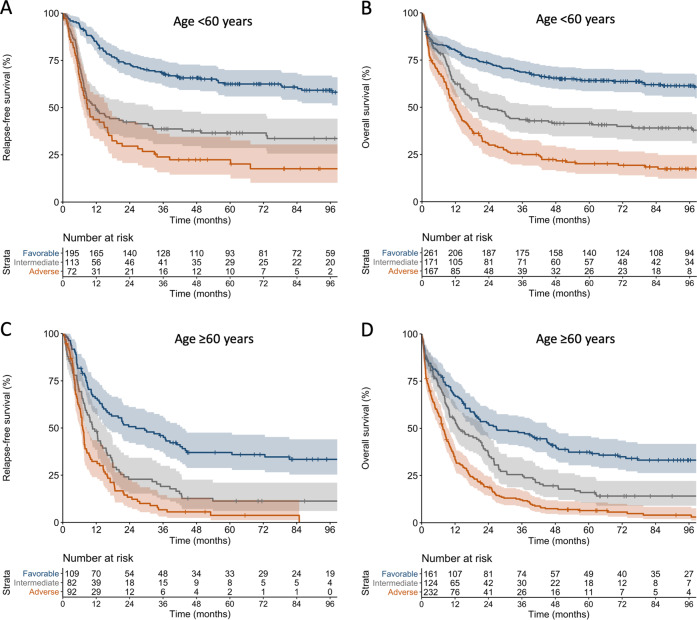
Fig. 3. Outcomes of patients according to the ELN-2017 genetic risk groups, stratified by age group.
a Relapse-free survival and b overall survival according to ELN-2017 categories in 599 patients aged <60 years. c Relapse-free survival and d overall survival according to ELN-2017 categories in 517 patients aged ≥60 years.
Fig. 4
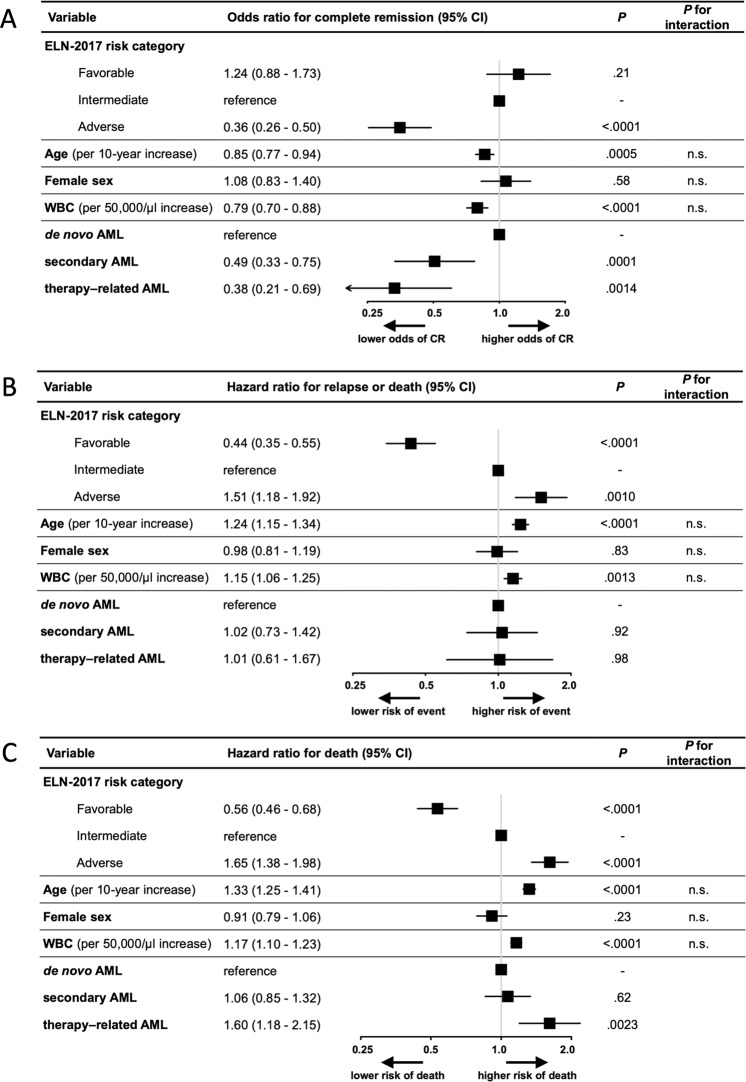
Fig. 4. Multivariable analyses of outcomes according to the ELN-2017 genetic risk groups and other pretreatment prognostic variables.
a Forrest plot showing odds ratios from a logistic regression model for achievement of complete remission. b Forrest plot showing hazard ratios from a Cox proportional hazards model for relapse-free survival. c Forrest plot showing hazard ratios from a Cox proportional hazards model for overall survival. Interaction P values refer to an interaction between the ELN-2017 risk groups and the respective variable. All multivariable models were stratified according to trial and induction therapy arm to account for potential differences in baseline risk between trials.
Fig. 5
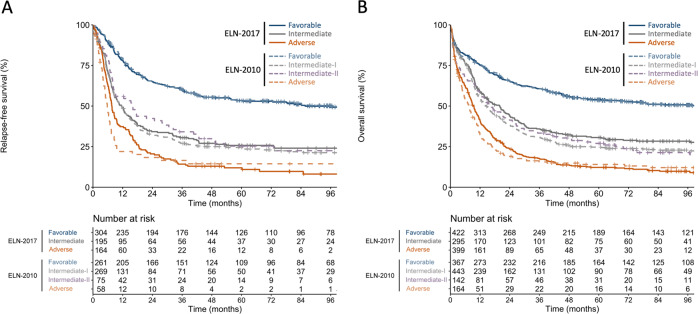
Fig. 5. Outcomes of risk categories defined by ELN-2017 guidelines (solid lines) in comparison to the ELN-2010 risk categories (dashed lines).
a Relapse-free survival and b overall survival.
Fig. 6
Fig. 6. Outcomes of patients according to the proposed refinement of the ELN-2017 genetic risk groups.
a Relapse-free survival and b overall survival in the entire cohort of 1116 patients (age range, 18–86 years).

References

    1. Döhner H, Estey EH, Amadori S, Appelbaum FR, Büchner T, Burnett AK, et al. Diagnosis and management of acute myeloid leukemia in adults: recommendations from an international expert panel, on behalf of the European LeukemiaNet. Blood. 2010;115:453–74. - PubMed
    1. Röllig C, Bornhäuser M, Thiede C, Taube F, Kramer M, Mohr B, et al. Long-term prognosis of acute myeloid leukemia according to the new genetic risk classification of the European LeukemiaNet recommendations: evaluation of the proposed reporting system. J Clin Oncol. 2011;29:2758–65. - PubMed
    1. Mrózek K, Marcucci G, Nicolet D, Maharry KS, Becker H, Whitman SP, et al. Prognostic significance of the European LeukemiaNet standardized system for reporting cytogenetic and molecular alterations in adults with acute myeloid leukemia. J Clin Oncol. 2012;30:4515–23. - PMC - PubMed
    1. Döhner H, Estey E, Grimwade D, Amadori S, Appelbaum FR, Büchner T, et al. Diagnosis and management of AML in adults: 2017 ELN recommendations from an international expert panel. Blood. 2017;129:424–47. - PMC - PubMed
    1. Boddu PC, Kadia TM, Garcia-Manero G, Cortes J, Alfayez M, Borthakur G, et al. Validation of the 2017 European LeukemiaNet classification for acute myeloid leukemia with NPM1and FLT3‐internal tandem duplication genotypes. Cancer. 2019;125:1091–1100. - PMC - PubMed

Publication types