


Both New and Chronic Potentially Inappropriate Medications Continued at Hospital Discharge Are Associated With Increased Risk of Adverse Events
- PMID: 32232988
- PMCID: PMC7687123
- DOI: 10.1111/jgs.16413
Both New and Chronic Potentially Inappropriate Medications Continued at Hospital Discharge Are Associated With Increased Risk of Adverse Events
Abstract
Background: Admission to hospital provides the opportunity to review patient medications; however, the extent to which the safety of drug regimens changes after hospitalization is unclear.
Objective: To estimate the number of potentially inappropriate medications (PIMs) prescribed to patients at hospital discharge and their association with the risk of adverse events 30 days after discharge.
Design: Prospective cohort study.
Setting: Tertiary care hospitals within the McGill University Health Centre Network in Montreal, Quebec, Canada.
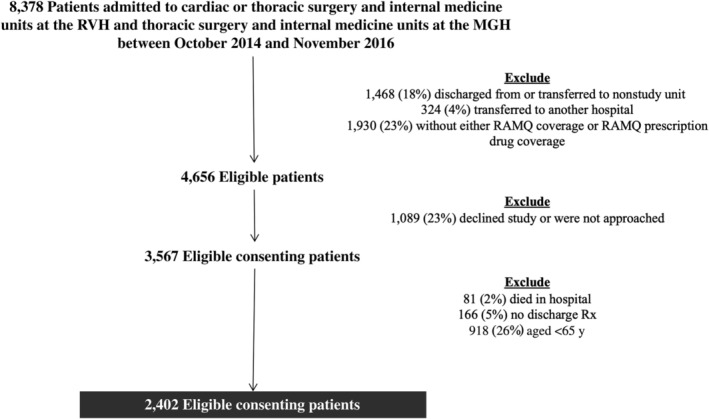
Participants: Patients from internal medicine, cardiac, and thoracic surgery, aged 65 years and older, admitted between October 2014 and November 2016.
Measures: Abstracted chart data were linked to provincial health databases. PIMs were identified using AGS (American Geriatrics Society) Beers Criteria®, STOPP, and Choosing Wisely statements. Multivariable logistic regression and Cox models were used to assess the association between PIMs and adverse events.
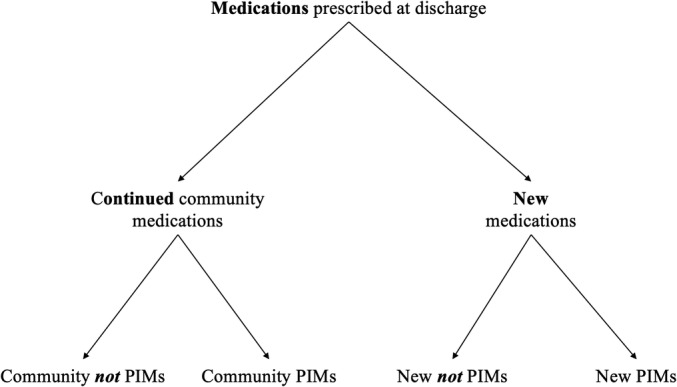
Results: Of 2,402 included patients, 1,381 (57%) were male; median age was 76 years (interquartile range [IQR] = 70-82 years); and eight discharge medications were prescribed (IQR = 2-8). A total of 1,576 (66%) patients were prescribed at least one PIM at discharge; 1,176 (49%) continued a PIM from prior to admission, and 755 (31%) were prescribed at least one new PIM. In the 30 days after discharge, 218 (9%) experienced an adverse drug event (ADE) and 862 (36%) visited the emergency department (ED), were rehospitalized, or died. After adjustment, each additional new PIM and continued community PIM were respectively associated with a 21% (odds ratio [OR] = 1.21; 95% confidence interval [CI] = 1.01-1.45) and a 10% (OR = 1.10; 95% CI = 1.01-1.21) increased odds of ADEs. They were also respectively associated with a 13% (hazard ratio [HR] = 1.13; 95% CI = 1.03-1.26) and a 5% (HR = 1.05; 95% CI = 1.00-1.10) increased risk of ED visits, rehospitalization, and death.
Conclusions: Two in three hospitalized patients were prescribed a PIM at discharge, and increasing numbers of PIMs were associated with an increased risk of ADEs and all-cause adverse events. Improving hospital prescribing practices may reduce the frequency of PIMs and associated adverse events. J Am Geriatr Soc 68:1184-1192, 2020.
Keywords: adverse drug events; hospital discharge; potentially inappropriate medications.
© 2020 The Authors. Journal of the American Geriatrics Society published by Wiley Periodicals, Inc. on behalf of The American Geriatrics Society.
Conflict of interest statement
Drs McDonald and Lee own the intellectual property rights to MedSafer in conjunction with McGill University.
Figures
Comment in
-
Less Really Is More in Inappropriate Medication Use in Older Adults: How Can We Improve Prescribing and Deprescribing in Older Adults?J Am Geriatr Soc. 2020 Jun;68(6):1175-1176. doi: 10.1111/jgs.16485. Epub 2020 May 4. J Am Geriatr Soc. 2020. PMID: 32364621 No abstract available.
References
-
- Rothberg MB, Pekow PS, Liu F, et al. Potentially inappropriate medication use in hospitalized elders. J Hosp Med. 2008;3:91‐102. - PubMed
-
- Poudel A, Peel NM, Nissen L, Mitchell C, Gray LC, Hubbard RE. Potentially inappropriate prescribing in older patients discharged from acute care hospitals to residential aged care facilities. Ann Pharmacother. 2014;48:1425‐1433. - PubMed
-
- Laroche M‐L, Charmes J‐P, Nouaille Y, Fourrier A, Merle L. Impact of hospitalisation in an acute medical geriatric unit on potentially inappropriate medication use. Drugs Aging. 2006;23:49‐59. - PubMed
Publication types
MeSH terms
Grants and funding
LinkOut - more resources
Full Text Sources
Medical
