


Characteristic Histopathological Findings and Cardiac Arrest Rhythm in Isolated Mitral Valve Prolapse and Sudden Cardiac Death
- PMID: 32233752
- PMCID: PMC7428599
- DOI: 10.1161/JAHA.119.015587
Characteristic Histopathological Findings and Cardiac Arrest Rhythm in Isolated Mitral Valve Prolapse and Sudden Cardiac Death
Abstract
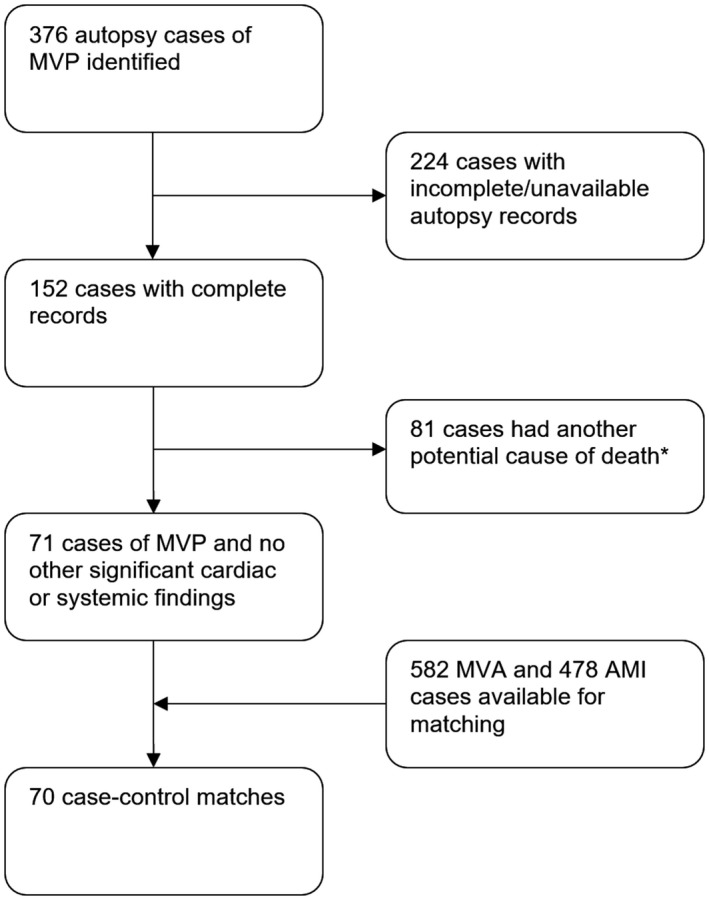
Background The association between mitral valve prolapse (MVP) and sudden death remains controversial. We aimed to describe histopathological changes in individuals with autopsy-determined isolated MVP (iMVP) and sudden death and document cardiac arrest rhythm. Methods and Results The Australian National Coronial Information System database was used to identify cases of iMVP between 2000 and 2018. Histopathological changes in iMVP and sudden death were compared with 2 control cohorts matched for age, sex, height, and weight (1 group with noncardiac death and 1 group with cardiac death). Data linkage with ambulance services provided cardiac arrest rhythm for iMVP cases. From 77 221 cardiovascular deaths in the National Coronial Information System database, there were 376 cases with MVP. Individual case review yielded 71 cases of iMVP. Mean age was 49±18 years, and 51% were women. Individuals with iMVP had higher cardiac mass (447 g versus 355 g; P<0.001) compared with noncardiac death, but similar cardiac mass (447 g versus 438 g; P=0.64) compared with cardiac death. Individuals with iMVP had larger mitral valve annulus compared with noncardiac death (121 versus 108 mm; P<0.001) and cardiac death (121 versus 110 mm; P=0.002), and more left ventricular fibrosis (79% versus 38%; P<0.001) compared with noncardiac death controls. In those with iMVP and witnessed cardiac arrest, 94% had ventricular fibrillation. Conclusions Individuals with iMVP and sudden death have increased cardiac mass, mitral annulus size, and left ventricular fibrosis compared with a matched cohort, with cardiac arrest caused by ventricular fibrillation. The histopathological changes in iMVP may provide the substrate necessary for development of malignant ventricular arrhythmias.
Keywords: sudden death; valvular heart disease; ventricular arrhythmia.
Figures


References
-
- Freed LA, Levy D, Levine RA, Larson MG, Evans JC, Fuller DL, Lehman B, Benjamin EJ. Prevalence and clinical outcome of mitral‐valve prolapse. N Engl J Med. 1999;341:1–7. - PubMed
-
- Nishimura RA, McGoon MD, Shub C, Miller FA Jr, Ilstrup DM, Tajik AJ. Echocardiographically documented mitral‐valve prolapse: long‐term follow‐up of 237 patients. N Engl J Med. 1985;313:1305–1309. - PubMed
-
- Hayek E, Gring CN, Griffin BP. Mitral valve prolapse. Lancet. 2005;365:507–518. - PubMed
-
- Sriram CS, Syed FF, Ferguson ME, Johnson JN, Enriquez‐Sarano M, Cetta F, Cannon BC, Asirvatham SJ, Ackerman MJ. Malignant bileaflet mitral valve prolapse syndrome in patients with otherwise idiopathic out‐of‐hospital cardiac arrest. J Am Coll Cardiol. 2013;62:222–230. - PubMed
-
- Basso C, Perazzolo Marra M, Rizzo S, De Lazzari M, Giorgi B, Cipriani A, Frigo AC, Rigato I, Migliore F, Pilichou K, et al. Arrhythmic mitral valve prolapse and sudden cardiac death. Circulation. 2015;132:556–566. - PubMed
Publication types
MeSH terms
LinkOut - more resources
Full Text Sources
Medical
Miscellaneous
