. 2020 May 1;123(5):1828-1837.
doi: 10.1152/jn.00527.2019. Epub 2020 Apr 1.

Light-evoked glutamate transporter EAAT5 activation coordinates with conventional feedback inhibition to control rod bipolar cell output

Affiliations

Light-evoked glutamate transporter EAAT5 activation coordinates with conventional feedback inhibition to control rod bipolar cell output

Gregory W Bligard et al. J Neurophysiol. .

Abstract

In the retina, modulation of the amplitude of dim visual signals primarily occurs at axon terminals of rod bipolar cells (RBCs). GABA and glycine inhibitory neurotransmitter receptors and the excitatory amino acid transporter 5 (EAAT5) modulate the RBC output. EAATs clear glutamate from the synapse, but they also have a glutamate-gated chloride conductance. EAAT5 acts primarily as an inhibitory glutamate-gated chloride channel. The relative role of visually evoked EAAT5 inhibition compared with GABA and glycine inhibition has not been addressed. In this study, we determine the contribution of EAAT5-mediated inhibition onto RBCs in response to light stimuli in mouse retinal slices. We find differences and similarities in the two forms of inhibition. Our results show that GABA and glycine mediate nearly all lateral inhibition onto RBCs, as EAAT5 is solely a mediator of RBC feedback inhibition. We also find that EAAT5 and conventional GABA inhibition both contribute to feedback inhibition at all stimulus intensities. Finally, our in silico modeling compares and contrasts EAAT5-mediated to GABA- and glycine-mediated feedback inhibition. Both forms of inhibition have a substantial impact on synaptic transmission to the postsynaptic AII amacrine cell. Our results suggest that the late phase EAAT5 inhibition acts with the early phase conventional, reciprocal GABA inhibition to modulate the rod signaling pathway between rod bipolar cells and their downstream synaptic targets.NEW & NOTEWORTHY Excitatory amino acid transporter 5 (EAAT5) glutamate transporters have a chloride channel that is strongly activated by glutamate, which modulates excitatory signaling. We found that EAAT5 is a major contributor to feedback inhibition on rod bipolar cells. Inhibition to rod bipolar cells is also mediated by GABA and glycine. GABA and glycine mediate the early phase of feedback inhibition, and EAAT5 mediates a more delayed inhibition. Together, inhibitory transmitters and EAAT5 coordinate to mediate feedback inhibition, controlling neuronal output.

Keywords: EAAT5; glucose transporter; retina; rod bipolar cell.


Figures
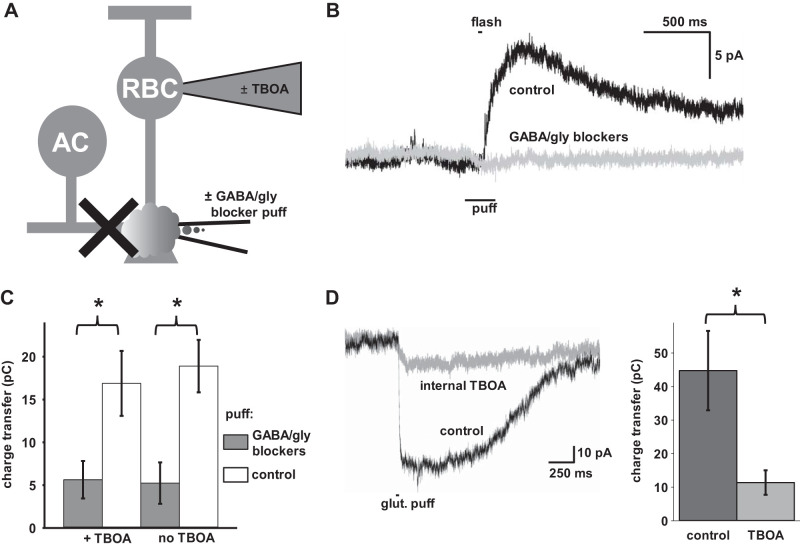
Fig. 1.
Fig. 1.
Intracellular and puff application of receptor antagonists. A: diagram illustrating experimental paradigm. Rod bipolar cells (RBCs) were recorded in the presence and absence of intracellular dl-threo-β-benzyloxyaspartic acid (TBOA) (3 mM) in the recording pipette, while a second puff pipette with extracellular solution with or without conventional inhibitor antagonists [250 µM bicuculline, 250 µM 1,2,5,6-tetrahydropyridin-4-yl)methylphosphinic acid hydrate (TPMPA), 5 µM strychnine] was targeted at the axon terminal. B: puff application of GABA/glycine blockers successfully blocks the light-evoked IPSC. An RBC was voltage clamped at 0 mV and a 30 ms flash of light (106 photon·µm−2·s−1) was given with a puff of blocker (gray) or vehicle (black) starting 100 ms before the onset and ending 100 ms after the offset of light. C: Puff application of GABA/glycine antagonists (dark bars) blocks light-evoked Inhibitory postsynaptic currents (IPSCs) compared with controls (white bars) while intracellular TBOA (left) has no significant effect compared with controls (right). RBCs were voltage clamped at 0 mV (n = 12 cells). D: intracellular application of TBOA blocks the response to glutamate. RBCs with (gray) and without (black) intracellular TBOA were voltage clamped at −60 mV with ECl = 0 and 5 µM 6-cyano-7-nitroquinoxaline-2,3-dione disodium salt hydrate (CNQX) and 50 µM d-AP5 bath-applied to block N-methyl-d-aspartic acid (NMDA) and α-amino-3-hydroxy-5-methylisoxazole-4-propionic acid (AMPA) receptors, then subjected to a brief 2.5 mM glutamate puff. Left: 2 example traces. Right: charge transfer for each category. (n = 8 cells). Error bars indicate means ± SE. *P < 0.05.
Fig. 2.
Fig. 2.
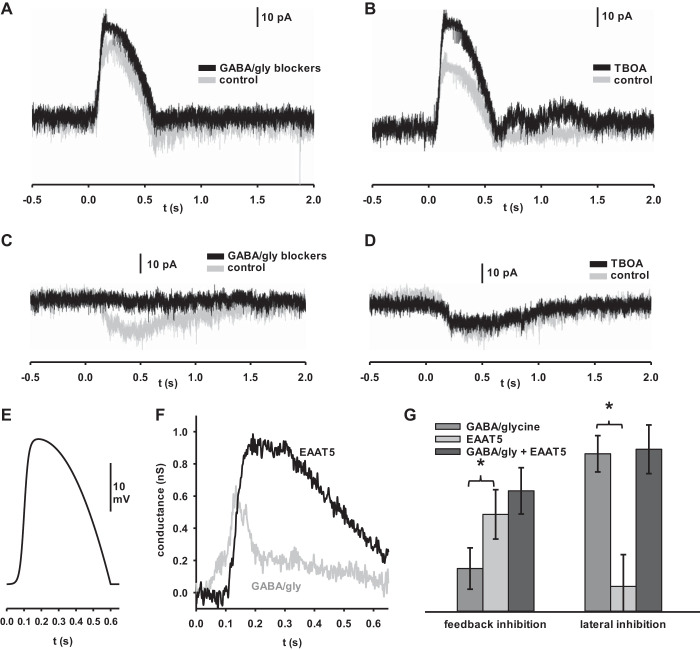
Excitatory amino acid transporter 5 (EAAT5) is the primary mediator of feedback inhibition in rod bipolar cells (RBCs) at ECl = 0 mV. A: RBC stimulated from a baseline of −60 mV with the voltage pulse pictured in Fig. 2E without (gray) and with (black) 2 s puff application of GABA/gly blockers. GABA/gly blockers elicited a small but measurable difference that could be attributed to feedback from conventional inhibitory sources. B: RBC stimulated from a baseline of −60 mV with the voltage pulse pictured in Fig. 2E without (gray) and with (black) extracellular application of dl-threo-β-benzyloxyaspartic acid (TBOA). TBOA elicited a larger difference that could be attributed to feedback inhibition from EAAT5. C: RBC held at −60 mV and flashed for 100 ms at 105 photon·µm−2·s−1 without (gray) and with (black) 2 s puff application of GABA/gly blockers. GABA/gly blockers showed a substantial blunting of the light response that could be attributed to lateral inhibition from conventional sources. D: RBCs held at −60 mV and flashed for 100 ms at 105 photon·µm−2·s−1 without (gray) and with (black) TBOA in the intracellular media. Very little difference between traces suggests that EAAT5 plays little role in lateral inhibition. E: voltage pulse input modeled to mimic the excitatory profile of an RBC in response to the light stimuli used here (Euler and Masland 2000). F: kinetics of conventional and EAAT5 inhibition. Control traces were subtracted from blocker traces for the experiments depicted in A and B, and then, each data point was divided by the holding potential at the moment it was recorded to calculate the inhibitory conductance. The inhibition masked by GABA and glycine blockers is shown in gray (GABA/gly), while the inhibition masked by TBOA is shown in black (EAAT5). Traces are averages (n = 24 cells). Overall, EAAT5 contributed more to feedback inhibition than GABA and glycine receptors, but GABA- and glycine-mediated feedback inhibition had a more rapid onset and peak than EAAT5-mediated feedb A and B ack inhibition. G, left: summary data for feedback inhibition experiments depicted in A and B. Data represent the difference in charge transfer between 2 comparitor conditions in individual cells. GABA/glycine- and EAAT5-mediated feedback were significantly different from each other and were also each significantly different from zero. (n = 24 cells). G, right: summary data for lateral inhibition experiments depicted in C and D. Data represent the difference in charge transfer between populations of cells. GABA/glycine mediated lateral inhibition was significantly different from both EAAT5-mediated lateral inhibition and from zero. EAAT5-mediated lateral inhibition was not significantly different from 0 (n = 10 cells) Error bars indicate SE. *P < 0.05.
Fig. 3.
Fig. 3.
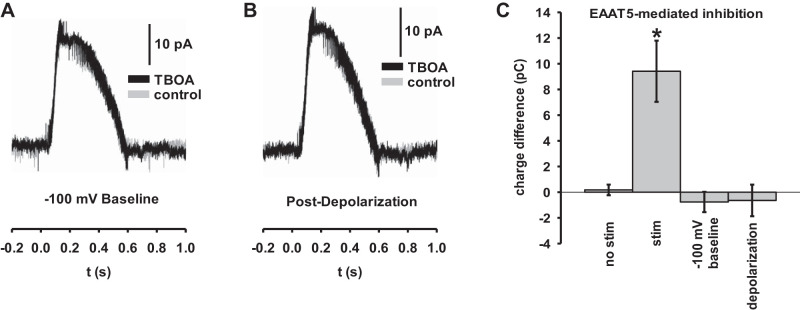
Excitatory amino acid transporter 5 (EAAT5)-mediated feedback inhibition is dependent on synaptic activation and glutamate release. A: rod bipolar cells (RBCs) stimulated from a baseline of −100 mV with the same voltage pulse as above, without (gray) and with (black) extracellular application of dl-threo-β-benzyloxyaspartic acid (TBOA). A lack of TBOA-sensitivity confirms that the feedback inhibition attributed to EAAT5 is dependent on synaptic activation. B: RBCs stimulated from a baseline of −60 mV with the same voltage pulse as above immediately following depolarization to −30 mV for 60 s. Lack of TBOA-sensitivity confirms that EAAT5-mediated feedback is dependent on vesicle release. C: summary data representing the difference in charge transfer between two comparitor conditions in individual cells. No stim indicates a cell held at −60 mV without applying a voltage stimulus. Stim, −100 mV baseline, and depolarization indicate experiments depicted in Fig. 2C and here in A and B, respectively. (n = 24 cells). Error bars indicate SE. *P < 0.05.
Fig. 4.
Fig. 4.
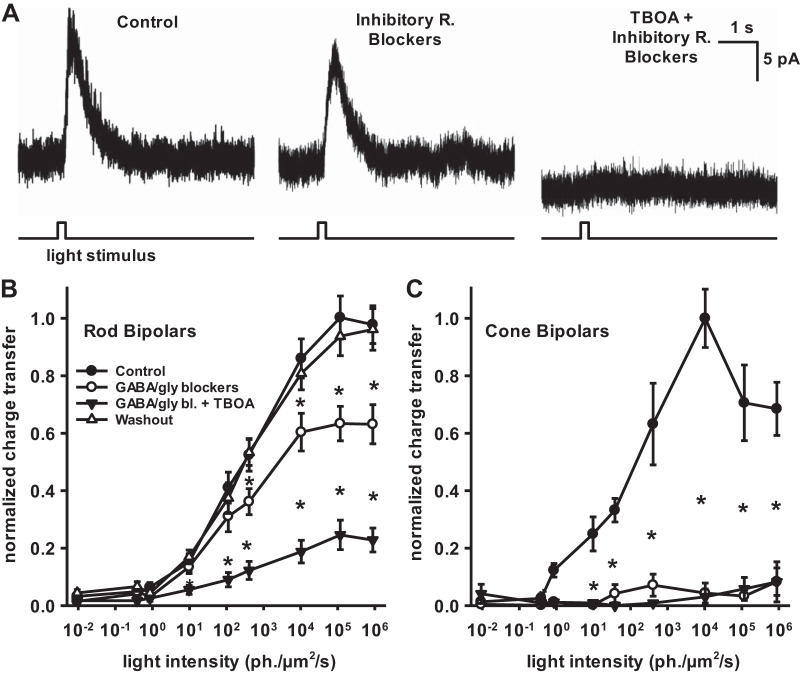
The mode of light-evoked inhibition to rod bipolar cells does not depend on light intensity. Inhibitory postsynaptic currents (IPSCs) evoked by a brief (200 ms) flash of light from bipolar cells voltage clamped at 0 mV and bath-applied inhibitory receptor antagonists. A: example rod bipolar cell (RBC) IPSCs evoked by a dim flash of light (400 photon·µm−2·s−1) from a black background were blocked very little by a mixture of GABA and glycine (gly) blockers [50 µM bicuculline, 50 µM 1,2,5,6-tetrahydropyridin-4-yl)methylphosphinic acid hydrate (TPMPA), and 1 µM strychnine]. Subsequent addition of the EAAT antagonist dl-threo-β-benzyloxyaspartic acid (TBOA) (50 µM) blocked the current. B: normalized inhibitory response by light intensity for RBCs. All stimuli were presented in the context of a zero-light background. Conventional inhibitory receptor blockers (open circles) decreased inhibition at brighter light intensities compared with controls (filled circles), but TBOA (filled triangles) caused a larger reduction in inhibition that was significant at all light intensities above 10 photon·µm−2·s−1 (n = 43 cells). C: normalized inhibitory response by light intensity for ON cone bipolar cells. Conventional inhibitory receptor blockers alone (open circles) completely ablated the inhibitory response compared with controls (filled circles) (n = 4 cells) Error bars indicate SE. *P < 0.05.
Fig. 5.
Fig. 5.
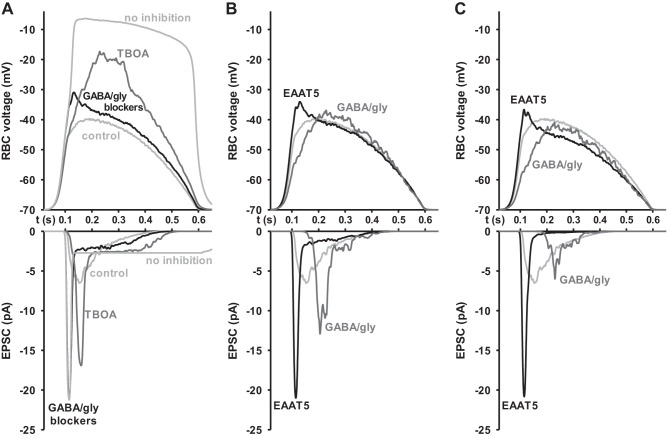
In silico model of the rod bipolar cell (RBC)-AII amacrine synapse. Readily-releasable pool of 7 vesicles. A: a virtual RBC was stimulated with an excitatory conductance in the presence or absence of each category of inhibitory conductance recorded from real cells. Top, the rod bipolar voltage response. In the absence of conventional feedback inhibition (“GABA/gly blockers”), the absence of excitatory amino acid transporter 5 (EAAT5) inhibition [dl-threo-β-benzyloxyaspartic acid (“TBOA”)], or the absence of any inhibition (“no inhibition”), the cell depolarizes excessively in response to a fixed excitatory conductance. In the presence of both forms of inhibition (“control”), the cell elicits a moderate voltage response. Bottom: the excitatory postsynaptic current (EPSC) of the downstream AII amacrine cell. In the presence of both forms of inhibition (“control”), the AII receives a moderate unsaturated transient current without a sustained phase. In the absence of conventional feedback inhibition (“GABA/gly blockers”), a rapid peak response becomes immediately saturated. In the absence of EAAT5 inhibition (“TBOA”), the peak response is also too large, and is followed by an abnormal plateau phase. B: the same virtual RBC, except that inhibition has been scaled up in amplitude. Each trace maintains the same total inhibitory conductance as the control, but the kinetics are purely one form of inhibition or the other. Control data shown in light gray. Top, the rod bipolar voltage response. When presynaptic feedback is mediated entirely by conventional receptors (“GABA/gly”), peak excitation of the RBC is shifted slightly later. When mediated entirely by EAAT5 (“EAAT5”), excitation is shifted earlier. In both cases the voltage reaches a slightly higher peak. Bottom: the AII amacrine cell EPSC. The timing of the peak AII excitation matches the peak voltage for each condition, but in both cases the amplitude of excitation is substantially increased from baseline. C: same as in B, but with each form of inhibitory conductance scaled up an additional 50%. At this level, conventional inhibition alone (GABA/gly) has finally been scaled up enough to dampen the peak of the EPSC, resulting in a delayed but unsaturated positive signal. EAAT5 alone is still inadequate to regulate the initial onset of the signal.

References

    1. Arriza JL, Eliasof S, Kavanaugh MP, Amara SG. Excitatory amino acid transporter 5, a retinal glutamate transporter coupled to a chloride conductance. Proc Natl Acad Sci USA 94: 4155–4160, 1997. doi: 10.1073/pnas.94.8.4155. - DOI - PMC - PubMed
    1. Bloomfield SA, Dacheux RF. Rod vision: pathways and processing in the mammalian retina. Prog Retin Eye Res 20: 351–384, 2001. doi: 10.1016/S1350-9462(00)00031-8. - DOI - PubMed
    1. Chávez AE, Grimes WN, Diamond JS. Mechanisms underlying lateral GABAergic feedback onto rod bipolar cells in rat retina. J Neurosci 30: 2330–2339, 2010. doi: 10.1523/JNEUROSCI.5574-09.2010. - DOI - PMC - PubMed
    1. Chávez AE, Singer JH, Diamond JS. Fast neurotransmitter release triggered by Ca influx through AMPA-type glutamate receptors. Nature 443: 705–708, 2006. doi: 10.1038/nature05123. - DOI - PubMed
    1. Cook PB, Lukasiewicz PD, McReynolds JS. Action potentials are required for the lateral transmission of glycinergic transient inhibition in the amphibian retina. J Neurosci 18: 2301–2308, 1998. doi: 10.1523/JNEUROSCI.18-06-02301.1998. - DOI - PMC - PubMed

Publication types