Review
. 2020 Mar 29;25(7):1567.
doi: 10.3390/molecules25071567.

Terpenoids, Cannabimimetic Ligands, beyond the Cannabis Plant

Affiliations
Review

Terpenoids, Cannabimimetic Ligands, beyond the Cannabis Plant

Elaine C D Gonçalves et al. Molecules. .

Abstract

Medicinal use of Cannabis sativa L. has an extensive history and it was essential in the discovery of phytocannabinoids, including the Cannabis major psychoactive compound-Δ9-tetrahydrocannabinol (Δ9-THC)-as well as the G-protein-coupled cannabinoid receptors (CBR), named cannabinoid receptor type-1 (CB1R) and cannabinoid receptor type-2 (CB2R), both part of the now known endocannabinoid system (ECS). Cannabinoids is a vast term that defines several compounds that have been characterized in three categories: (i) endogenous, (ii) synthetic, and (iii) phytocannabinoids, and are able to modulate the CBR and ECS. Particularly, phytocannabinoids are natural terpenoids or phenolic compounds derived from Cannabis sativa. However, these terpenoids and phenolic compounds can also be derived from other plants (non-cannabinoids) and still induce cannabinoid-like properties. Cannabimimetic ligands, beyond the Cannabis plant, can act as CBR agonists or antagonists, or ECS enzyme inhibitors, besides being able of playing a role in immune-mediated inflammatory and infectious diseases, neuroinflammatory, neurological, and neurodegenerative diseases, as well as in cancer, and autoimmunity by itself. In this review, we summarize and critically highlight past, present, and future progress on the understanding of the role of cannabinoid-like molecules, mainly terpenes, as prospective therapeutics for different pathological conditions.

Keywords: Cannabis plant; cannabinoid receptors; endocannabinoids; inflammation.; phytocannabinoid; terpenoids.


Conflict of interest statement

The authors declare no conflict of interest.

Figures
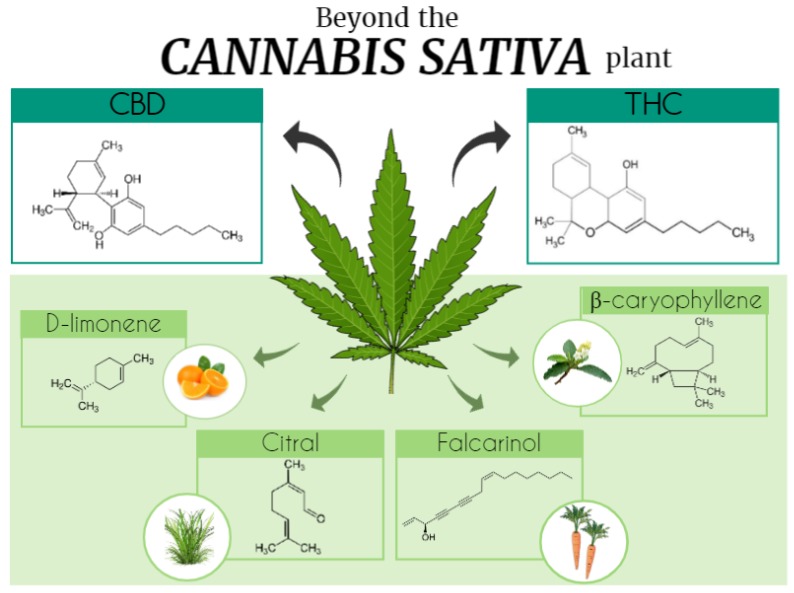
Figure 1
Figure 1
Beyond the Cannabis sativa plant. The Era of cannabinoids started with the description and isolation of the main Cannabis sativa psychoactive component, Δ9-tetrahydrocannabinol (THC). However, many other natural compounds were also identified, totalizing 565 substances among cannabinoids and non-cannabinoids constituents. This figure illustrates some of the Cannabis sativa compounds (d-limonene, β-caryophyllene, citral, and falcarinol) and its molecular structures that can be also found in other plants, such as Cordia verbenacea, lemon, Cymbopogon citratus, and carrot. CBD, cannabidiol. Figure created using the Mind the Graph platform.
Figure 2
Figure 2
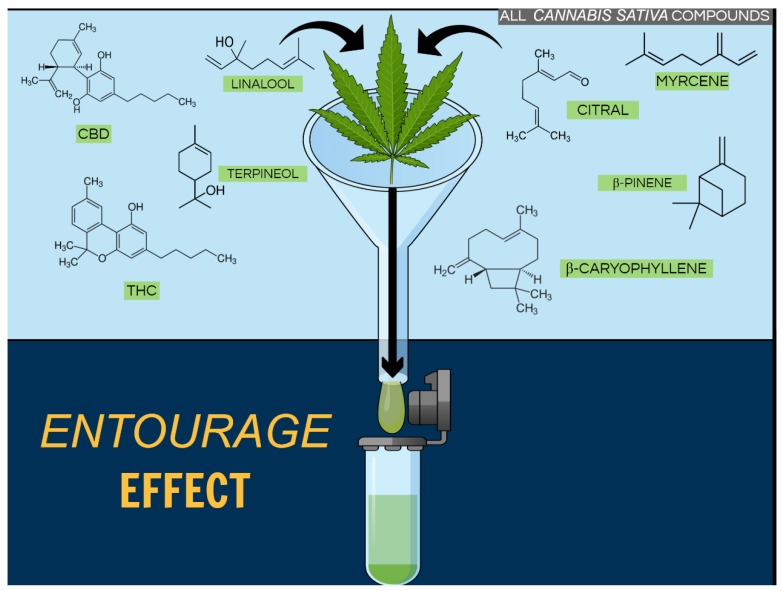
Entourage effect. Beyond the Δ9- tetrahydrocannabinol (Δ9-THC) and cannabidiol (CBD), there are many compounds present in Cannabis sativa, including terpenoids (such as linalool, terpineol, and citral), which could contribute to beneficial effects related to this plant. However, the underlying mechanism of these medicinal effects is largely unknown when molecules are associated. Figure created using the Mind the Graph platform.
Figure 3
Figure 3
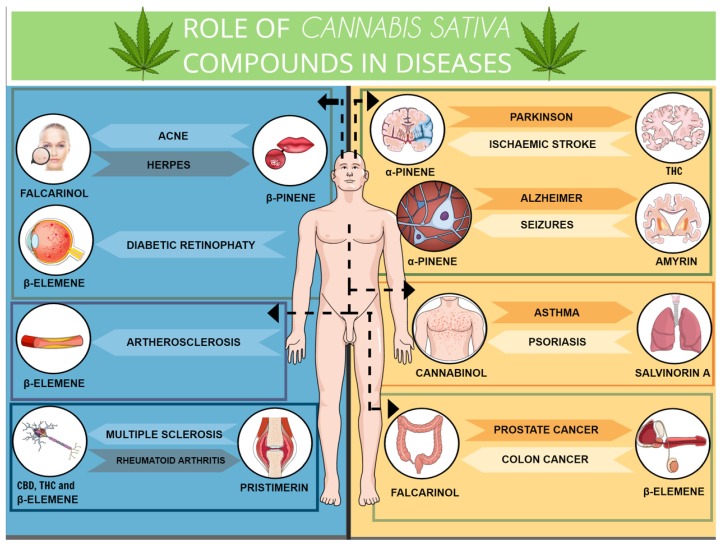
Role of Cannabis sativa compounds in diseases. The Cannabis sativa compounds have been proved useful for treatment of different diseases in the periphery and the CNS, as illustrated above. The CBD and THC actions in the CNS include immunomodulatory, neuroprotective, anxiolytic, and anticonvulsant, in addition to its potential effects on PD and multiple sclerosis control. Anticancer effects can be attributed to almost all Cannabis sativa compounds. This figure further illustrates the effect of terpenoids, cannabimimetic ligands, beyond the Cannabis plant in different pathological conditions, such as Herpes infection, diabetic retinopathy, psoriasis, asthma, AD, seizures, ischemic stroke, and others. Figure created using the Mind the Graph platform.

References

    1. Di Marzo V., Bifulco M., De Petrocellis L. The endocannabinoid system and its therapeutic exploitation. Nat. Reviews. Drug Discov. 2004;3:771–784. doi: 10.1038/nrd1495. - DOI - PubMed
    1. Rubin V. Cannabis and Culture. Mouton; The Hague, The Netherlands: 1975.
    1. Guy G.W., Whittle B.A., Robson P. The Medicinal Uses of Cannabis and Cannabinoids. Pharmaceutical Press; London, UK: 2004.
    1. Pacher P., Batkai S., Kunos G. The endocannabinoid system as an emerging target of pharmacotherapy. Pharmacol. Rev. 2006;58:389–462. doi: 10.1124/pr.58.3.2. - DOI - PMC - PubMed
    1. Russell C., Rueda S., Room R., Tyndall M., Fischer B. Routes of administration for cannabis use—Basic prevalence and related health outcomes: A scoping review and synthesis. Int. J. Drug Policy. 2018;52:87–96. doi: 10.1016/j.drugpo.2017.11.008. - DOI - PubMed

MeSH terms