Review
. 2020 Mar 29;12(4):824.
doi: 10.3390/cancers12040824.

Chromosome Instability; Implications in Cancer Development, Progression, and Clinical Outcomes

Affiliations
Review

Chromosome Instability; Implications in Cancer Development, Progression, and Clinical Outcomes

Raghvendra Vishwakarma et al. Cancers (Basel). .

Abstract

Chromosome instability (CIN) refers to an ongoing rate of chromosomal changes and is a driver of genetic, cell-to-cell heterogeneity. It is an aberrant phenotype that is intimately associated with cancer development and progression. The presence, extent, and level of CIN has tremendous implications for the clinical management and outcomes of those living with cancer. Despite its relevance in cancer, there is still extensive misuse of the term CIN, and this has adversely impacted our ability to identify and characterize the molecular determinants of CIN. Though several decades of genetic research have provided insight into CIN, the molecular determinants remain largely unknown, which severely limits its clinical potential. In this review, we provide a definition of CIN, describe the two main types, and discuss how it differs from aneuploidy. We subsequently detail its impact on cancer development and progression, and describe how it influences metastatic potential with reference to cancer prognosis and outcomes. Finally, we end with a discussion of how CIN induces genetic heterogeneity to influence the use and efficacy of several precision medicine strategies, including patient and risk stratification, as well as its impact on the acquisition of drug resistance and disease recurrence.

Keywords: aneuploidy; cancer; chemoresistance; chromosome instability; clinical outcome; genome instability; metastasis; prognosis; therapeutic targeting; tumor heterogeneity.


Conflict of interest statement

The authors declare no conflict of interest. The funders had no role in the writing of the manuscript, or in the decision to publish.

Figures
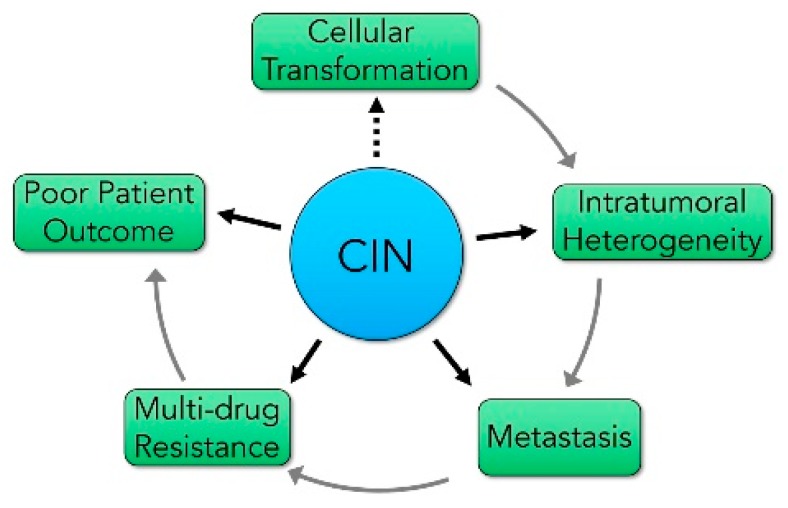
Figure 1
Figure 1
The impact of chromosome instability (CIN) on key features of cancer development, progression, and outcomes. A schematic depicting the central impact CIN has on early tumorigenic events (cellular transformation), tumor evolution (intratumoral heterogeneity), disease progression (metastasis), and the development of chemoresistance (multi-drug resistance), all of which are often associated with poor patient outcomes. Dotted lines identify proposed relationships, while solid lines identify established relationships.
Figure 2
Figure 2
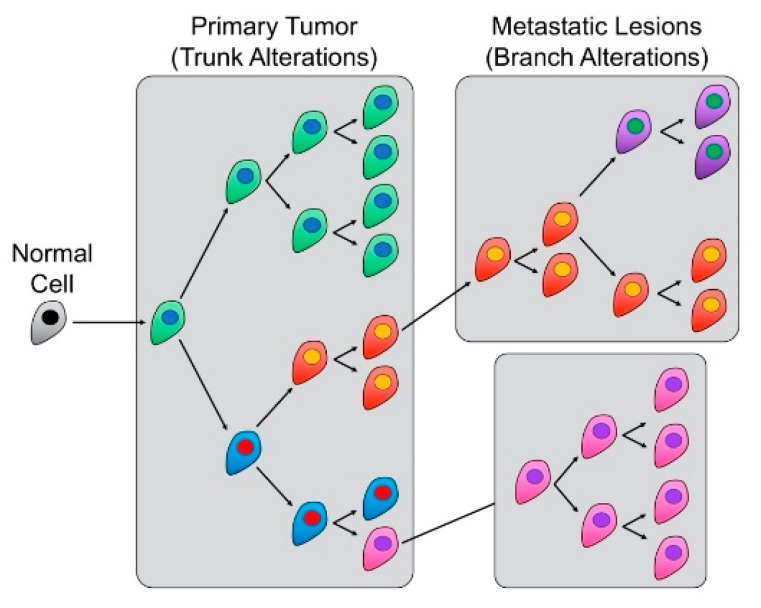
CIN drives trunk and branch alterations to contribute to tumor evolution and metastasis. Illustration showing the tree-like ‘trunk’ and ‘branch’ alterations driven by CIN. In general, trunk alterations are early events that are conserved in all subsequent cellular progeny, whereas branch alterations are subsequent genetic alterations that direct clonal evolution and intratumoral heterogeneity to drive disease progression, metastasis, and drug resistance. Note that the color changes coincide with cells that have accrued additional genetic alterations (e.g., CIN).
Figure 3
Figure 3
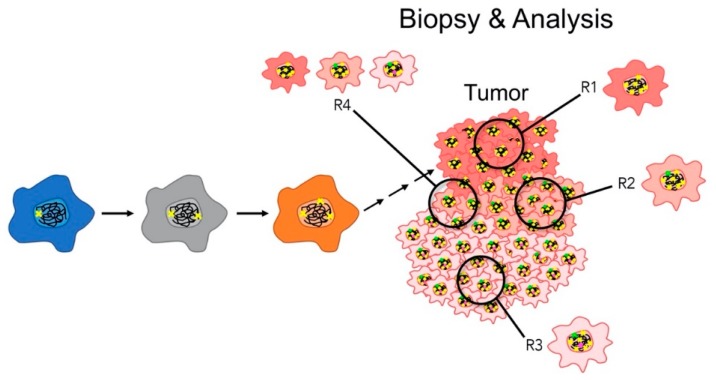
Impact of CIN on regional biopsies and subsequent analyses. A schematic showing how CIN (represented by arrows) induces genetic diversity (colored ‘x’) within a given tumor (represented by color changes). Note that the ability to glean tumor-specific insight (trunk versus branch alterations) into the aberrant genetics driving tumor development and progression is impacted by regional sampling and the composition and clonality of the tumor cells contained within the biopsied region. Single region bias is demonstrated by the four distinct regions (R1–4), which exhibit variation in both the type of clones identified (R1–3) and in the composition (presence and frequency) of the clones (R4) contained within a given biopsy.

References

    1. Nowell P.C. Discovery of the Philadelphia chromosome: A personal perspective. J. Clin. Investig. 2007;117:2033–2035. doi: 10.1172/JCI31771. - DOI - PMC - PubMed
    1. Rowley J.D. Letter: A new consistent chromosomal abnormality in chronic myelogenous leukaemia identified by quinacrine fluorescence and Giemsa staining. Nature. 1973;243:290–293. doi: 10.1038/243290a0. - DOI - PubMed
    1. Cancer Genome Atlas Research Network. Weinstein J.N., Collisson E.A., Mills G.B., Shaw K.R., Ozenberger B.A., Ellrott K., Shmulevich I., Sander C., Stuart J.M. The Cancer Genome Atlas Pan-Cancer analysis project. Nat. Genet. 2013;45:1113–1120. doi: 10.1038/ng.2764. - DOI - PMC - PubMed
    1. The ICGC/TCGA Pan-Cancer Analysis of Whole Genomes Consortium Pan-cancer analysis of whole genomes. Nature. 2020;578:82–93. doi: 10.1038/s41586-020-1969-6. - DOI - PMC - PubMed
    1. Comings D.E. A general theory of carcinogenesis. Proc. Natl. Acad. Sci. USA. 1973;70:3324–3328. doi: 10.1073/pnas.70.12.3324. - DOI - PMC - PubMed

LinkOut - more resources