. 2020 Mar 30;12(4):950.
doi: 10.3390/nu12040950.

Biochemical and Hematological Correlates of Elevated Homocysteine in National Surveys and a Longitudinal Study of Urban Adults

Affiliations

Biochemical and Hematological Correlates of Elevated Homocysteine in National Surveys and a Longitudinal Study of Urban Adults

May A Beydoun et al. Nutrients. .

Abstract

Elevated blood homocysteine (Hcy) among middle-aged adults can increase age-related disease risk, possibly through other biochemical and hematological markers. We selected markers for hyperhomocysteinemia among middle-aged adults, studied time-dependent Hcy-marker associations and computed highly predictive indices of hyperhomocysteinemia, with cross-sectional and longitudinal validations. We used data from the National Health and Nutrition Examination Survey (NHANES III, phase 2, nmax = 4000), the NHANES 1999-2006 (nmax = 10,151) and pooled NHANES (cross-sectional validation). Longitudinal validation consisted of mixed-effects linear regression models (Hcy predicting markers' annual rates of change), applied to the Healthy Aging in Neighborhoods of Diversity Across the Life Span (HANDLS, n = 227-244 participants, k = 2.4 repeats/participant, Agebase: 30-65 years) data. Machine learning detected nine independent markers for Hcy > 14 µmol/L (NHANES III, phase 2): older age; lower folate and B-12 status; higher serum levels of creatinine, uric acid, alkaline phosphatase, and cotinine; mean cell hemoglobin and red cell distribution widths (RDW); results replicated in the 1999-2006 NHANES [AUC = 0.60-0.80]. Indices combining binary markers increased elevated Hcy odds by 6.9-7.5-fold. In HANDLS, first-visit Hcy predicted annual increase in creatinine, RDW and alkaline phosphatase, with third-visit index (2013-2018) directly predicting Hcy (2004-2009). We provide evidence of the internal and external validity of indices composed of several biomarkers that are strongly associated with elevated Hcy.

Keywords: aging; biochemical indices; hematological indices; homocysteine; inflammation; predictive models.


Conflict of interest statement

The authors declare no conflict of interest.

Figures
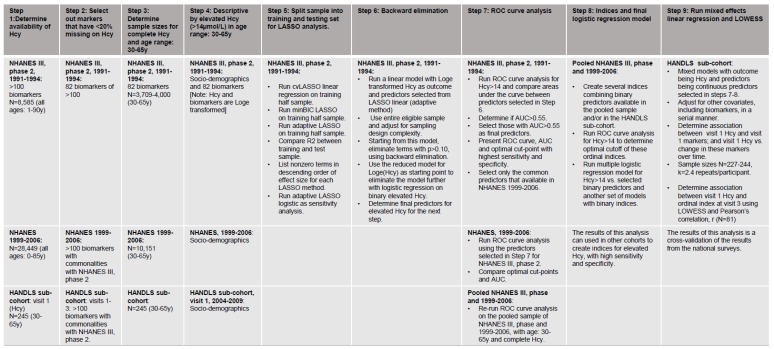
Figure 1
Figure 1
Flow diagram of predictive modeling using LASSO, ROC curves and multivariable regression modeling. Abbreviations: cvLASSO = cross-validation LASSO; LASSO = least absolute shrinkage and selection operator; LOWESS = Locally weighted regression; HANDLS = Healthy Aging in Neighborhoods of Diversity Across the Life Span; minBIC LASSO = minimum Bayesian information criterion LASSO; NHANES = National Health and Nutrition Examination Surveys; R2 = coefficient of determination.
Figure 2
Figure 2
Nine-marker index (Index I) and its predictive value of elevated Hcy: ROC curves for pooled NHANES 1. 1 n = 13,822; optimal cut-point was at 5; AUC = 0.799, 95% CI: 0.785,0.814. Index I included binary biomarkers of elevated Hcy selected using LASSO and backward elimination. The full list of the nine components of Index I are: Age, serum folate, serum vitamin B-12, serum creatinine, red cell distribution width, mean cell hemoglobin, serum cotinine, serum uric acid and alkaline phosphatase. Cut-points for individual components are: serum folate, Loge, in nmol/L, <2.83; serum creatinine, Loge, in µmol/L ≥4.481; older age, in years, ≥49; serum vitamin B-12, Loge, in pmol/L, <5.74; mean cell hemoglobin, Loge, in pg, ≥3.422; red cell distribution width, Loge, in %, ≥2.553; serum uric acid, Loge, in µmol/L, ≥5.826; serum alkaline phosphatase, Loge, in µmol/L, ≥4.356 U/L; serum cotinine, Loge, in ng/mL, −0.579.
Figure 3
Figure 3
Eight-marker index (Index II) and its predictive value of elevated Hcy: pooled NHANES 1. 1 n = 13,920; optimal cut-point at 5; AUC = 0.798; 95% CI: 0.783,0.812. The index consisted of a summation of all binary Index I biomarkers (See Figure 2 footnotes for cut-points), excluding blood cotinine, which was not available in HANDLS.
Figure 4
Figure 4
Lowess smoother of total Visit 1 homocysteine vs. Visit 3 Index II (r = 0.34, n = 81): HANDLS 2004–2009 (Hcy) and 2013–2018 (Index II) 1. Abbreviations: HANDLS = Healthy Aging in Neighborhoods of Diversity Across the Life Span: Hcy = Homocysteine; NHANES = National Health and Nutrition Examination Surveys; ROC = Receiver Operating Characteristics analysis. 1 Blood total Hcy, in µmol/L, is Loge-transformed and uncategorized. Index II was computed using cut-points obtained from the pooled NHANES ROC analysis. See Table 2 footnotes for details. Index II may range from 0 to 8, and no cut-point was used in this analysis.

References

    1. Selhub J. Public health significance of elevated homocysteine. Food Nutr. Bull. 2008;29:S116–S125. doi: 10.1177/15648265080292S116. - DOI - PubMed
    1. Seshadri S., Beiser A., Selhub J., Jacques P.F., Rosenberg I.H., D’Agostino R.B., Wilson P.W., Wolf P.A. Plasma homocysteine as a risk factor for dementia and Alzheimer’s disease. N. Engl. J. Med. 2002;346:476–483. doi: 10.1056/NEJMoa011613. - DOI - PubMed
    1. Clarke R., Smith A.D., Jobst K.A., Refsum H., Sutton L., Ueland P.M. Folate, vitamin B12, and serum total homocysteine levels in confirmed Alzheimer disease. Arch. Neurol. 1998;55:1449–1455. doi: 10.1001/archneur.55.11.1449. - DOI - PubMed
    1. Beydoun M.A., Beydoun H.A., Gamaldo A.A., Teel A., Zonderman A.B., Wang Y. Epidemiologic studies of modifiable factors associated with cognition and dementia: Systematic review and meta-analysis. BMC Public Health. 2014;14:643. doi: 10.1186/1471-2458-14-643. - DOI - PMC - PubMed
    1. Selhub J., Jacques P.F., Rosenberg I.H., Rogers G., Bowman B.A., Gunter E.W., Wright J.D., Johnson C.L. Serum total homocysteine concentrations in the third National Health and Nutrition Examination Survey (1991–1994): Population reference ranges and contribution of vitamin status to high serum concentrations. Ann. Intern. Med. 1999;131:331–339. doi: 10.7326/0003-4819-131-5-199909070-00003. - DOI - PubMed

MeSH terms

LinkOut - more resources
