Review
. 2020 Mar 30;9(4):829.
doi: 10.3390/cells9040829.

Vγ9Vδ2 T Cells: Can We Re-Purpose a Potent Anti-Infection Mechanism for Cancer Therapy?

Affiliations
Review

Vγ9Vδ2 T Cells: Can We Re-Purpose a Potent Anti-Infection Mechanism for Cancer Therapy?

Klaus-Peter Künkele et al. Cells. .

Abstract

Cancer therapies based on in vivo stimulation, or on adoptive T cell transfer of Vγ9Vδ2 T cells, have been tested in the past decades but have failed to provide consistent clinical efficacy. New, promising concepts such as γδ Chimeric Antigen Receptor (CAR) -T cells and γδ T-cell engagers are currently under preclinical evaluation. Since the impact of factors, such as the relatively low abundance of γδ T cells within tumor tissue is still under investigation, it remains to be shown whether these effector T cells can provide significant efficacy against solid tumors. Here, we highlight key learnings from the natural role of Vγ9Vδ2 T cells in the elimination of host cells bearing intracellular bacterial agents and we translate these into the setting of tumor therapy. We discuss the availability and relevance of preclinical models as well as currently available tools and knowledge from a drug development perspective. Finally, we compare advantages and disadvantages of existing therapeutic concepts and propose a role for Vγ9Vδ2 T cells in immune-oncology next to Cluster of Differentiation (CD) 3 activating therapies.

Keywords: BTN3A; Vγ9Vδ2 T cells; cancer; drug development; gamma delta T cells; immuno-oncology; infection; phoshorylated antigens.


Conflict of interest statement

The authors declare no competing financial interests.

Figures
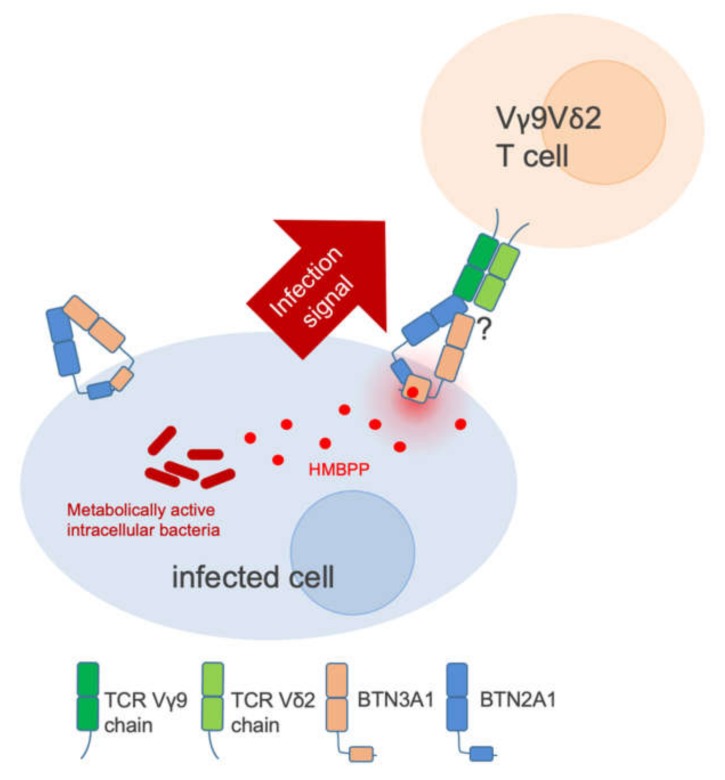
Figure 1
Figure 1
Butyrophilin 3 family member A1 (BTN3A1) is a pathogen-associated molecular pattern (PAMP) receptor. HMBPP from metabolically active bacteria, leaks into the cytoplasm where it is detected by the intracellular B30.2 domain of BTN3A1, triggering a conformational change within the protein. Thereby, the intracellular infection signal is transmitted through the plasma membrane to the surface, where BTN3A1 is constitutively associated with the Butyrophilin family member BTN2A1. Together they form an immunological synapse in which BTN2A1 interacts with the Vγ9 chain of the Vγ9Vδ2 TCR.
Figure 2
Figure 2
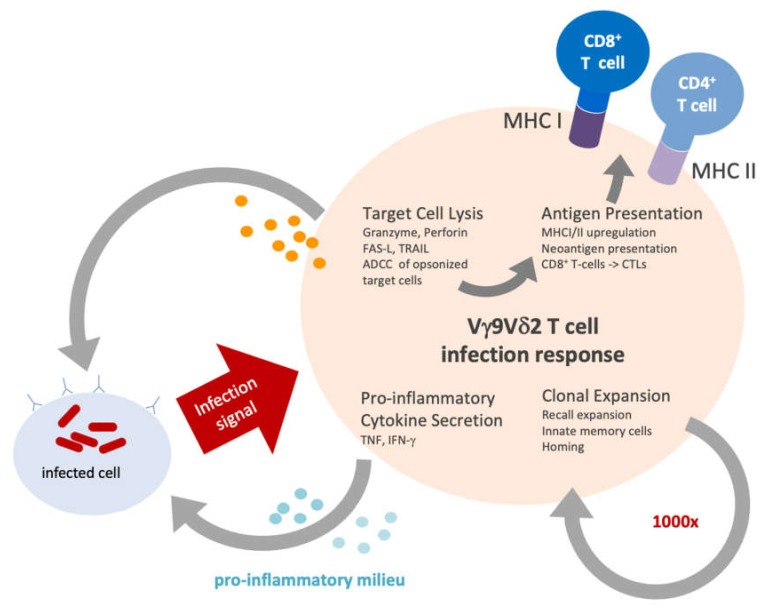
Immune functions of Vγ9Vδ2 T cells. An infection signal derived from an infected cell and mediated via BTN3A will induce a variety of cellular functions as follows:(i) lysis of the infected cell by cytotoxic mediators, such as granzymes, perforins or via the FS7-associated cell surface Antigen (Fas)/(CD95) and TRAIL-receptor induced cell death pathways; (ii) soluble material and opsonized, phagocytosed cellular material is digested and presented to TCR αβ+ CD4+ and CD8+ T cells; (iii) a clonal expansion up to 1000-fold increase after stimulation with their selective antigens; (iv) stimulated γδ T cells release many different cytokines and chemokines, most importantly the pro-inflammatory molecules TNF-α and IFN-γ.

References

    1. Decker W.K., Safdar A. Bioimmunoadjuvants for the treatment of neoplastic and infectious disease: Coley’s legacy revisited. Cytokine Growth Factor Rev. 2009;20:271–281. doi: 10.1016/j.cytogfr.2009.07.004. - DOI - PubMed
    1. Falzone L., Salomone S., Libra M. Evolution of Cancer Pharmacological Treatments at the Turn of the Third Millennium. Front. Pharm. 2018;9:1300. doi: 10.3389/fphar.2018.01300. - DOI - PMC - PubMed
    1. Lamm D.L., Blumenstein B.A., Crawford E.D., Montie J.E., Scardino P., Grossman H.B., Stanisic T.H., Smith J.A., Sullivan J., Sarosdy M.F. A randomized trial of intravesical doxorubicin and immunotherapy with bacille Calmette-Guérin for transitional-cell carcinoma of the bladder. N. Engl. J. Med. 1991;325:1205–1209. doi: 10.1056/NEJM199110243251703. - DOI - PubMed
    1. Medzhitov R., Preston-Hurlburt P., Janeway C.A. A human homologue of the Drosophila Toll protein signals activation of adaptive immunity. Nature. 1997;388:394–397. doi: 10.1038/41131. - DOI - PubMed
    1. Brubaker S.W., Bonham K.S., Zanoni I., Kagan J.C. Innate immune pattern recognition: A cell biological perspective. Annu. Rev. Immunol. 2015;33:257–290. doi: 10.1146/annurev-immunol-032414-112240. - DOI - PMC - PubMed

Substances