


Role of Interleukin-6 in Depressive Disorder
- PMID: 32235786
- PMCID: PMC7139933
- DOI: 10.3390/ijms21062194
Role of Interleukin-6 in Depressive Disorder
Abstract
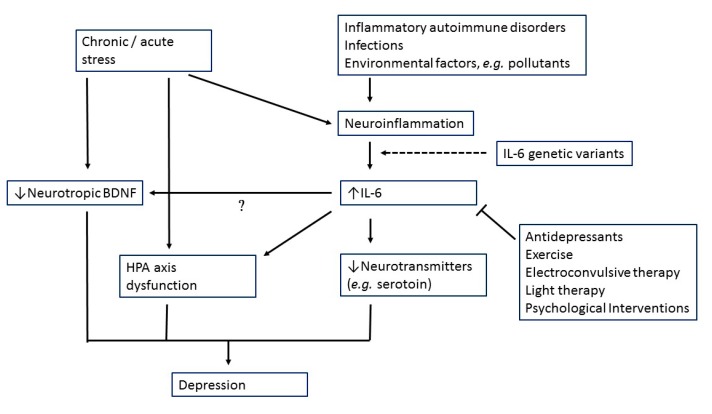
Major depressive disorder (MDD), which is a leading psychiatric illness across the world, severely affects quality of life and causes an increased incidence of suicide. Evidence from animal as well as clinical studies have indicated that increased peripheral or central cytokine interleukin-6 (IL-6) levels play an important role in stress reaction and depressive disorder, especially physical disorders comorbid with depression. Increased release of IL-6 in MDD has been found to be a factor associated with MDD prognosis and therapeutic response, and may affect a wide range of depressive symptomatology. However, study results of the IL6 genetic effects in MDD are controversial. Increased IL-6 activity may cause depression through activation of hypothalamic-pituitary-adrenal axis or influence of the neurotransmitter metabolism. The important role of neuroinflammation in MDD pathogenesis has created a new perspective that the combining of blood IL-6 and other depression-related cytokine levels may help to classify MDD biological subtypes, which may allow physicians to identify the optimal treatment for MDD patients. To modulate the IL-6 activity by IL-6-related agents, current antidepressive agents, herb medication, pre-/probiotics or non-pharmacological interventions may hold great promise for the MDD patients with inflammatory features.
Keywords: antidepressant; interleukin-6; major depressive disorder; polymorphism; stress.
Conflict of interest statement
S.-J.T. has received support from the Taiwan Ministry of Science and Technology, and from the Taipei Veterans General Hospital. There is no commercial or financial involvement that might present an appearance of a conflict of interest in connection with the submitted article. E.Y.-C.T. and A.C.Y declare no conflict of interest.
Figures
References
-
- Dunn A.J., Wang J., Ando T. Effects of cytokines on cerebral neurotransmission. Comparison with the effects of stress. Adv. Exp. Med. Biol. 1999;461:117–127. - PubMed
-
- Licinio J., Wong M.L. The role of inflammatory mediators in the biology of major depression: Central nervous system cytokines modulate the biological substrate of depressive symptoms, regulate stress-responsive systems, and contribute to neurotoxicity and neuroprotection. Mol. Psychiatry. 1999;4:317–327. doi: 10.1038/sj.mp.4000586. - DOI - PubMed
Publication types
MeSH terms
Substances
Grants and funding
LinkOut - more resources
Full Text Sources
Medical
