


Kinesiologist-guided functional exercise in addition to intradialytic cycling program in end-stage kidney disease patients: a randomised controlled trial
- PMID: 32235852
- PMCID: PMC7109131
- DOI: 10.1038/s41598-020-62709-1
Kinesiologist-guided functional exercise in addition to intradialytic cycling program in end-stage kidney disease patients: a randomised controlled trial
Erratum in
-
Author Correction: Kinesiologist-guided functional exercise in addition to intradialytic cycling program in end-stage kidney disease patients: a randomised controlled trial.Sci Rep. 2020 Jun 23;10(1):10399. doi: 10.1038/s41598-020-67057-8. Sci Rep. 2020. PMID: 32576882 Free PMC article.
Abstract
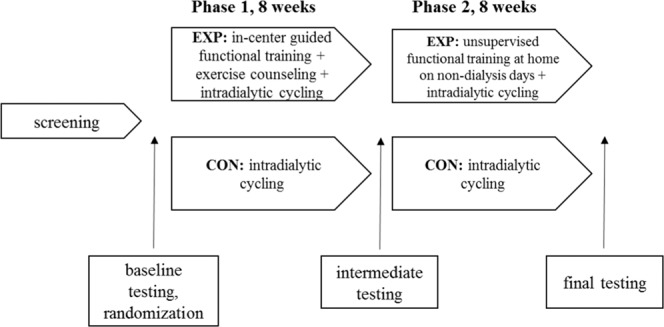
Intradialytic cycling is a widely used workout mode, whereas added benefit of other exercise modalities remains unknown. This is the first randomised controlled trial on the effects and sustainability of functional training and counselling in addition to intradialytic cycling. Patients were randomly assigned to a kinesiologist-guided functional training in addition to intradialytic cycling (n = 20, experimental group) or intradialytic cycling only (n = 20, control group) over 16 weeks. The experimental group attended predialysis functional exercise in the first eight weeks and afterward performed functional training at home for the next eight weeks. The primary study endpoint was 10-repetition-sit-to-stand test time at eight weeks: at this test, the experimental group improved significantly better than controls (-4.5 ± 1.9 s, 95%CI -8.4 to -0.7; P = 0.021), which was maintained at week 16 (-4.7 ± 2.1 s, 95%CI -9.0 to -0.3; P = 0.037). At week 8, the experimental group significantly outperformed controls also at handgrip strength (P = 0.004), lower body flexibility test (P < 0.001), balance test (P < 0.001), and upper body flexibility test (P = 0.003). At week 16, superior results of the experimental group in secondary end-points remained preserved for handgrip strength, balance, and upper body flexibility tests. Functional training with exercise counselling meaningfully improves physical performance and successfully prepares patients for sustainable home exercise.
Conflict of interest statement
The authors declare no competing interests.
Figures


References
-
- Sheng K, et al. Intradialytic exercise in hemodialysis patients: a systematic review and meta-analysis. Am. J. Nephrol. 2014;40:478–90. - PubMed
-
- Parker K. Intradialytic Exercise is Medicine for Hemodialysis Patients. Curr. Sports Med. Rep. 2016;15:269–75. - PubMed
-
- Storer TW, Casaburi R, Sawelson S, Kopple JD. Endurance exercise training during haemodialysis improves strength, power, fatigability and physical performance in maintenance haemodialysis patients. Nephrol. Dial. Transplant. 2005;20:1429–1437. - PubMed
-
- Groussard C, et al. Beneficial effects of an intradialytic cycling training program in patients with end-stage kidney disease. Appl. Physiol. Nutr. Metab. 2015;40:550–556. - PubMed
-
- Hristea D, et al. Combining intra-dialytic exercise and nutritional supplementation in malnourished older haemodialysis patients: Towards better quality of life and autonomy. Nephrology. 2016;21:785–790. - PubMed
