Review
. 2020 Apr;52(4):538-547.
doi: 10.1038/s12276-020-0412-2. Epub 2020 Apr 1.

New insights into the functions of Cox-2 in skin and esophageal malignancies

Affiliations
Review

New insights into the functions of Cox-2 in skin and esophageal malignancies

Hyeongsun Moon et al. Exp Mol Med. 2020 Apr.

Abstract

Understanding the cellular and molecular mechanisms of tumor initiation and progression for each cancer type is central to making improvements in both prevention and therapy. Identifying the cancer cells of origin and the necessary and sufficient mechanisms of transformation and progression provide opportunities for improved specific clinical interventions. In the last few decades, advanced genetic manipulation techniques have facilitated rapid progress in defining the etiologies of cancers and their cells of origin. Recent studies driven by various groups have provided experimental evidence indicating the cellular origins for each type of skin and esophageal cancer and have identified underlying mechanisms that stem/progenitor cells use to initiate tumor development. Specifically, cyclooxygenase-2 (Cox-2) is associated with tumor initiation and progression in many cancer types. Recent studies provide data demonstrating the roles of Cox-2 in skin and esophageal malignancies, especially in squamous cell carcinomas (SCCs) occurring in both sites. Here, we review experimental evidence aiming to define the origins of skin and esophageal cancers and discuss how Cox-2 contributes to tumorigenesis and differentiation.


Conflict of interest statement

The authors declare that they have no conflict of interest.

Figures
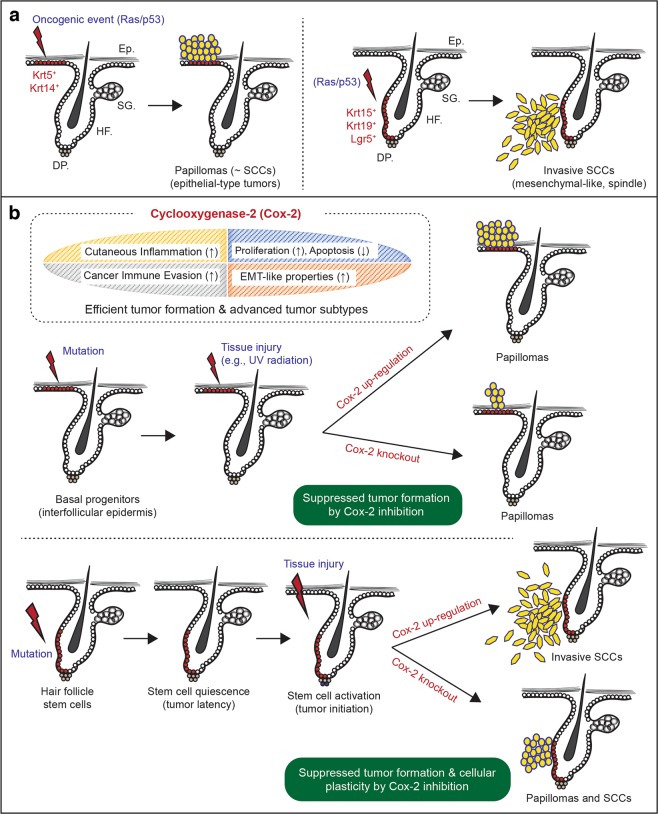
Fig. 1
Fig. 1. The role of Cox-2 in stem/progenitor cells during the earliest stages of cutaneous SCCs.
a Oncogenic expression of Ras (gain-of-function) and p53 (loss-of-function) can induce papillomatous tumors from basal stem/progenitors at the interfollicular epidermis. The same oncogenic combination (Ras/p53) in hair follicle stem cells can directly induce a more invasive form of SCC, mesenchymal-like spindle cell carcinoma. Ep., epithelium; SG., sebaceous gland; HF., hair follicle; DP., dermal papilla. b Skin damage, for example, UV exposure-induced skin damage, can accelerate tumorigenesis via Cox-2 upregulation from tumor-prone stem/progenitor cells. However, cell-type-specific knockout of Cox-2 can suppress tumor formation from both epidermal basal stem/progenitors and hair follicle stem cells. Furthermore, Cox-2 inhibition can suppress the cellular plasticity of hair follicle stem cell-originating cutaneous SCCs and lead to the formation of less aggressive SCC subtypes.
Fig. 2
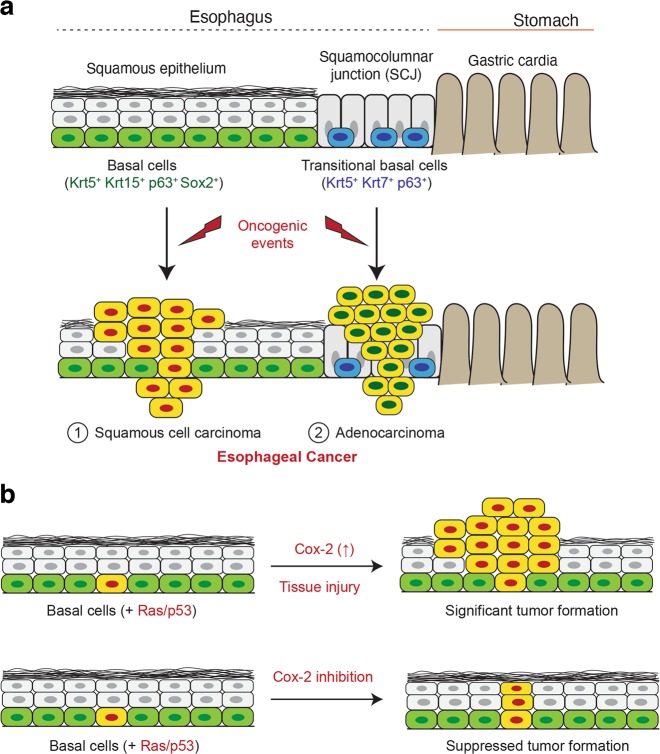
Fig. 2. The role of Cox-2 in foregut basal stem/progenitor cells during the earliest stages of SCC formation.
a Cellular diversity and anatomical distinctions between esophageal SCCs and Barrett’s adenocarcinoma. While SCCs are known to arise from basal stem/progenitors within the squamous epithelium, the cellular origins of Barrett’s adenocarcinoma could be variable. Examples include Krt7-positive transitional basal cells and residual embryonic stem cells at the squamous columnar junctional regions. b Cox-2 can be upregulated by cellular extrinsic stress factors such as smoking and gastric acid reflux, which in turn accelerate tumorigenesis. However, Cox-2 inhibition can significantly suppress tumor formation from tumor-prone basal stem/progenitor cells and has features that support a more differentiated cell fate.

References

    1. Subbaramaiah K, Dannenberg AJ. Cyclooxygenase 2: a molecular target for cancer prevention and treatment. Trends Pharmacol. Sci. 2003;24:96–102. - PubMed
    1. Gong L, et al. Celecoxib pathways: pharmacokinetics and pharmacodynamics. Pharmacogenet. Genomics. 2012;22:310–318. - PMC - PubMed
    1. Simões MCF, Sousa JJS, Pais AACC. Skin cancer and new treatment perspectives: a review. Cancer Lett. 2015;357:8–42. - PubMed
    1. Siegel RL, Miller KD, Jemal A. Cancer statistics, 2019. CA Cancer J. Clin. 2019;69:7–34. - PubMed
    1. Guy GP, et al. Vital signs: melanoma incidence and mortality trends and projections—United States, 1982–2030. MMWR Morb. Mortal. Wkly. Rep. 2015;64:591–596. - PMC - PubMed

Publication types

MeSH terms

Substances