Review
. 2020 Jun;63(6):1103-1109.
doi: 10.1007/s00125-020-05132-5. Epub 2020 Mar 31.

Why are South Asians prone to type 2 diabetes? A hypothesis based on underexplored pathways

Affiliations
Review

Why are South Asians prone to type 2 diabetes? A hypothesis based on underexplored pathways

K M Venkat Narayan et al. Diabetologia. 2020 Jun.

Abstract

South Asians have a high prevalence of type 2 diabetes, even at a lower BMI. This review sets out our perspective and hypothesis on the reasons for this. Emerging data from epidemiological studies indicate that South Asians may have a lower ability to secrete insulin, and thus may have less compensatory reserves when challenged with unhealthy lifestyles. Thus, insulin resistance may not be the primary driver of type 2 diabetes in this population. Furthermore, data also suggest that South Asians, on average, have lower muscle mass, and may have a specific propensity to ectopic hepatic fat accumulation and for intramyocellular fat deposition, which cause further disruption in insulin action. We hypothesise that the high diabetes susceptibility in South Asians is evolutionarily set through dual parallel and/or interacting mechanisms: reduced beta cell function and impaired insulin action owing to low lean mass, which is further accentuated by ectopic fat deposition in the liver and muscle. These areas warrant further research.

Keywords: Aetiology; Evolutionary biology; Hepatic fat; Insulin secretion; Lean muscle mass; Pathophysiology; Review; South Asians; Type 2 diabetes.


Figures
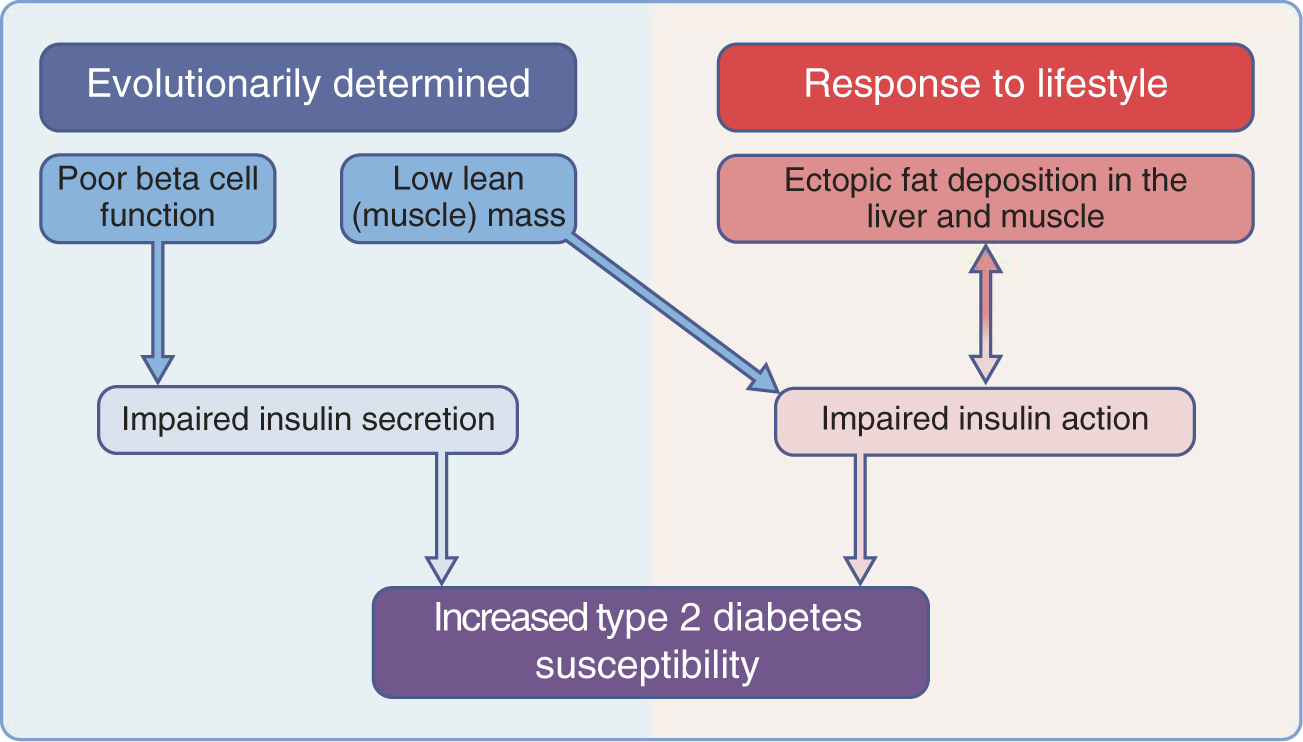
Fig. 1
Fig. 1
Proposed pathophysiological pathways for type 2 diabetes. Both impaired insulin secretion and impaired insulin action (or insulin resistance) have evolutionary roots among South Asians, with low beta cell function and low lean muscle mass. Adverse lifestyle behaviours further exacerbate insulin action with ectopic fat deposition in liver and muscle.

References

    1. Gujral UP, Pradeepa R, Weber MB, Narayan KM, Mohan V (2013) Type 2 diabetes in South Asians: similarities and differences with white Caucasian and other populations. Ann N Y Acad Sci 1281: 51–63. 10.1111/j.1749-6632.2012.06838.x - DOI - PMC - PubMed
    1. Unnikrishnan R, Gupta PK, Mohan V (2018) Diabetes in South Asians: phenotype, clinical presentation, and natural history. Curr Diab Rep 18(6):30 10.1007/s11892-018-1002-8 - DOI - PubMed
    1. Kanaya AM, Herrington D, Vittinghoff E et al. (2014) Understanding the high prevalence of diabetes in U.S. south Asians compared with four racial/ethnic groups: the MASALA and MESA studies. Diabetes Care 37(6):1621–1628. 10.2337/dc13-2656 - DOI - PMC - PubMed
    1. Chandalia M, Lin P, Seenivasan T et al. (2007) Insulin resistance and body fat distribution in South Asian men compared to Caucasian men. PLoS One 2(8):e812 10.1371/journal.pone.0000812 - DOI - PMC - PubMed
    1. Banerji MA, Faridi N, Atluri R, Chaiken RL, Lebovitz HE (1999) Body composition, visceral fat, leptin, and insulin resistance in Asian Indian men. J Clin Endocrinol Metab 84(1):137–144. 10.1210/jcem.84.1.5371 - DOI - PubMed

Publication types
