Randomized Controlled Trial
. 2020 Mar 30;15(1):122.
doi: 10.1186/s13018-020-01631-8.

Safety and efficacy of treating symptomatic, partial-thickness rotator cuff tears with fresh, uncultured, unmodified, autologous adipose-derived regenerative cells (UA-ADRCs) isolated at the point of care: a prospective, randomized, controlled first-in-human pilot study

Affiliations
Randomized Controlled Trial

Safety and efficacy of treating symptomatic, partial-thickness rotator cuff tears with fresh, uncultured, unmodified, autologous adipose-derived regenerative cells (UA-ADRCs) isolated at the point of care: a prospective, randomized, controlled first-in-human pilot study

Jason L Hurd et al. J Orthop Surg Res. .

Abstract

Background: This study tested the hypothesis that treatment of symptomatic, partial-thickness rotator cuff tears (sPTRCT) with fresh, uncultured, unmodified, autologous adipose-derived regenerative cells (UA-ADRCs) isolated from lipoaspirate at the point of care is safe and more effective than corticosteroid injection.

Methods: Subjects aged between 30 and 75 years with sPTRCT who did not respond to physical therapy treatments for at least 6 weeks were randomly assigned to receive a single injection of an average 11.4 × 10⁶ UA-ADRCs (in 5 mL liquid; mean cell viability: 88%) (n = 11; modified intention-to-treat (mITT) population) or a single injection of 80 mg of methylprednisolone (40 mg/mL; 2 mL) plus 3 mL of 0.25% bupivacaine (n = 5; mITT population), respectively. Safety and efficacy were assessed using the American Shoulder and Elbow Surgeons Standardized Shoulder Assessment Form (ASES), RAND Short Form-36 Health Survey, and pain visual analogue scale (VAS) at baseline (BL) as well as 3 weeks (W3), W6, W9, W12, W24, W32, W40, and W52 post treatment. Fat-saturated T2-weighted magnetic resonance imaging of the shoulder was performed at BL as well as at W24 and W52 post treatment.

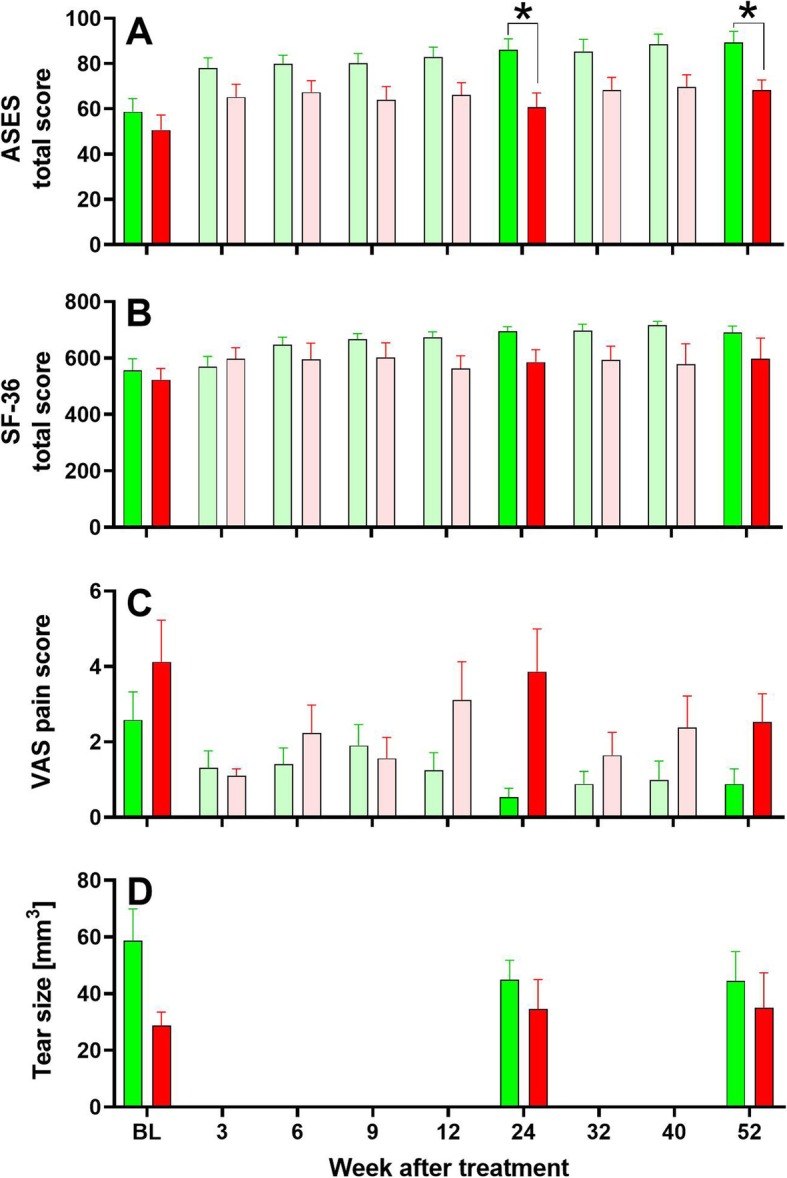
Results: No severe adverse events related to the injection of UA-ADRCs were observed in the 12 months post treatment. The risks connected with treatment of sPTRCT with UA-ADRCs were not greater than those connected with treatment of sPTRCT with corticosteroid injection. However, one subject in the corticosteroid group developed a full rotator cuff tear during the course of this pilot study. Despite the small number of subjects in this pilot study, those in the UA-ADRCs group showed statistically significantly higher mean ASES total scores at W24 and W52 post treatment than those in the corticosteroid group (p < 0.05).

Discussion: This pilot study suggests that the use of UA-ADRCs in subjects with sPTRCT is safe and leads to improved shoulder function without adverse effects. To verify the results of this initial safety and feasibility pilot study in a larger patient population, a randomized controlled trial on 246 patients suffering from sPTRCT is currently ongoing.

Trial registration: Clinicaltrials.gov ID NCT02918136. Registered September 28, 2016, https://clinicaltrials.gov/ct2/show/NCT02918136.

Level of evidence: Level I; prospective, randomized, controlled trial.

Keywords: Adipose-derived regenerative cells (ADRCs); Partial rotator cuff tear; Point of care treatment; Safety; Shoulder disease; Stem cells; Stromal vascular fraction.


Conflict of interest statement

JLH, TRF, JW, MH, MH, and ML are employees of Sanford Health, a minority shareholder of InGeneron, Inc. (Houston, TX, USA), which is the manufacturer and distributor of the Transpose RT/Matrase system that was investigated in this pilot study. GEW is employed as Chief Scientific Officer at InGeneron, Inc. CS has served as consultant to SciCoTec (Gruenwald, Germany), the majority shareholder of InGeneron, Inc. CA is managing director of InGeneron GmbH (Munich, Germany) which is owned by InGeneron, Inc. EA is Executive Chair of InGeneron, Inc., and Chairman of the Board of SciCoTec.

Figures
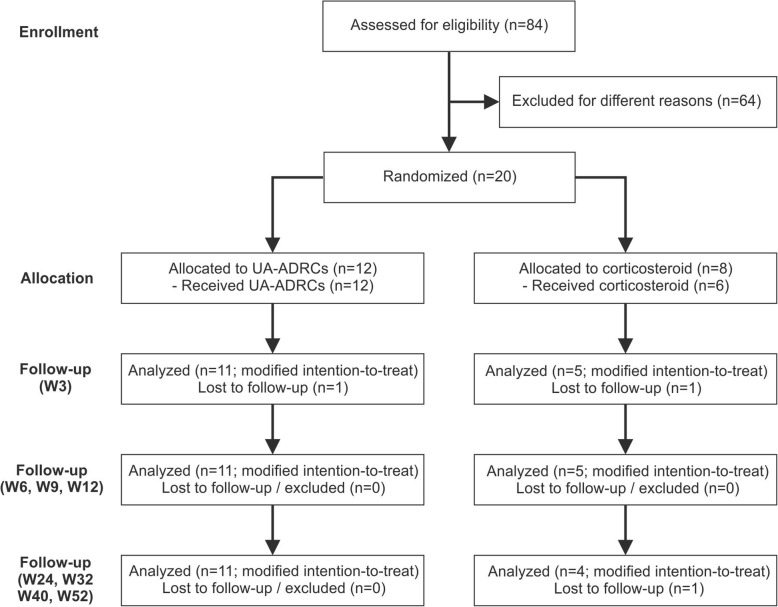
Fig. 1
Fig. 1
Flow of subjects in this pilot study according to CONSORT [31]
Fig. 2
Fig. 2
a Schematic representation of isolating UA-ADRCs from lipoaspirate with the Transpose RT/Matrase system (InGeneron) used in this pilot study (derived from [28]): (1) recovered lipoaspirate (25 mL) is loaded together with 2.5 mL reconstituted, proprietary enzymatic Matrase Reagent and lactated Ringer solution (preheated to 39 °C) into a processing tube up to the MAX FILL line; (2) the filled processing tubes are subjected in an inverted position inside the Transpose RT system to repetitive acceleration and deceleration for 30 min at 39 °C; (3) the processed lipoaspirate solution is filtered through a 200 μm filter and transferred into a wash tube; (4) after filling the wash tube with saline (room temperature) up to the MAX FILL line, the cells are separated from the rest of the tissue by centrifugation at 600 g for 5 min at room temperature; (5) the ADRCs (approximately 2 mL) are extracted through a swabable luer vial adapter at the bottom of the wash tube, and the remaining substances (fat, debris, and liquid) are discarded; (6) the cells are returned into the empty wash tube and (after adding fresh saline up to the MAX FILL line) centrifugated again for 5 min; (7, 8) the previous washing step is repeated; and (9) finally the concentrated ADRCs (approximately 3 mL) are extracted and slowly pushed through a luer coupler into a new sterile syringe for further application to the subject. This gentle and highly efficient isolation process results in a high cell yield (7.2 × 10⁵ ± 0.90 × 10⁵ ADRCs per mL lipoaspirate in [28]), high cell viability (85.9 ± 1.1% in [28]) and, thus, high number of living cells per mL lipoaspirate (6.25 × 10⁵ ± 0.79 × 10⁵ ADRCs per mL lipoaspirate in [28]). To our knowledge, the latter is the highest value ever reported in studies describing methods for isolating ADRCs [28]. be Adipogenic (b), osteogenic (c), hepatogenic (d), and neurogenic (e) differentiation potential of adipose derived stem cells (ASCs) derived from ADRCs isolated from lipoaspirate using the Transpose RT/Matrase system, demonstrated by culturing ASCs on their 3rd (bd) or 6th passage (e) for 2 weeks (b, c), 10 days (d), or 3 weeks (e) in adipogenic (b), osteogenic (c), hepatogenic (d), or neurogenic (e) differentiation medium (panels taken from [28]). Adipogenic, osteogenic, hepatogenic, and neurogenic differentiation was demonstrated by respectively presence of intracytoplasmic lipids (triglycerides) using Oil red-O staining (b; the yellow arrows in b indicate single Oil red-O positive cells), presence of calcific deposits using Alizarin red staining (c), presence of structures containing a high proportion of carbohydrate macromolecules (glycogen, glycoprotein, and proteoglycans) using Periodic Acid Schiff staining (d), or immunofluorescence for the detection of beta III Tubulin (β3TUB) (e) (details are provided in [28]). The scale bar in E represents 100 μm in (b, c) and 50 μm in (d, e)
Fig. 3
Fig. 3
Mean and standard error of the mean of ASES total score (a), RAND Short Form-36 total score (b), VAS pain score (c), and tear size (d) as a function of time post treatment after treating sPTRCT with a single injection of UA-ADRCs isolated from lipoaspirate at the point of care (green bars) or a single injection of corticosteroid (red bars). Results of statistical analysis (post-hoc Bonferroni's multiple comparisons test) are indicated (*p < 0.05). Note: bars with pale color show those data that were not considered in the statistical analysis (according to the hypothesis tested in this pilot study)
Fig. 4
Fig. 4
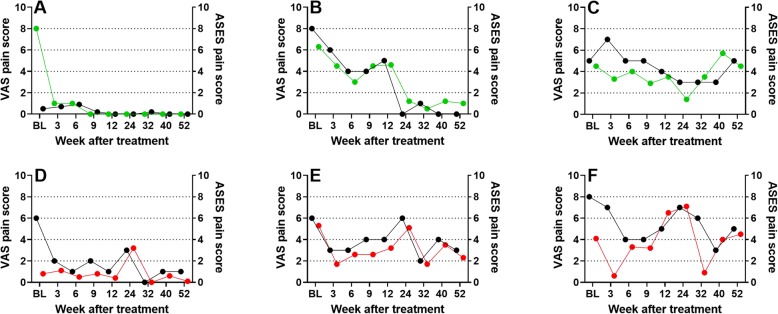
Individual ASES pain scores (black dots and right Y axis) and VAS pain scores (green and red dots and left Y axis) of select subjects treated with respectively UA-ADRCs (a–c) or corticosteroid (df) in this pilot study. Details are provided in the main text.
Fig. 5
Fig. 5
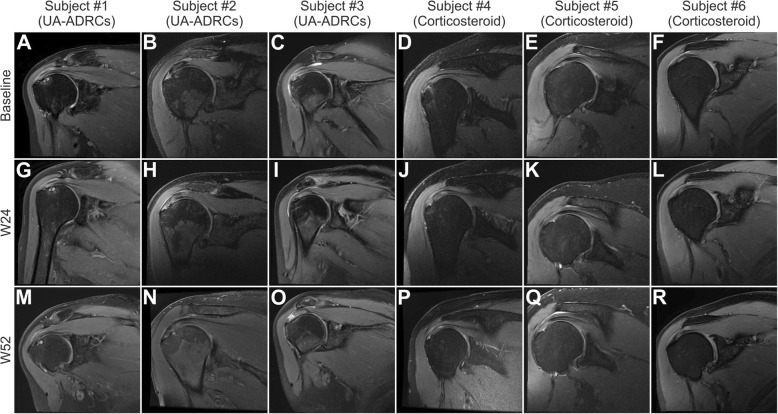
Coronal MRI scans (T2, proton density-weighted, fat-saturated (PD FS)) of the index shoulder of select subjects treated with respectively UA-ADRCs (ac, gi, mo) or corticosteroid (df, jl, pr) in this pilot study. Repetition time (TR) was 2375 ms in n, 2950 ms in d, 3317 in j, 3500 in a, c, e, f, i, k, m, o, q, r, 3516 in p, 3660 in l, 3820 in g, and 3917 in b, h. Echo time (TE) was 34 ms in a, c, e, f, g, i, km, o, q, r, 37 in n, 45 in b, h, j, 46 in d, and 65 in p. NEX was 1 in am, o, q, r, 1.5 in p, and 2 in m

References

    1. Matava MJ, Purcell DB, Rudzki JR. Partial-thickness rotator cuff tears. Am J Sports Med. 2005;33(9):1405–1417. doi: 10.1177/0363546505280213. - DOI - PubMed
    1. Via AG, De Cupis M, Spoliti M, Oliva F. Clinical and biological aspects of rotator cuff tears. Muscles Ligaments Tendons J. 2013;3(2):70–79. doi: 10.11138/mltj/2013.3.2.070. - DOI - PMC - PubMed
    1. Matthewson G, Beach CJ, Nelson AA, Woodmass JM, Ono Y, Boorman RS, Lo IK, Thornton GM. Partial thickness rotator cuff tears: current concepts. Adv Orthop. 2015;2015:458786. doi: 10.1155/2015/458786. - DOI - PMC - PubMed
    1. Ellman H. Diagnosis and treatment of incomplete rotator cuff tears. Clin Orthop Relat Res. 1990;254:64–74. - PubMed
    1. Cotton RE, Rideout DF. Tears of the humeral rotator cuff. J Bone Joint Surg. 1964;46B(2):314–328. doi: 10.1302/0301-620X.46B2.314. - DOI - PubMed

Publication types

MeSH terms

Associated data