


A comparison of genomic diagnostics in adults and children with epilepsy and comorbid intellectual disability
- PMID: 32238909
- PMCID: PMC7381648
- DOI: 10.1038/s41431-020-0610-3
A comparison of genomic diagnostics in adults and children with epilepsy and comorbid intellectual disability
Abstract
Next generation sequencing provides an important opportunity for improved diagnosis in epilepsy. To date, the majority of diagnostic genetic testing is conducted in the paediatric arena, while the utility of such testing is less well understood in adults with epilepsy. We conducted whole exome sequencing (WES) and copy number variant analyses in an Irish cohort of 101 people with epilepsy and co-morbid intellectual disability to compare the diagnostic yield of genomic testing between adult and paediatric patients. Variant interpretation followed American College of Medical Genetics and Genomics (ACMG) guidelines. We demonstrate that WES, in combination with array-comparative genomic hybridisation, provides a diagnostic rate of 27% in unrelated adult epilepsy patients and 42% in unrelated paediatric patients. We observe a 2.7% rate of ACMG-defined incidental findings. Our findings indicate that WES has similar utility in both adult and paediatric cohorts and is appropriate for diagnostic testing in both epilepsy patient groups.
Conflict of interest statement
NJL, ASR and CAS are employed by Congenica Ltd.
Figures
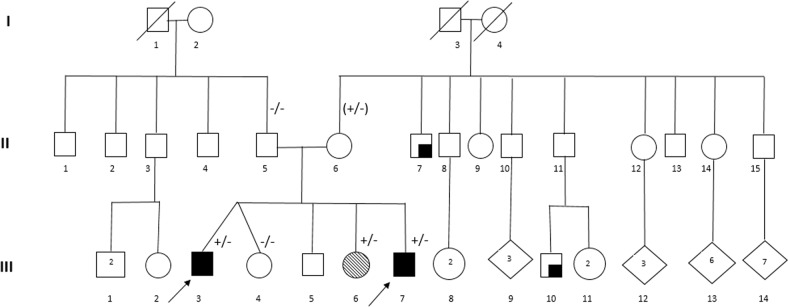
 ) Probands: Epilepsy, history of febrile seizures, mild/moderate intellectual disability (ID), ±Asperger syndrome. (
 ) Sister of probands: Moderate ID, behavioural problems, no epilepsy. (
 ) Epilepsy, no ID. Variant of Interest: MBD5 p.(D242fs) ± = Heterozygote for MBD5 p. (D242fs). (±) = Mosaic heterozygote for MBD5 p.(D242fs). −/− = Tested negative for MBD5 p. (D242fs). b II5 Unaffected father of proband. II6 Unaffected mother of probands. II7 Developed epilepsy at 52 years. III3 Proband (Patient 37): Epilepsy, mild intellectual disability (ID), Aspeger syndrome, history of febrile seizures. Tetralogy of Fallot at birth. III4 Unaffected twin sister. III6 Moderate ID, complex mood disorder, challenging behaviour. III7 Proband (Patient 39): Moderate ID, epilepsy, history of febrile seizures. III10 Few seizures as teenager. No seizures now.
References
-
- Covanis A, Guekht A, Li S, Secco M, Shakir R, Perucca E. From global campaign to global commitment: The World Health Assembly’s Resolution on epilepsy. Epilepsia. 2015;56:1651–7. - PubMed
