


Heart failure with mid-range ejection fraction: pro and cons of the new classification of Heart Failure by European Society of Cardiology guidelines
- PMID: 32239646
- PMCID: PMC7160484
- DOI: 10.1002/ehf2.12586
Heart failure with mid-range ejection fraction: pro and cons of the new classification of Heart Failure by European Society of Cardiology guidelines
Abstract
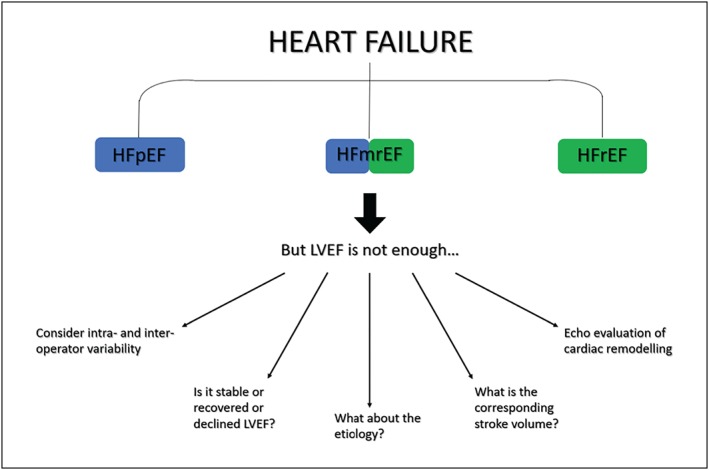
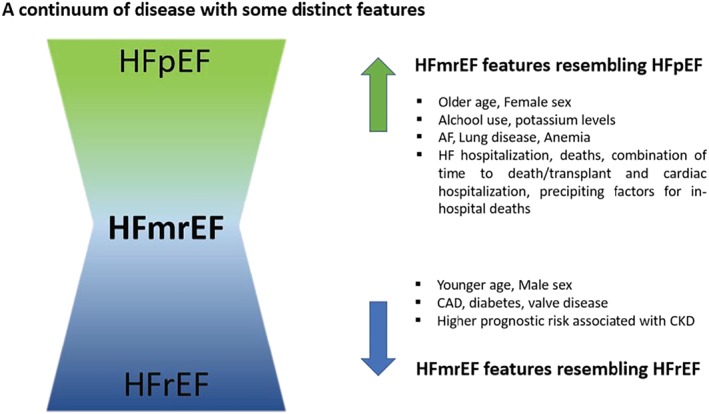
Currently, the assessment of left ventricular ejection fraction (LVEF) is the cornerstone of the classification of patients with heart failure (HF). The mid-range LVEF (HFmrEF) category was identified in an attempt to uncover specific characteristics of these patients. So far, the analysis of trials, registries, and observational studies have demonstrated that patients with mid-range LVEF belong to a patient cohort with generally intermediate clinical profile as compared with other groups but with a remarkable variety of intrinsic phenotypes. This is due to the limitations of LVEF as the sole criterion to categorize patients with HF and characterize their prognosis, above all when it is >40%. To better define the HFmrEF phenotype, it is reasonable to consider other parameters, such as LVEF changes over time, HF aetiology, co-morbidities, and other imaging parameters. A multiparametric evaluation may contextualize a patient with HFmrEF in a more defined phenotype with a specific prognosis.
Keywords: Classification; Heart failure with mid-range ejection fraction; Heart failure with preserved ejection fraction; Heart failure with reduced ejection fraction.
© 2020 The Authors. ESC Heart Failure published by John Wiley & Sons Ltd on behalf of the European Society of Cardiology.
Conflict of interest statement
None declared.
Figures
References
-
- Butler J, Fonarow GC, Zile MR, Lam CS, Roessig L, Schelbert EB, Shah SJ, Ahmed A, Bonow RO, Cleland JGF, Cody RJ, Chioncel O, Collins SP, Dunnmon P, Filippatos G, Lefkowitz MP, Marti CN, McMurray JJ, Misselwitz F, Nodari S, O'Connor C, Pfeffer MA, Pieske B, Pitt B, Rosano G, Sabbah HN, Senni M, Solomon SD, Stockbridge N, Teerlink JR, Georgiopoulou VV, Gheorghiade M. Developing therapies for heart failure with preserved ejection fraction: current state and future directions. JACC Heart Fail 2014; 2: 97–112. - PMC - PubMed
-
- 32013 ACCF/AHA guideline for the management of heart failure: a report of the American College of Cardiology Foundation/American Heart Association Task Force on Practice Guidelines. J Am Coll Cardiol 2013; 62: e147–e239. - PubMed
-
- Atherton JJ, Sindone A, De Pasquale CG, Driscoll A, MacDonald PS, Hopper I, Kistler PM, Briffa T, Wong J, Abhayaratna W, Thomas L. National Heart Foundation of Australia and Cardiac Society of Australia and New Zealand: guidelines for the prevention, detection, and management of heart failure in Australia 2018. Heart Lung Circ 2018; 27: 1123–1208. - PubMed
-
- Rickenbacher P, Kaufmann BA, Maeder MT, Bernheim A, Goetschalckx K, Pfister O, Pfisterer M, Brunner‐la Rocca HP, TIME‐CHF Investigators . Heart failure with mid‐range ejection fraction: a distinct clinical entity? Insights from the Trial of Intensified versus standard Medical therapy in Elderly patients with Congestive Heart Failure (TIME‐CHF). Eur J Heart Fail 2017; 19: 1586–1596. - PubMed
-
- Toma M, Ezekowitz JA, Bakal JA, O'Connor CM, Hernandez AF, Sardar MR, Zolty R, Massie BM, Swedberg K, Armstrong PW, Starling RC. The relationship between left ventricular ejection fraction and mortality in patients with acute heart failure: insights from the ASCEND‐HF Trial. Eur J Heart Fail 2014; 16: 334–341. - PubMed
Publication types
MeSH terms
Grants and funding
LinkOut - more resources
Full Text Sources
Medical
Research Materials
Miscellaneous
