


Exploring the prevalence of gaming disorder and Internet gaming disorder: a rapid scoping review
- PMID: 32241295
- PMCID: PMC7119162
- DOI: 10.1186/s13643-020-01329-2
Exploring the prevalence of gaming disorder and Internet gaming disorder: a rapid scoping review
Abstract
Background: Internet gaming disorder (IGD) was included in the DSM-5 in 2013 as a condition requiring further research, and gaming disorder (GD) was included in the ICD-11 in 2018. Given the importance of including these conditions in diagnostic guidelines, a review was conducted to describe their prevalence.
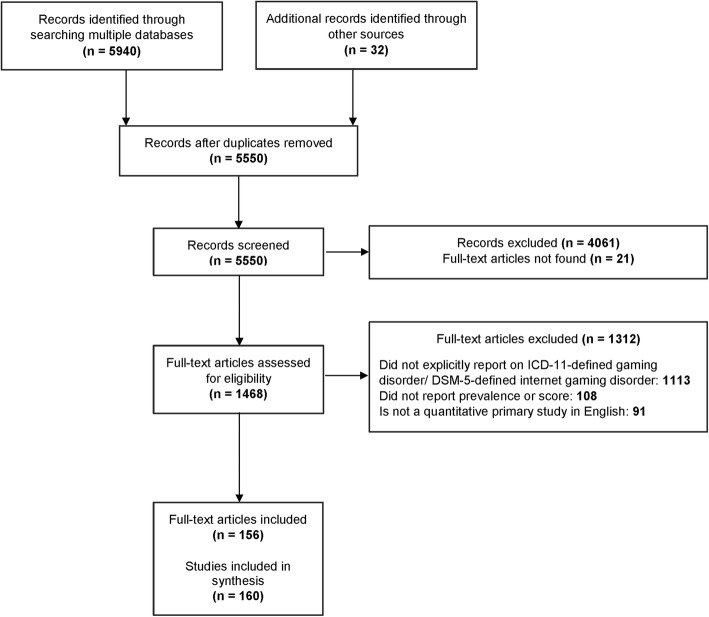
Methods: Using guidance from the Joanna Briggs Institute and the Preferred Reporting Items for Systematic reviews and Meta-Analyses extension for Scoping Reviews (PRISMA-ScR), we conducted a rapid scoping review. MEDLINE, Embase, PsycINFO, and the Cochrane library were searched for literature published from inception to July 2018. All review stages were pilot-tested to calibrate reviewers. The titles/abstracts and full-text articles were screened by one reviewer to include quantitative primary studies that reported GD or IGD prevalence. Excluded citations were screened by a second reviewer to confirm exclusion. Charting was conducted by one reviewer and verified by another, to capture relevant data. Results were summarized descriptively in tables or text.
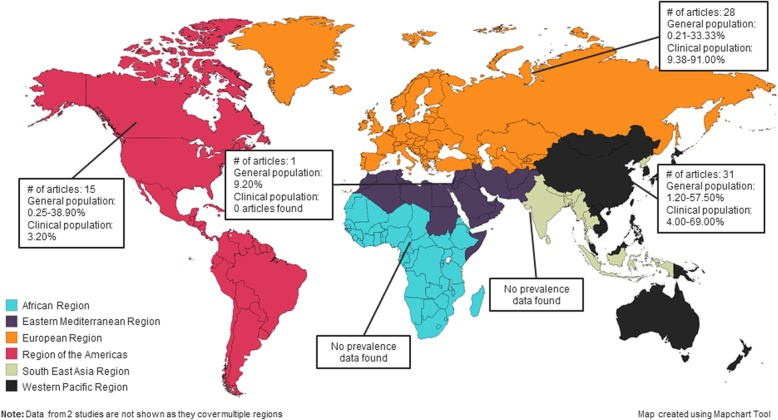
Results: We assessed 5550 potentially relevant citations. No studies on GD were identified. We found 160 studies of various designs that used 35 different methods to diagnose IGD. The prevalence of IGD ranged from 0.21-57.50% in general populations, 3.20-91.00% in clinical populations, and 50.42-79.25% in populations undergoing intervention (severe cases). Most studies were conducted in the Republic of Korea (n = 45), China (n = 29), and the USA (n = 20). Results are also presented for severe IGD and by geographic region, gender/sex, and age groups (child, adolescent, adult). The five most frequently reported health-related variables were depression (67 times), Internet addiction (54 times), anxiety (48 times), impulsiveness (37 times), and attention-deficit hyperactivity disorder (24 times).
Conclusions: Due to the variability in diagnostic approaches, knowledge users should interpret the wide IGD prevalence ranges with caution. In addition to further research on GD, consensus on the definition of IGD and how it is measured is needed, to better understand the prevalence of these conditions.
Keywords: DSM-5; Gaming disorder; ICD-11; Internet gaming disorder; Knowledge synthesis; Prevalence; Rapid review; Scoping review.
Conflict of interest statement
The authors declare that they have no competing interests. CCL is employed at the Canadian Agency for Drugs and Technologies in Health (CADTH). ACT is an associate editor for
Figures
References
-
- American Psychiatric Association . Diagnostic and statistical manual of mental disorders (DSM-5®) Arlington, VA: American Psychiatric Publishing; 2013.
-
- Gaming disorder [http://www.who.int/features/qa/gaming-disorder/en/]. Accessed 15 May 2019.
-
- Peters MDJGC, McInerney P, Baldini Soares C, Khalil H, Parker D. Chapter 11: scoping reviews. In: Aromataris E, Munn Z, editors. Joanna Briggs Institute Reviewer's Manual: The Joanna Briggs Institute; 2017. https://wiki.joannabriggs.org/display/MANUAL/Chapter+11%3A+Scoping+reviews. Accessed 15 May 2019.
Publication types
MeSH terms
LinkOut - more resources
Full Text Sources
