


Impact of feeding microalgae (Aurantiochytrium limacinum) and co-extruded mixture of full-fat flaxseed as sources of n-3 fatty acids to ISA brown and Shaver white breeders and progeny on pullet skeletal attributes at hatch through to 18 weeks of age
- PMID: 32241494
- PMCID: PMC7587698
- DOI: 10.1016/j.psj.2019.12.016
Impact of feeding microalgae (Aurantiochytrium limacinum) and co-extruded mixture of full-fat flaxseed as sources of n-3 fatty acids to ISA brown and Shaver white breeders and progeny on pullet skeletal attributes at hatch through to 18 weeks of age
Abstract
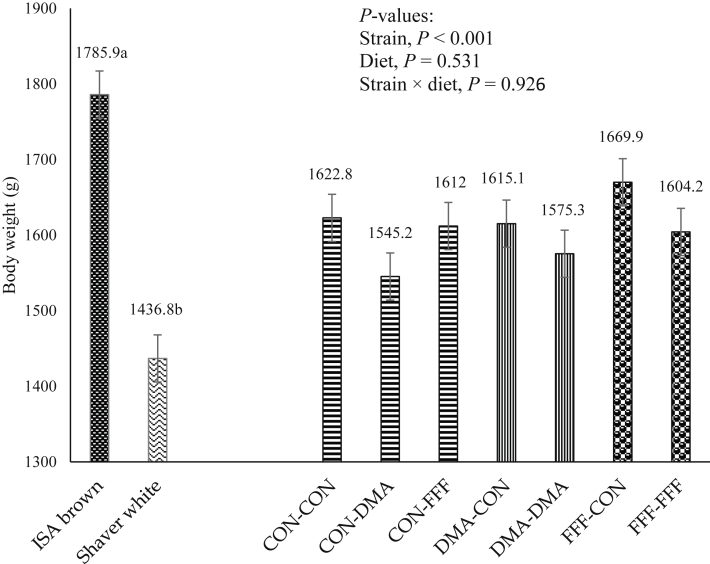
Impact of feeding n-3 fatty acids (FA) to ISA brown and Shaver white breeders and their progeny on bone development in pullets was investigated. Breeders were fed Control (CON); CON + 1% microalgae (DMA: Aurantiochytrium limacinum) as the source of docosahexaenoic acid; and CON + 2.6% of a co-extruded mixture of full-fat flaxseed (FFF) and pulses mixture as source of α-linolenic acid. Test diets (DMA and FFF) were balanced for total n-3 FA and n-6: n-3 FA ratio. Samples of day-old progeny were euthanized for bone mineral content (BMC) and tibia collagen type II. The remaining pullets were fed posthatch treatments as follows: from breeder CON: CON (CON-CON), DMA (CON-DMA), and FFF (CON-FFF), from breeder DMA: CON (DMA-CON) and DMA (DMA-DMA) and from breeder FFF: CON (FFF-CON) and FFF (FFF-FFF). A total of 60 pullets per posthatch diets were reared in cages (12 pullets/cage, n = 5) with free access to feed and water, bled at 6, 12, and 18 wk of age (WOA) for bone turnover markers and necropsied at 18 WOA for tibia and femur samples. Day-old pullets from breeder fed CON had greater BMC (P < 0.001) relative to those from breeders fed other diets. There was strain and diet interaction (P ≤ 0.024) on tibia breaking strength (TBS) and tibia cortical ash concentration at 18 WOA such that diet responses were only observed in Shaver white pullets. In this context, TBS of DMA-DMA and FFF-FFF was greater than for pullets originating from CON breeder, and the cortical ash weight of DMA-DMA and FFF-FFF pullets was 23.8 and 20.2%, respectively, higher than for CON-CON pullets. In conclusions, the strain effects were strong on tibia attributes on 18-week-old pullets. Breeder feeding of n-3 FA was more effective when concomitant with posthatch feeding of n-3 FA in supporting the skeletal strength and cortical bone development in Shaver white pullets. Further investigations are warranted to establish the impact these strategies on skeletal health during laying cycle.
Keywords: bone development and quality; breeder feeding; n-3 fatty acids; posthatch feeding; pullets.
Copyright © 2019. Published by Elsevier Inc.
Figures

References
-
- Akbari Moghaddam Kakhki R., Heuthorst T., Wornath-Vanhumbeck A., Neijat M., Kiarie E. Interactive effects of calcium and top-dressed 25-hydroxy vitamin D3 on egg production, egg shell quality, and bones attributes in aged Lohmann LSL-lite layers. Poult. Sci. 2018;98:1254–1262. - PubMed
-
- Akbari Moghaddam Kakhki R., Heuthorst T., Wornath-Vanhumbeck A., Neijat M., Kiarie E. Medullary bone attributes in aged Lohmann LSL-lite layers fed different levels of calcium and top-dressed 25-hydroxy vitamin D3. Can. J. Anim. Sci. 2018;99:138–149.
-
- Anderson K., Havenstein G., Jenkins P., Osborne J. Changes in commercial laying stock performance, 1958-2011: thirty-seven flocks of the North Carolina random sample and subsequent layer performance and management tests. World. Poult. Sci. J. 2013;69:489–514.
MeSH terms
Substances
LinkOut - more resources
Full Text Sources
Research Materials
Miscellaneous
