


Is serum vitamin B12 decrease a necessity for the diagnosis of subacute combined degeneration?: A meta-analysis
- PMID: 32243408
- PMCID: PMC7440176
- DOI: 10.1097/MD.0000000000019700
Is serum vitamin B12 decrease a necessity for the diagnosis of subacute combined degeneration?: A meta-analysis
Abstract
Background: To determine the prevalence of subacute combined degeneration (SCD) patients with normal or elevated serum vitamin B12 level and to identify clinical characteristics of these patients.
Methods: We searched PubMed, EMBASE, and Cochrane library, without language restriction up to June 2019 and included studies with SCD patients who were diagnosed with normal or elevated serum vitamin B12 levels. Meta-analysis was performed to estimate the prevalence of SCD in patients with normal or elevated serum vitamin B12 levels and compare the differences of clinical data between patients with low and no-low serum vitamin B12 level.
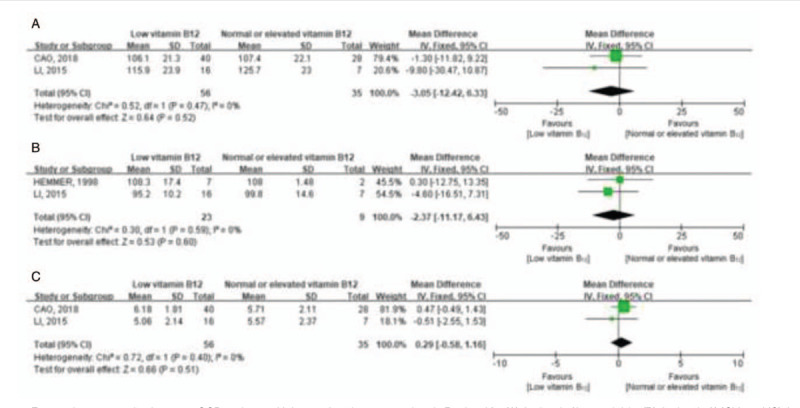
Results: Six studies were included in our analysis, with a total number of 181 patients involved. The pooled proportion in patients with no-low serum vitamin B12 level was 31.0% (95% confidence interval [CI]: 22.5-40.8). There was no significant difference in the level of hemoglobin (Mean difference (MD): -3.05, 95% CI: -12.42 to 6.33. P = 0.52) and erythrocyte mean corpuscular volume (MD: -2.37, 95% CI: -11.17 to 6.43, P = 0.60) between SCD patients with no-low and those with low serum vitamin B12 levels. The meta-analysis showed that the functional disability rating scale on admission in patients with low serum vitamin B12 level was no worse than that with normal or elevated serum vitamin B12 level (MD: 0.29, 95% CI: -0.58 to 1.16, P = 0.51).
Conclusion: Decreased level of serum vitamin B12 may not be a necessity for the diagnosis of SCD. Approximately one third of the SCD patients have normal or elevated serum vitamin B12 level. No differences were found in clinical severity between patients with normal or elevated serum vitamin B12 level and those with low level of serum vitamin B12 on admission.
Conflict of interest statement
The authors have no funding and conflicts of interest to disclose.
Figures
References
-
- Divate PG, Patanwala R. Neurological manifestations of B(12) deficiency with emphasis on its aetiology. J Assoc Physicians India 2014;62:400–5. - PubMed
-
- Liu M, Jiang Y, Wang W, et al. The natural history of electrophysiological and magnetic resonance changes of subacute combined degeneration. Zhonghua Nei Ke Za Zhi 2001;40:180–2. - PubMed
Publication types
MeSH terms
Substances
LinkOut - more resources
Full Text Sources
