Review
. 2020 Apr 2;78(1):9-29.
doi: 10.1016/j.molcel.2020.03.011.

How RNA-Binding Proteins Interact with RNA: Molecules and Mechanisms

Affiliations
Review

How RNA-Binding Proteins Interact with RNA: Molecules and Mechanisms

Meredith Corley et al. Mol Cell. .

Abstract

RNA-binding proteins (RBPs) comprise a large class of over 2,000 proteins that interact with transcripts in all manner of RNA-driven processes. The structures and mechanisms that RBPs use to bind and regulate RNA are incredibly diverse. In this review, we take a look at the components of protein-RNA interaction, from the molecular level to multi-component interaction. We first summarize what is known about protein-RNA molecular interactions based on analyses of solved structures. We additionally describe software currently available for predicting protein-RNA interaction and other resources useful for the study of RBPs. We then review the structure and function of seventeen known RNA-binding domains and analyze the hydrogen bonds adopted by protein-RNA structures on a domain-by-domain basis. We conclude with a summary of the higher-level mechanisms that regulate protein-RNA interactions.

Keywords: (∗)Insert Keywords Here(∗).


Conflict of interest statement

Declaration of Interests G.W.Y. is co-founder, member of the board of directors, equity holder, and paid consultant for Locana and Eclipse BioInnovations. G.W.Y. is a Distinguished Visiting Professor at the National University of Singapore. The terms of this arrangement have been reviewed and approved by the University of California, San Diego in accordance with its conflict of interest policies. All other authors declare no competing interests.

Figures
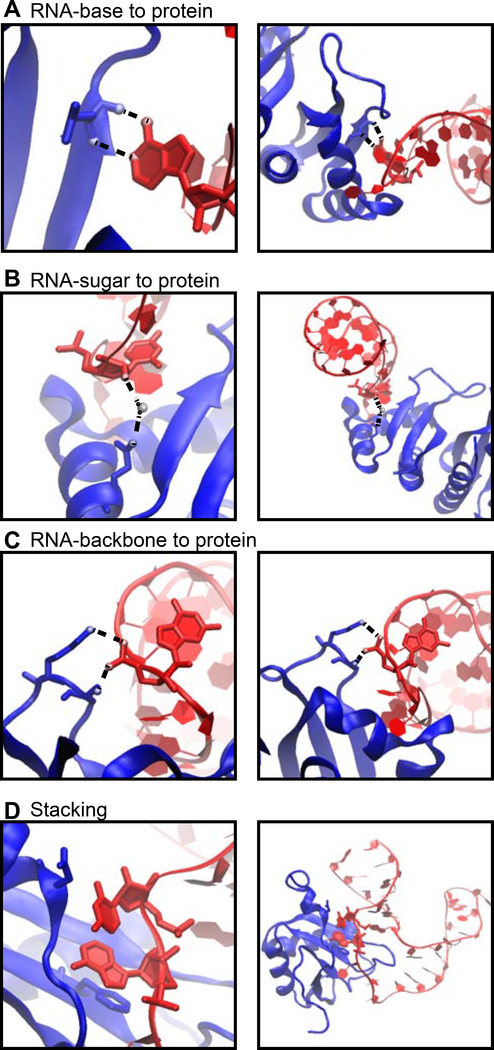
Figure 1.
Figure 1.
Examples of protein-RNA hydrogen bonds and stacking interactions. The KH domain of human NOVA1 (PDB ID: 2ANR) (Teplova et al., 2011) and human U1A (PDB ID: 1AUD) (Oubridge et al., 1994) visualized with VMD (Humphrey et al., 1996) in detailed (left) and zoomed-out (right) perspectives. RNA in red, protein in blue. (A) Mainchain atoms of a Leu form hydrogen bonds with adenine. (B) Hydrogen bonds form between Gln and the 2’-OH of a cytosine, bridged by a water molecule. (C) Two hydrogen bonds form between the phosphate backbone atoms of guanine and Ser and Lys. (D) An adenine and cytosine in an unpaired loop stack between Asp and Phe.
Figure 2.
Figure 2.
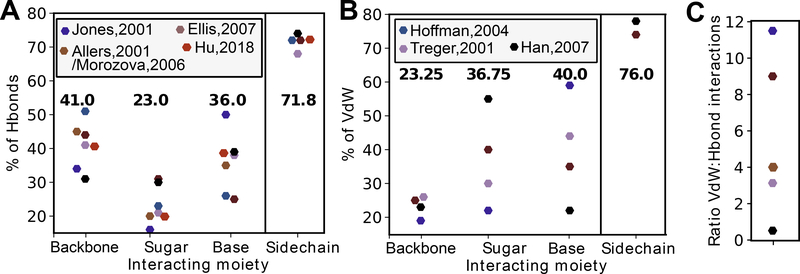
Meta-analysis of seven studies analyzing hydrogen bonds and Van der Waals interactions (VdW) in protein-RNA structures. (A) Reports across studies of the percent of hydrogen bonds in protein-RNA structures that occur with the RNA backbone (phosphate), sugar (2’-OH), or base. The percent of hydrogen bonds that occur with the protein sidechain (as opposed to the mainchain). Averages shown above each category. (B) Reports of the percent of VdWs in protein-RNA structures that occur with the RNA backbone (phosphate), sugar (2’-OH), or base. The percent of VdWs that occur with the protein sidechain (as opposed to the mainchain). Averages shown above each category. (C) Reports across studies of the average ratio of VdWs to hydrogen bonds per protein-RNA structure.
Figure 3.
Figure 3.
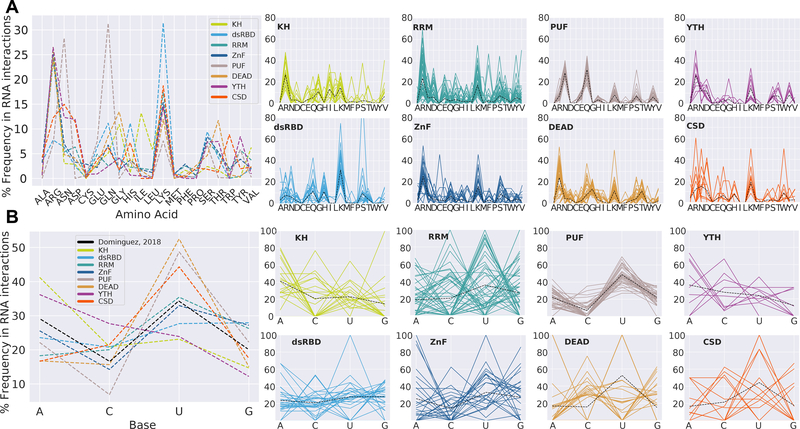
Amino acid and base preferences in RNA-protein hydrogen bonds observed in over 200 structures, organized by domain. (A) The average frequency of each amino acid in forming hydrogen bonds with RNA across eight RNA binding domain types (left). The frequency of each amino acid (one-letter abbreviations) in forming hydrogen bonds with RNA in multiple structures, separated by domain type (right, smaller plots). (B) The average frequency of each RNA nucleotide in forming hydrogen bonds with protein across eight RNA binding domain types, as well as the average frequency of each base in sequence motifs from bind-N-seq data (Dominguez et al., 2018) (left). The frequency of each RNA nucleotide in forming hydrogen bonds with protein in multiple structures, separated by domain type (right, smaller plots).
Figure 4.
Figure 4.
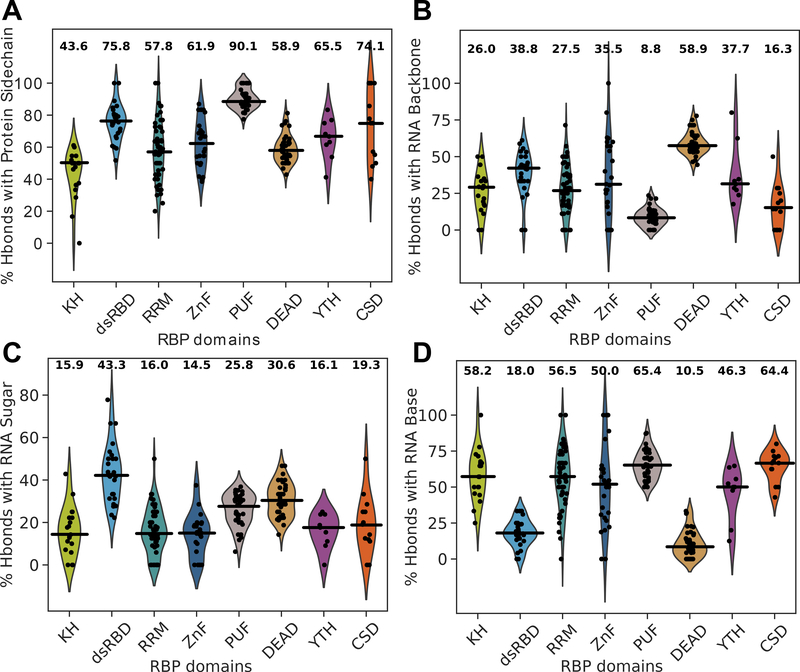
Assessment of protein-RNA hydrogen bonds in over 200 structures, organized by RNA binding domain. Averages for each statistic are listed above each domain’s violin plot and medians are indicated with black horizontal bars. (A) The percent of protein-RNA hydrogen bonds that are formed using protein sidechains (as opposed to the mainchain). (B) The percent of protein-RNA hydrogen bonds that are formed with RNA backbone atoms. (C) The percent of protein-RNA hydrogen bonds that are formed with RNA sugar atoms. (D) The percent of protein-RNA hydrogen bonds that are formed with RNA base atoms.
Figure 5.
Figure 5.
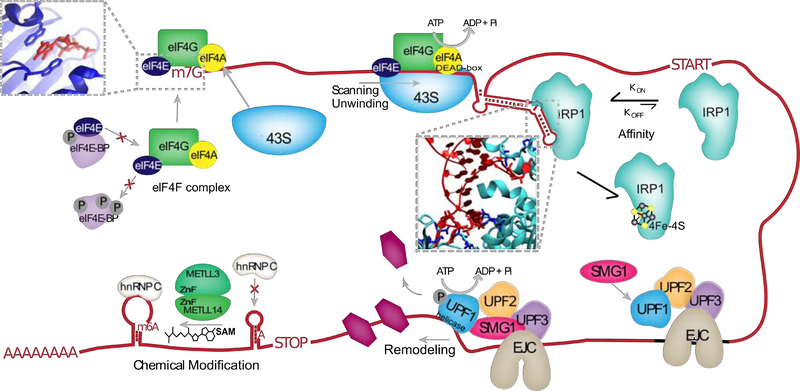
Examples of mechanisms controlling RBP binding, interactions with RNA, and their regulation. eIF4E (dark blue) interacts with 7-methyl-guanosine cap (m7G), in part through stacking interactions (inset) and binds to RNA as part of the eIF4F which includes RBPs eIf4G and eIF4A. eIF4E association with eIF4F is prevented by sequestration to hypo-phosphorylated eIF4E-BP. The 43S ribosomal subunit is recruited to the eIF4F complex, and processively scans the 5’UTR, aided by ATP-driven helicase activity of the eIF4A DEAD-box domain. The RBP IRP1 specifically binds hairpin elements in the 5’UTR with high affinity through specific residues (inset, dark blue) that hydrogen bond with the bulge and apical loop of the RNA. RNA binding by IRP1 is prevented by 4Fe-4S ligand binding to IRP1. UPF1 is recruited to the exon junction complex (EJC), where its helicase activity is activated by interactions with SMG1 and UPF2. Driven by ATP, UPF1 removes both RNA structures and other bound RBPs in the 5’−3’ direction. A zinc-finger (ZnF) containing METTL3-METTL14 complex deposits methyl groups donated by S-adenosyl methionine (SAM) on targeted adenosines (m6A). M6A modifications reduce base-pairing in RNA, such that some locations become available for hnRNPC binding.

References

    1. Akopian D, Shen K, Zhang X, and Shan SO (2013). Signal Recognition Particle: An Essential Protein-Targeting Machine. Annual Review of Biochemistry, Vol 82 82, 693–721. - PMC - PubMed
    1. Allain FH, Howe PW, Neuhaus D, and Varani G (1997). Structural basis of the RNA-binding specificity of human U1A protein. EMBO J 16, 5764–5772. - PMC - PubMed
    1. Allers J, and Shamoo Y (2001). Structure-based analysis of protein-RNA interactions using the program ENTANGLE. J Mol Biol 311, 75–86. - PubMed
    1. Amir M, Kumar V, Dohare R, Islam A, Ahmad F, and Hassan MI (2018). Sequence, structure and evolutionary analysis of cold shock domain proteins, a member of OB fold family. J Evolution Biol 31, 1903–1917. - PubMed
    1. Auweter SD, Oberstrass FC, and Allain FH (2006). Sequence-specific binding of single-stranded RNA: is there a code for recognition? Nucleic Acids Res 34, 4943–4959. - PMC - PubMed

Publication types