Review
. 2020 May:35:100962.
doi: 10.1016/j.molmet.2020.02.005. Epub 2020 Feb 13.

A non-proliferative role of pyrimidine metabolism in cancer

Affiliations
Review

A non-proliferative role of pyrimidine metabolism in cancer

Aarif Siddiqui et al. Mol Metab. 2020 May.

Abstract

Background: Nucleotide metabolism is a critical pathway that generates purine and pyrimidine molecules for DNA replication, RNA synthesis, and cellular bioenergetics. Increased nucleotide metabolism supports uncontrolled growth of tumors and is a hallmark of cancer. Agents inhibiting synthesis and incorporation of nucleotides in DNA are widely used as chemotherapeutics to reduce tumor growth, cause DNA damage, and induce cell death. Thus, the research on nucleotide metabolism in cancer is primarily focused on its role in cell proliferation. However, in addition to proliferation, the role of purine molecules is established as ligands for purinergic signals. However, so far, the role of the pyrimidines has not been discussed beyond cell growth.

Scope of the review: In this review we present the key evidence from recent pivotal studies supporting the notion of a non-proliferative role for pyrimidine metabolism (PyM) in cancer, with a special focus on its effect on differentiation in cancers from different origins.

Major conclusion: In leukemic cells, the pyrimidine catabolism induces terminal differentiation toward monocytic lineage to check the aberrant cell proliferation, whereas in some solid tumors (e.g., triple negative breast cancer and hepatocellular carcinoma), catalytic degradation of pyrimidines maintains the mesenchymal-like state driven by epithelial-to-mesenchymal transition (EMT). This review further broadens this concept to understand the effect of PyM on metastasis and, ultimately, delivers a rationale to investigate the involvement of the pyrimidine molecules as oncometabolites. Overall, understanding the non-proliferative role of PyM in cancer will lead to improvement of the existing antimetabolites and to development of new therapeutic options.

Keywords: Cancer; Chemoresistance; Epithelial-to-mesenchymal transition; Pyrimidine metabolism.


Figures

Figure 1
Figure 1
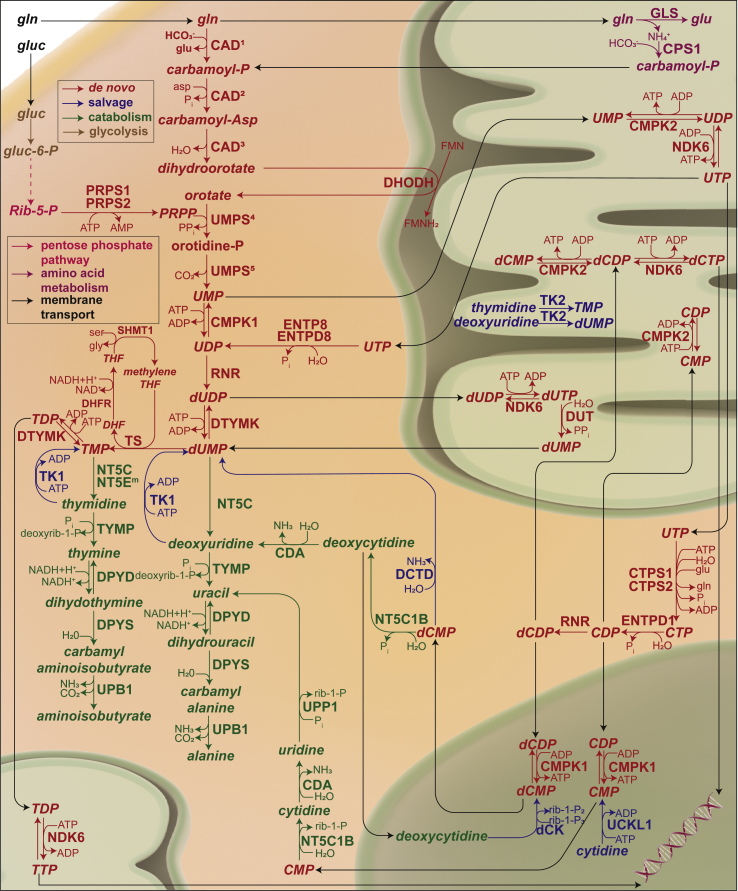
Pathway map of pyrimidine metabolism depicting de novo, salvage, and catalytic pathways. CAD: carbamoyl-phosphate synthetase 21, aspartate transcarbamylase2, and dihydroorotase³, UMPS: uridine monophosphate synthetase (orotate phosphorybosyl transferase4, and orotidylate decarboxylase5), CMPK1/2: cytidine/uridine monophosphate kinase 1/2, RNR: ribonucleotide reductase, DTYMK: deoxythymidylate kinase, ENTPD8: ectonucleoside triphosphate diphosphohydrolase 8, NDK6: nucleoside diphosphate kinase 6, DUT: deoxyuridine triphosphatase, CTPS1/2: CTP synthase 1/2, ENTPD1: ectonucleoside triphosphate diphosphohydrolase 1, PRPS1/2: phosphoribosyl pyrophosphate synthetase 1/2, TS: thymidylate synthase, SHMT1: serine hydroxymethyltransferase 1, DHFR: dihdyrofolate reductase, NT5C: 5′,3′-nucleotidase, cytosolic, TYMP: thymidine phosphorylase, DPYD: dihydropyrimidine dehydrogenase, DPYS: dihydropyrimidinase, UPB1: beta-ureidopropionase 1, NT51B: 5′-nucleotidase, cytosolic IB, CDA: cytidine deaminase, UPP1: uridine phosphorylase 1, CDA: cytidine deaminase, TK1/2: thymdine kinase 1/2 dCK: deoxycytidine kinase, UCKL1: uridine-cytidine kinase 1 like 1, DCTD: dCMP deaminase, GLS: glutaminase, CPS1: carbamoyl-phosphate synthase.
Figure 2
Figure 2
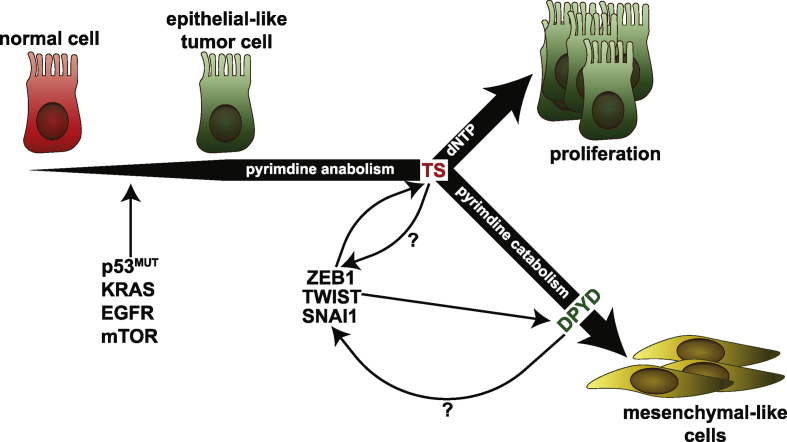
Interplay between EMT-TFs and pyrimidine metabolism genes. As the normal cells undergo oncogenic transformation, oncogenes activate and upregulate PyM genes. PyM in cancer is essential for proliferation, but the catabolic activity of PyM enzymes is further required to maintain aggressive cells in a mesenchymal-like state. This review aims to open a discussion that could lead to identification of possible feedback loops that connect the PyM back to EMT. The question marks in the figure indicate possibility of an existing feedback activation.
Figure 3
Figure 3
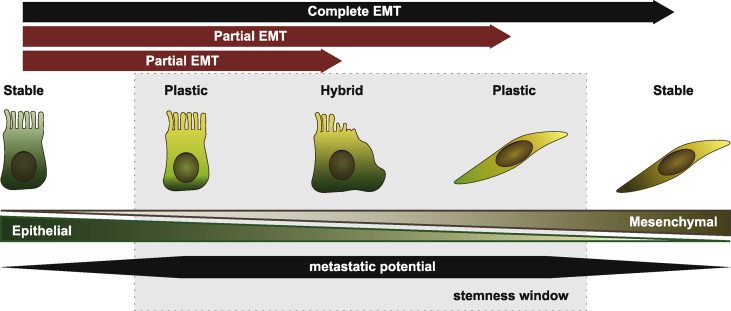
Correlation between different EMT states and stemness. Cancer cells that are locked in either epithelial or mesenchymal phenotype lose their plasticity to switch between EMT states and seed new tumors. Whereas, cells that undergo partial EMT exist within the frame of stemness window and could readily switch between differentiation phenotypes. The stemness window defines the zone that supports metastasis in cancers such as breast.
Figure 4
Figure 4
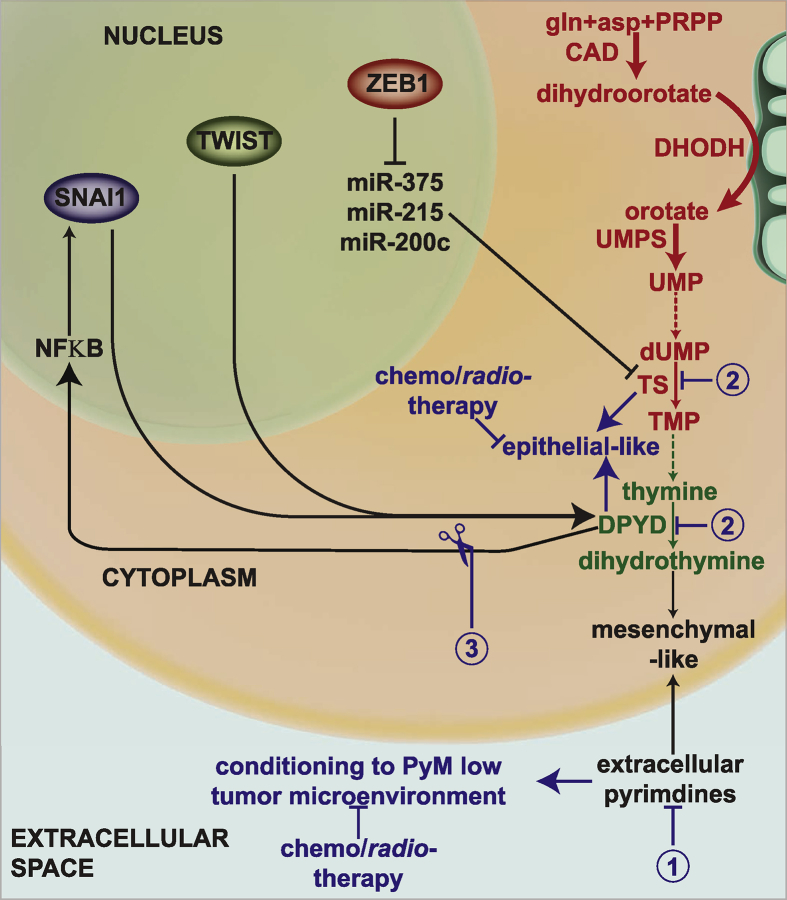
Schematic representation of the proposed therapeutic strategies to tackle aggressive tumors by harnessing PyM-mediated EMT. The first strategy aims at identifying and eliminating the entities that enrich the tumor microenvironment with pyrimidine metabolites. The loss of pyrimidine-rich microenvironment, which might support EMT, could sensitize the cancer cells to chemo-/radiotherapy. Similarly, the second strategy aims at the cytosolic depletion of PyM and, thus, forcing the cells into an epithelial-like state. Mesenchymal-like cells could be converted to epithelial-like cells by administering either lower doses of anti-PyM drugs or novel and more effective (and less toxic) drugs. The cells can then be targeted by chemo-/radiotherapy. The third strategy aims at recognizing the interactions between PyM enzymes and EMT-TFs, such as NFκB, and targeting them to break the connection between PyM and EMT-TFs. De novo reactions have been depicted in red, salvage reactions in green, proposed therapeutic strategies in blue and interactions in black. The broken lines represent multiple-step conversions.

References

    1. Villa E., Ali E.S., Sahu U., Ben-Sahra I. Cancer cells tune the signaling pathways to empower de Novo synthesis of nucleotides. Cancers. 2019;11:688. - PMC - PubMed
    1. Buj R., Aird K.M. Deoxyribonucleotide triphosphate metabolism in cancer and metabolic disease. Frontiers in Endocrinology. 2018;9 - PMC - PubMed
    1. Shiotani T., Hashimoto Y., Fujita J., Yamauchi N., Yamaji Y., Futami H. Reversal of enzymic phenotype of thymidine metabolism in induced differentiation of U-937 cells. Cancer Research. 1989;49:6758–6763. - PubMed
    1. Dongre A., Weinberg R.A. New insights into the mechanisms of epithelial–mesenchymal transition and implications for cancer. Nature Reviews Molecular Cell Biology. 2019;20:69–84. - PubMed
    1. Guarino M., Rubino B., Ballabio G. The role of epithelial-mesenchymal transition in cancer pathology. Pathology. 2007;39:305–318. - PubMed

Publication types