Review
. 2020 Mar 31;12(4):965.
doi: 10.3390/nu12040965.

MK-7 and Its Effects on Bone Quality and Strength

Affiliations
Review

MK-7 and Its Effects on Bone Quality and Strength

Toshiro Sato et al. Nutrients. .

Abstract

Vitamin K acts as a cofactor and is required for post-translational γ-carboxylation of vitamin K-dependent proteins (VKDP). The current recommended daily intake (RDI) of vitamin K in most countries has been established based on normal coagulation requirements. Vitamin K1 and menaquinone (MK)-4 has been shown to decrease osteocalcin (OC) γ-carboxylation at RDI levels. Among the several vitamin K homologs, only MK-7 (vitamin K2) can promote γ-carboxylation of extrahepatic VKDPs, OC, and the matrix Gla protein at a nutritional dose around RDI. MK-7 has higher efficacy due to its higher bioavailability and longer half-life than other vitamin K homologs. As vitamin K1, MK-4, and MK-7 have distinct bioactivities, their RDIs should be established based on their relative activities. MK-7 increases bone mineral density and promotes bone quality and strength. Collagen production, and thus, bone quality may be affected by MK-7 or MK-4 converted from MK-7. In this review, we comprehensively discuss the various properties of MK-7.

Keywords: bone metabolism; bone quality; menaquinone-7; osteocalcin; vitamin K2.


Conflict of interest statement

The authors declare no conflict of interest.

Figures
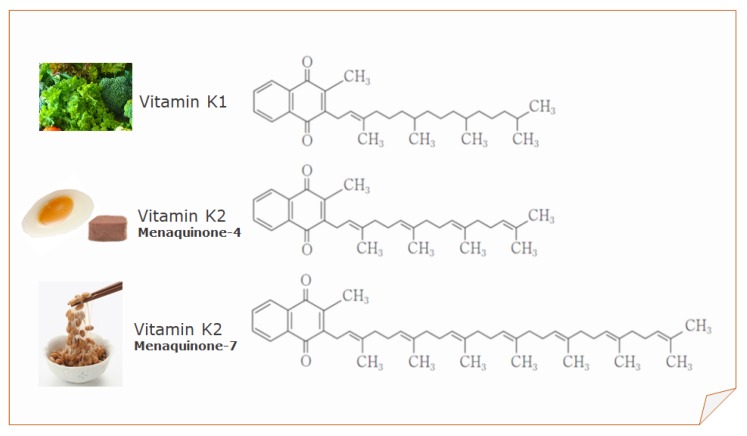
Figure 1
Figure 1
Structure of vitamin K1, menaquinone-4 (MK-4), and menaquinone-7 (MK-7).
Figure 2
Figure 2
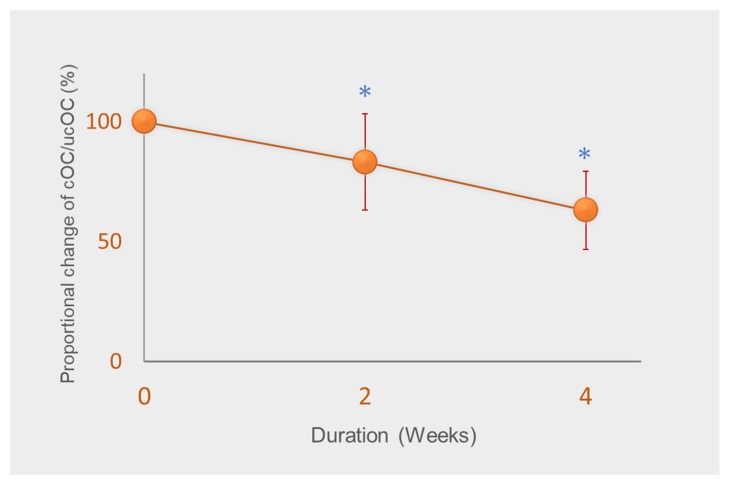
Change in the ratio of carboxylated osteocalcin (cOC) to undercarboxylated osteocalcin (ucOC) from baseline. Subjects were administered 72 µg vitamin K/day (around adequate intake of vitamin K) for four weeks. Data are expressed as mean ± standard deviation of 14–15 subjects. * Significantly different from baseline, p < 0.001. Adapted from [35].
Figure 3
Figure 3
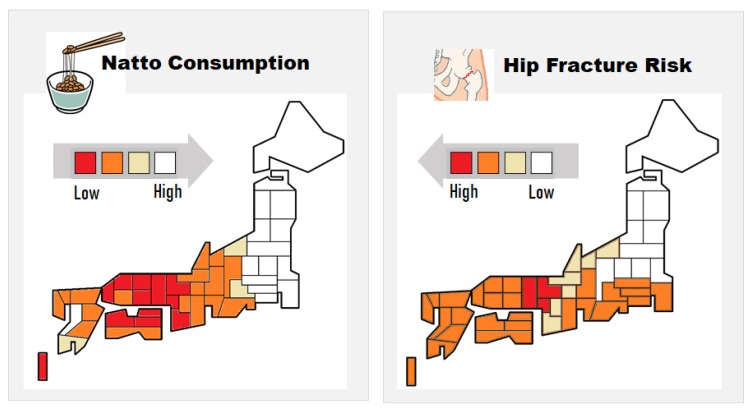
Correlation between the regional relative incidence of hip fractures and natto consumption in Japanese women. Adapted from [41].
Figure 4
Figure 4
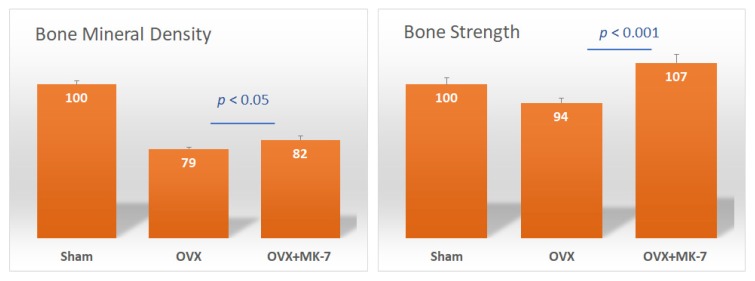
Effect of menaquinone-7 (MK-7) on bone mineral density (BMD) and bone strength of the femurs of ovariectomized rats. Sham: sham-operated group; OVX: ovariectomized rat control group; OVX + MK-7: ovariectomized rats that were fed MK-7. Data are expressed as relative values with the sham group taken as 100%. Adapted from [45].

References

    1. Shearer M.J. Vitamin K and vitamin K-dependent proteins. Br. J. Haematol. 1990;75:156–162. doi: 10.1111/j.1365-2141.1990.tb02642.x. - DOI - PubMed
    1. Furie B., Furie B.C. The molecular basis of blood coagulation. Cell. 1988;53:505–518. doi: 10.1016/0092-8674(88)90567-3. - DOI - PubMed
    1. Price P.A. Role of vitamin-K-dependent proteins in bone metabolism. Annu. Rev. Nutr. 1988;8:565–583. doi: 10.1146/annurev.nu.08.070188.003025. - DOI - PubMed
    1. Wei F.F., Trenson S., Verhamme P., Vermeer C., Staessen J.A. Vitamin K-dependent matrix Gla protein as multifaceted protector of vascular and tissue integrity. Hypertension. 2019;73:1160–1169. doi: 10.1161/HYPERTENSIONAHA.119.12412. - DOI - PMC - PubMed
    1. Cancela M.L., Conceico N., Laize V. Gla-rich protein, a new player in tissue calcification? Adv. Nutr. 2012;3:174–181. doi: 10.3945/an.111.001685. - DOI - PMC - PubMed