


A Devil of a Transmissible Cancer
- PMID: 32244613
- PMCID: PMC7345153
- DOI: 10.3390/tropicalmed5020050
A Devil of a Transmissible Cancer
Abstract
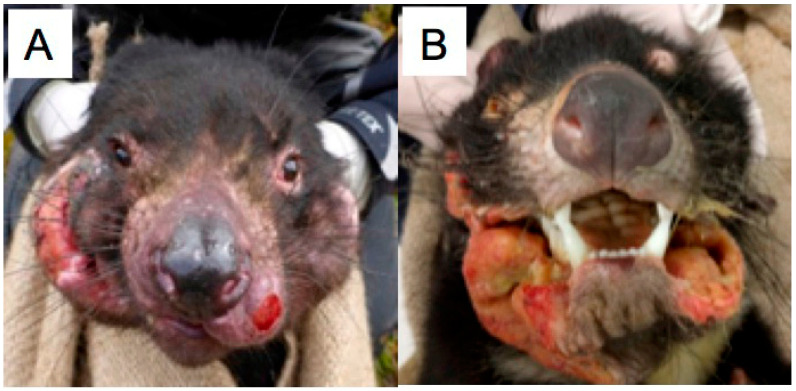
Devil facial tumor disease (DFTD) encompasses two independent transmissible cancers that have killed the majority of Tasmanian devils. The cancer cells are derived from Schwann cells and are spread between devils during biting, a common behavior during the mating season. The Centers for Disease Control and Prevention (CDC) defines a parasite as "An organism that lives on or in a host organism and gets its food from, or at, the expense of its host." Most cancers, including DFTD, live within a host organism and derive resources from its host, and consequently have parasitic-like features. Devil facial tumor disease is a transmissible cancer and, therefore, DFTD shares one additional feature common to most parasites. Through direct contact between devils, DFTD has spread throughout the devil population. However, unlike many parasites, the DFTD cancer cells have a simple lifecycle and do not have either independent, vector-borne, or quiescent phases. To facilitate a description of devil facial tumor disease, this review uses life cycles of parasites as an analogy.
Keywords: MHC; devil facial tumor disease; immune escape; parasite; transmissible cancer.
Conflict of interest statement
The authors declare no conflict of interest.
Figures
References
Publication types
Grants and funding
LinkOut - more resources
Full Text Sources
Research Materials
