Review
. 2020 Apr 1;21(7):2455.
doi: 10.3390/ijms21072455.

Shape Anisotropic Iron Oxide-Based Magnetic Nanoparticles: Synthesis and Biomedical Applications

Affiliations
Review

Shape Anisotropic Iron Oxide-Based Magnetic Nanoparticles: Synthesis and Biomedical Applications

Raquel G D Andrade et al. Int J Mol Sci. .

Abstract

Research on iron oxide-based magnetic nanoparticles and their clinical use has been, so far, mainly focused on the spherical shape. However, efforts have been made to develop synthetic routes that produce different anisotropic shapes not only in magnetite nanoparticles, but also in other ferrites, as their magnetic behavior and biological activity can be improved by controlling the shape. Ferrite nanoparticles show several properties that arise from finite-size and surface effects, like high magnetization and superparamagnetism, which make them interesting for use in nanomedicine. Herein, we show recent developments on the synthesis of anisotropic ferrite nanoparticles and the importance of shape-dependent properties for biomedical applications, such as magnetic drug delivery, magnetic hyperthermia and magnetic resonance imaging. A brief discussion on toxicity of iron oxide nanoparticles is also included.

Keywords: anisotropy; drug delivery; hyperthermia; magnetic nanoparticles; magnetic resonance imaging.


Conflict of interest statement

The authors declare no conflict of interest.

Figures
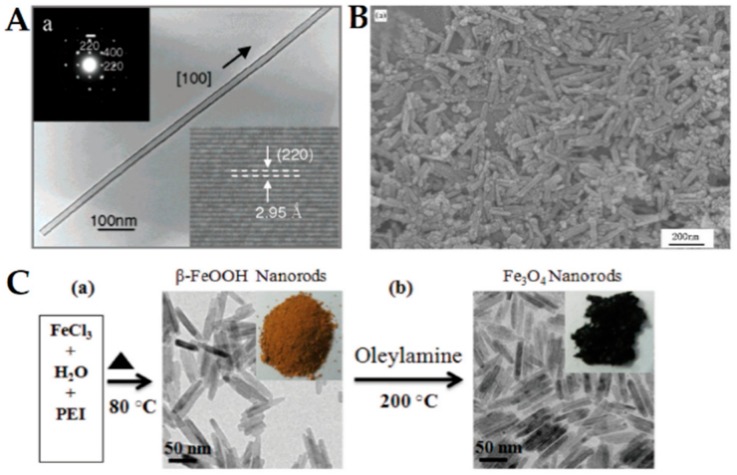
Figure 1
Figure 1
(A) TEM image of a Fe3O4 nanotube. Upper inset: Selected area electron diffraction of the nanotube. Lower inset: HRTEM image taken on the tube wall. Reproduced from [85] with permission from American Chemical Society, 2020. (B) SEM image of magnetite nanorods described in [71]. Reproduced from [71] with permission from Elsevier, 2020. (C) Scheme of the two-step synthesis of magnetite nanorods. Adapted from [88] with permission from Royal Society of Chemistry, 2020.
Figure 2
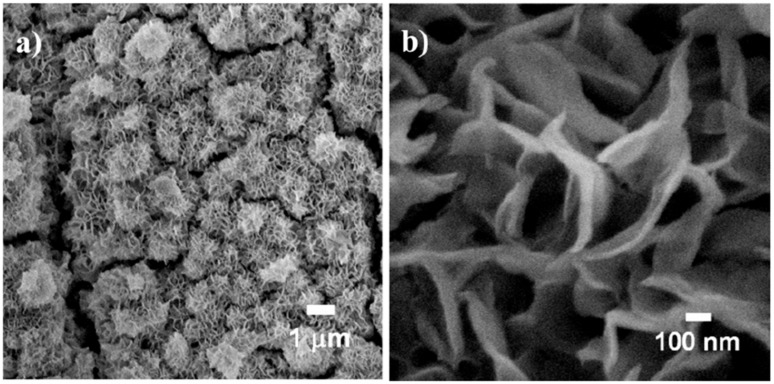
Figure 2
SEM image at different magnifications of magnetite nanosheets. Adapted from [100] with permission from American Chemical Society, 2020.
Figure 3
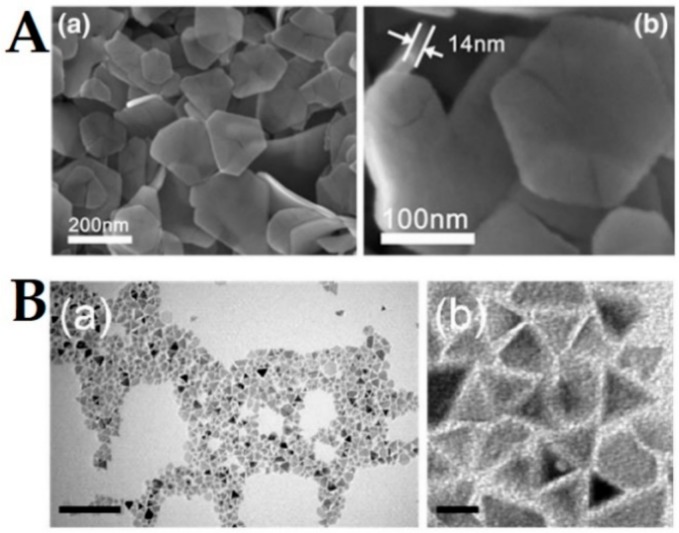
Figure 3
(A) SEM images of hexagonal-shaped magnetite nanoplates at different magnifications. Reproduced from [109] published in Open Access by Springer. (B) TEM images of triangle-shaped magnetite ultra-thin nanoplates at different magnifications. Adapted from [110] with permission from Royal Society of Chemistry, 2020.
Figure 4
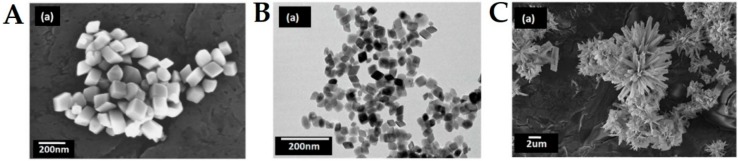
Figure 4
(A) SEM image of distorted cubes. (B) TEM image of nanocubes. (C) SEM image of self-oriented flowers. Reproduced from [115] with permission from Springer Nature, 2020.
Figure 5
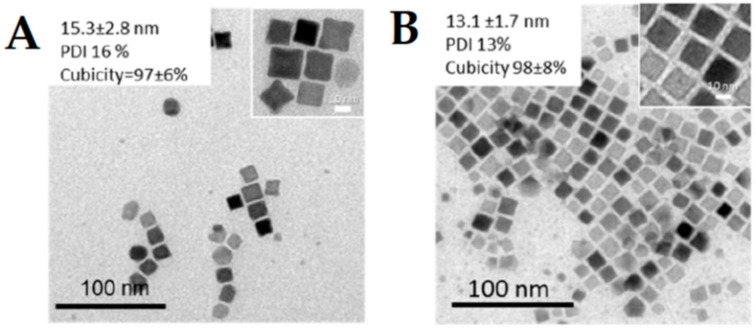
Figure 5
TEM image of (A) CoFe2O4 and (B) MnFe2O4 nanocubes. Adapted from [126] with permission from American Chemical Society 2020.
Figure 6
Figure 6
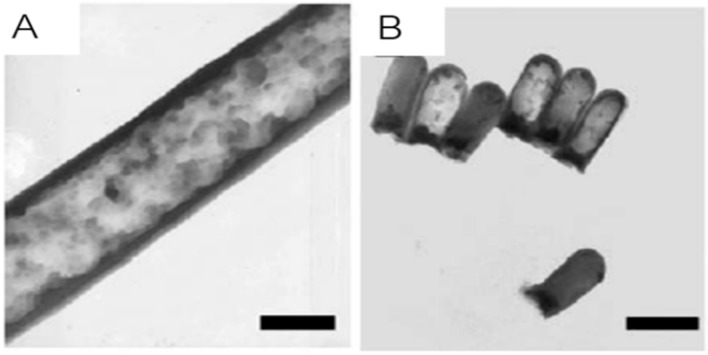
TEM images of 200 nm (A) and 60 nm (B) nanotubes with magnetite. Scale bars, 200 nm. Adapted from [147] with permission from Elsevier, 2020.
Figure 7
Figure 7
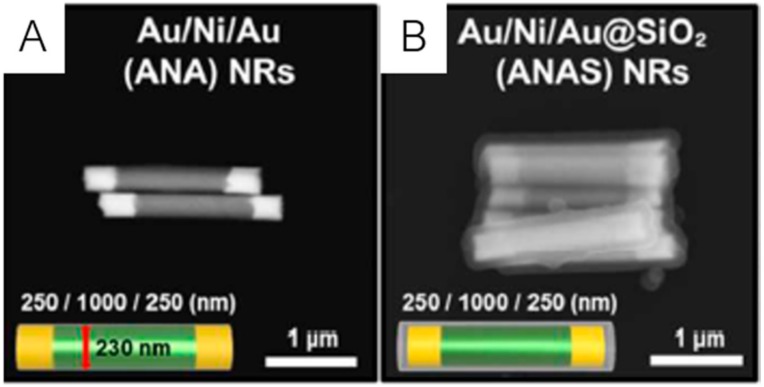
FE-SEM images of Au/Ni/Au nanorods (A) and silica-coated Au/Ni/Au nanorods (B) and respective schematic representations. Adapted from [65] with permission from Royal Society of Chemistry, 2020.
Figure 8
Figure 8
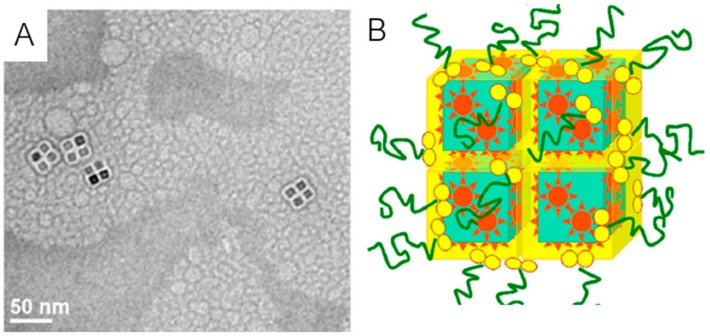
TEM image (A) and schematic representation (B) of Rubik-like paclitaxel-loaded magnetic nanoassemblies. Adapted from [151] with permission from Elsevier, 2020.
Figure 9
Figure 9
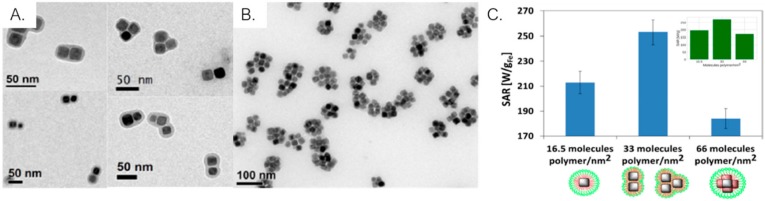
TEM images of dimer and trimer (A) and centrosymmetric (with more than 4 nanocubes) (B) iron oxide nanoclusters; (C) SAR values of the different nanoassemblies shows that dimer and trimer structures have the highest SAR values. Adapted from [158] with permission from American Chemical Society 2020.
Figure 10
Figure 10
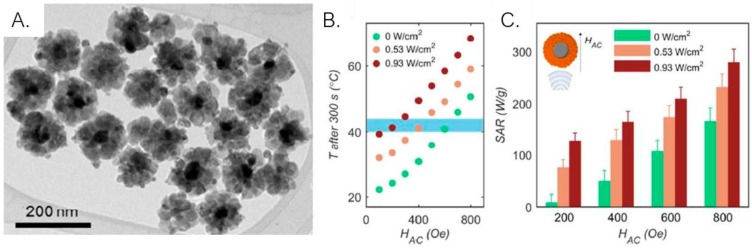
(A) TEM image of Ag/Fe3O4 nanoflowers; (B) Temperature reached after 300 s of heating for different ac field intensities. The therapeutic temperature window (blue zone) is reached for lower magnetic field intensities when a laser is applied; (C) SAR values of Ag/Fe3O4 nanoflowers as a function of AC field intensity (HAC) for different laser power densities. SAR values are the highest when a laser is simultaneously applied. Adapted from [162] with permission from American Chemical Society, 2020.
Figure 11
Figure 11
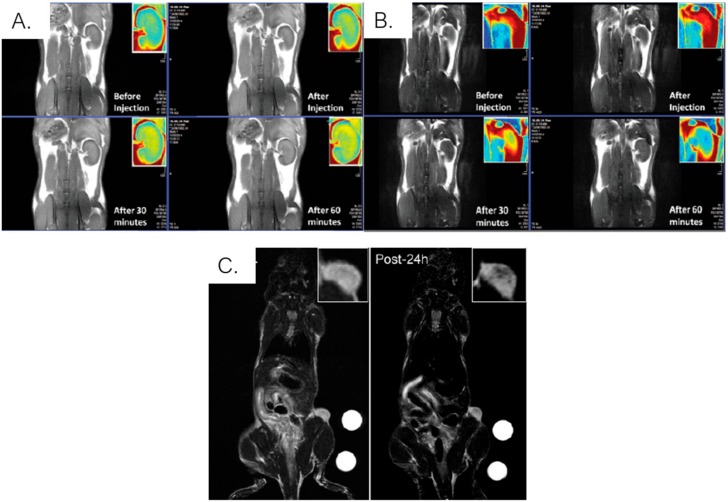
T1- (A) and T2-weighted (B) in vivo MR images before injection, immediately after and after 30 and 60 minutes of silica coated nanocubes. The contrast enhancement is clearly observed in the coronal images of the kidney. Adapted from [124] with permission from Royal Society of Chemistry 2020. (C) T2-weighted in vivo MR images before (left) and 24 h after (right) injection of BSA-coated nanocubes into mice bearing U87-MG tumor cells. The darkening of the tumor mass is clearly visible after the injection of nanoparticles. Adapted from [175] with permission from MDPI 2020.

References

    1. Chen G., Roy I., Yang C., Prasad P. Nanochemistry and nanomedicine for nanoparticle-based diagnostics and therapy. Chem. Rev. 2016;116:2826–2885. doi: 10.1021/acs.chemrev.5b00148. - DOI - PubMed
    1. Shi J., Kantoff P., Wooster R., Farokhzad O. Cancer nanomedicine: Progress, challenges and opportunities. Nat. Rev. Cancer. 2016;17:20–37. doi: 10.1038/nrc.2016.108. - DOI - PMC - PubMed
    1. Akbarzadeh A., Samiei M., Davaran S. Magnetic nanoparticles: Preparation, physical properties, and applications in biomedicine. Nanoscale Res. Lett. 2012;7:1–13. doi: 10.1186/1556-276X-7-144. - DOI - PMC - PubMed
    1. Kim B., Rutka J., Chan W. Nanomedicine. N. Engl. J. Med. 2010;363:2434–2443. doi: 10.1056/NEJMra0912273. - DOI - PubMed
    1. Kolhatkar A., Jamison A., Litvinov D., Willson R., Lee T. Tuning the magnetic properties of nanoparticles. Int. J. Mol. Sci. 2013;14:15977–16009. doi: 10.3390/ijms140815977. - DOI - PMC - PubMed

MeSH terms

LinkOut - more resources