Review
. 2020 Mar 20;21(6):2145.
doi: 10.3390/ijms21062145.

Iron Metabolism at the Interface between Host and Pathogen: From Nutritional Immunity to Antibacterial Development

Affiliations
Review

Iron Metabolism at the Interface between Host and Pathogen: From Nutritional Immunity to Antibacterial Development

Marialaura Marchetti et al. Int J Mol Sci. .

Abstract

Nutritional immunity is a form of innate immunity widespread in both vertebrates and invertebrates. The term refers to a rich repertoire of mechanisms set up by the host to inhibit bacterial proliferation by sequestering trace minerals (mainly iron, but also zinc and manganese). This strategy, selected by evolution, represents an effective front-line defense against pathogens and has thus inspired the exploitation of iron restriction in the development of innovative antimicrobials or enhancers of antimicrobial therapy. This review focuses on the mechanisms of nutritional immunity, the strategies adopted by opportunistic human pathogen Staphylococcus aureus to circumvent it, and the impact of deletion mutants on the fitness, infectivity, and persistence inside the host. This information finally converges in an overview of the current development of inhibitors targeting the different stages of iron uptake, an as-yet unexploited target in the field of antistaphylococcal drug discovery.

Keywords: Staphylococcus aureus; hemophores; iron; nutritional immunity; siderophores; virulence.


Conflict of interest statement

The authors declare no conflict of interest.

Figures
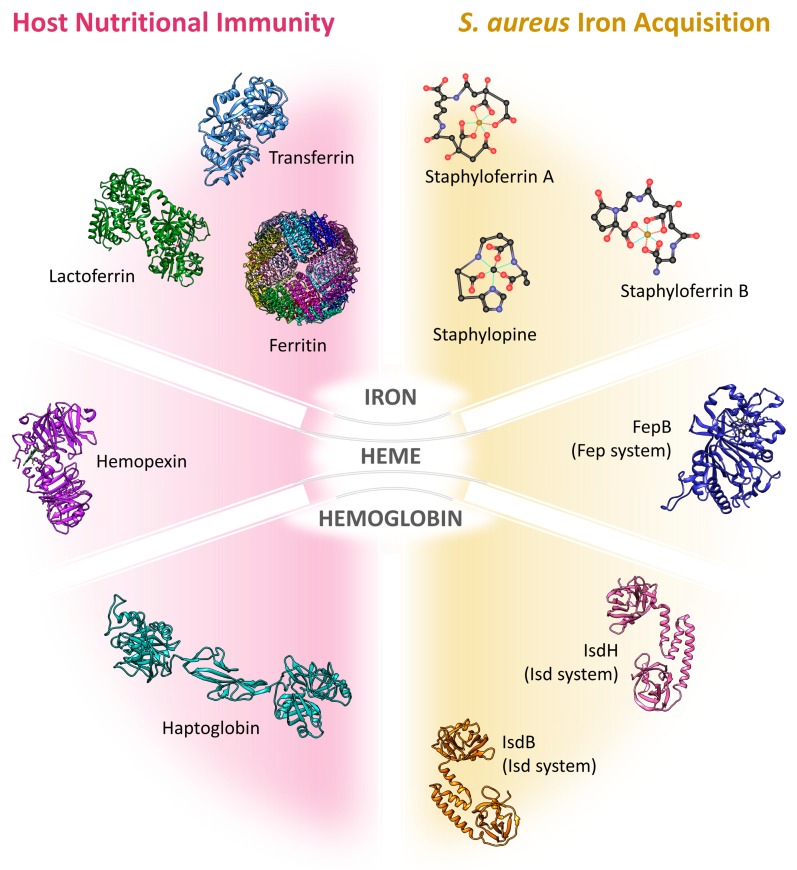
Figure 1
Figure 1
Schematic illustration of human proteins recruited in iron sequestration within the nutritional immunity (left), and Staphylococcus aureus effectors in iron retrieval (right). For protein representation, the following Protein Data Bank entries have been used: transferrin (1d3k), lactoferrin (1b0l), ferritin (1fha), hemopexin (1qhu), Hp 1-1 (extracted from 4wjg), IsdBN1N2 (extracted from 5vmm), IsdHN2N3 (extracted from 6tb2), FepB (3o72, illustration of the homolog Escherichia coli EfeB), and Hb/heme/iron (1a3n). Staphyloferrin A and B, and staphylopine have been modelled on the basis of Endicott et al. [46] and Deane [47] works, respectively. Proteins are divided into three groups based on the source of iron they exploit.
Figure 2
Figure 2
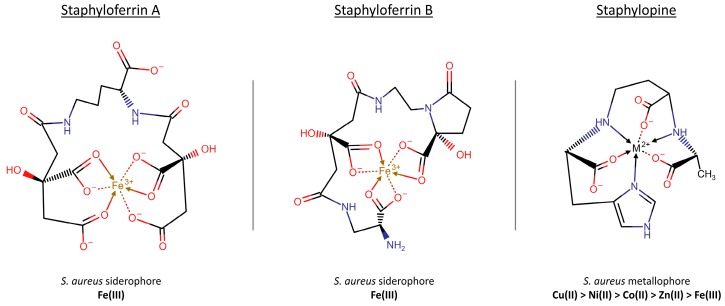
Structures of the three siderophores of S. aureus, adapted from Neumann et al. [106] on the basis of iron-bound models [46,47]. The chemical structures were drawn with Chemicalize.
Figure 3
Figure 3
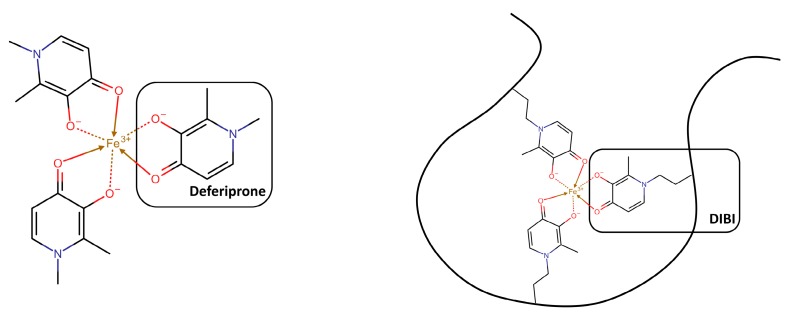
Schematic representation of Deferiprone (Ferriprox®) and DIBI in their iron-bound forms (adapted from [249]). The chemical structures were drawn with Chemicalize.
Figure 4
Figure 4
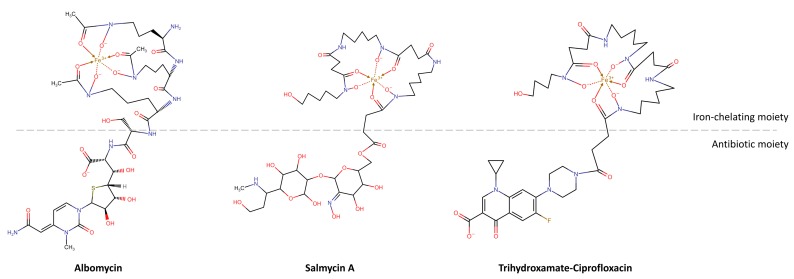
Schematic representation of the state-of-the-art Trojan horses (adapted from [261,262]). The chemical structures were drawn with Chemicalize.
Figure 5
Figure 5
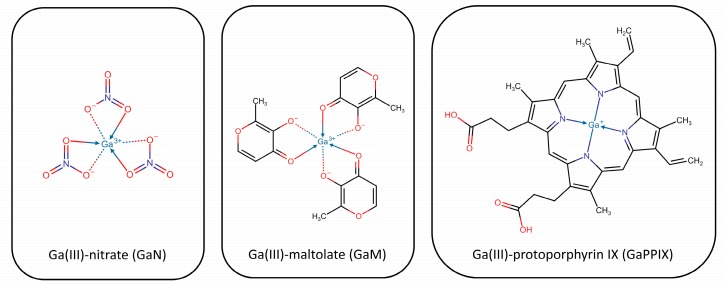
Representation of Ga-derivatives. The chemical structures were drawn with Chemicalize.

References

    1. Hood M.I., Skaar E.P. Nutritional immunity: Transition metals at the pathogen–host interface. Nat. Rev. Microbiol. 2012;10:525–537. doi: 10.1038/nrmicro2836. - DOI - PMC - PubMed
    1. Posey J.E., Gherardini F.C. Lack of a role for iron in the lyme disease pathogen. Science. 2000;288:1651–1653. doi: 10.1126/science.288.5471.1651. - DOI - PubMed
    1. Pandey A., Bringel F., Meyer J.-M. Iron requirement and search for siderophores in lactic acid bacteria. Appl. Microbiol. Biotechnol. 1994;40:735–739. doi: 10.1007/BF00173337. - DOI

    1. Perutz M.F. Stereochemistry of cooperative effects in haemoglobin: Haem–haem interaction and the problem of allostery. Nature. 1970;228:726–734. doi: 10.1038/228726a0. - DOI - PubMed
    1. Sánchez M., Sabio L., Gálvez N., Capdevila M., Dominguez-Vera J.M. Iron chemistry at the service of life. IUBMB Life. 2017;69:382–388. doi: 10.1002/iub.1602. - DOI - PubMed

MeSH terms