. 2020 Mar 20;13(6):1413.
doi: 10.3390/ma13061413.

In-Line Holography in Transmission Electron Microscopy for the Atomic Resolution Imaging of Single Particle of Radiation-Sensitive Matter

Affiliations

In-Line Holography in Transmission Electron Microscopy for the Atomic Resolution Imaging of Single Particle of Radiation-Sensitive Matter

Elvio Carlino. Materials (Basel). .

Abstract

In this paper, for the first time it is shown how in-line holography in Transmission Electron Microscopy (TEM) enables the study of radiation-sensitive nanoparticles of organic and inorganic materials providing high-contrast holograms of single nanoparticles, while illuminating specimens with a density of current as low as 1-2 e-Å-2s-1. This provides a powerful method for true single-particle atomic resolution imaging and opens up new perspectives for the study of soft matter in biology and materials science. The approach is not limited to a particular class of TEM specimens, such as homogenous samples or samples specially designed for a particular TEM experiment, but has better application in the study of those specimens with differences in shape, chemical composition, crystallography, and orientation, which cannot be currently addressed at atomic resolution.

Keywords: TEM; atomic resolution imaging; in-line holography; nanostructured drugs; organic materials; radiation damage; single particle imaging; soft matter.


Conflict of interest statement

The authors declare no conflicts of interest.

Figures
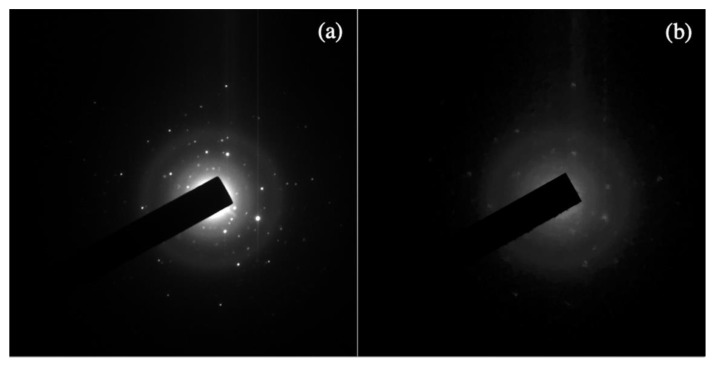
Figure 1
Figure 1
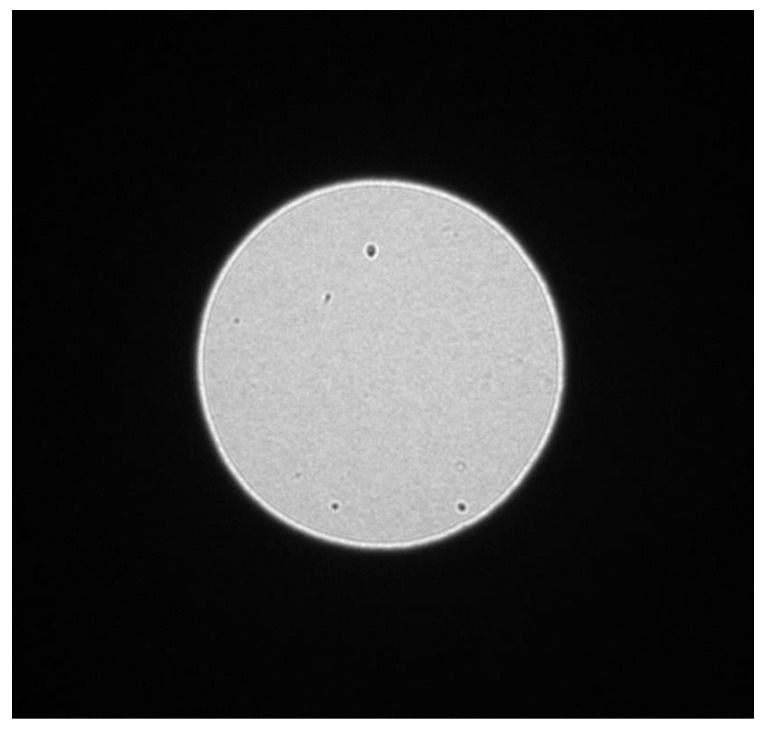
Selected area electron diffraction patterns of a specimen consisting of nanoparticles of Vincamine; (a) after an exposure to the electron beam with a density of current of 300 eÅ−2s−1 for 0.01 sec [4] and (b) after an exposure to the same current density for 0.3 s.
Figure 2
Figure 2
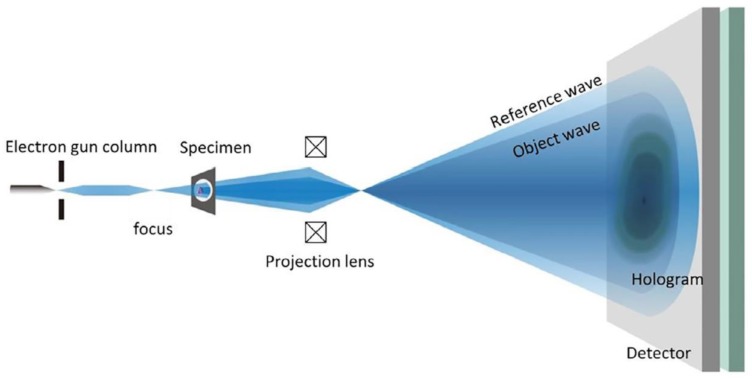
Scheme of the in-line hologram as firstly proposed by Dennis Gabor.
Figure 3
Figure 3
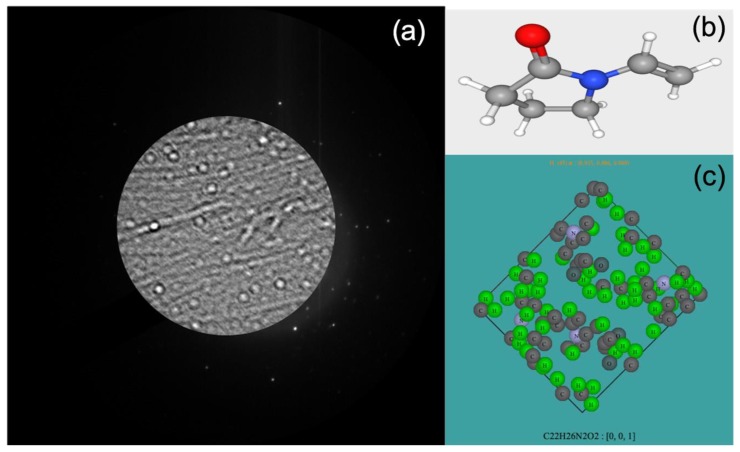
(a) In line-hologram on Vinpocetine and polyvinylpyrrolidone acquired in diffraction mode. (b) 3D Chemical structure of polyvinylpyrrolidone (gray atoms: C; white atoms: H; red atoms: O; blue atoms: N). (c) Crystal cell of Vinpocetine in [0,0,1] zone axis.
Figure 4
Figure 4
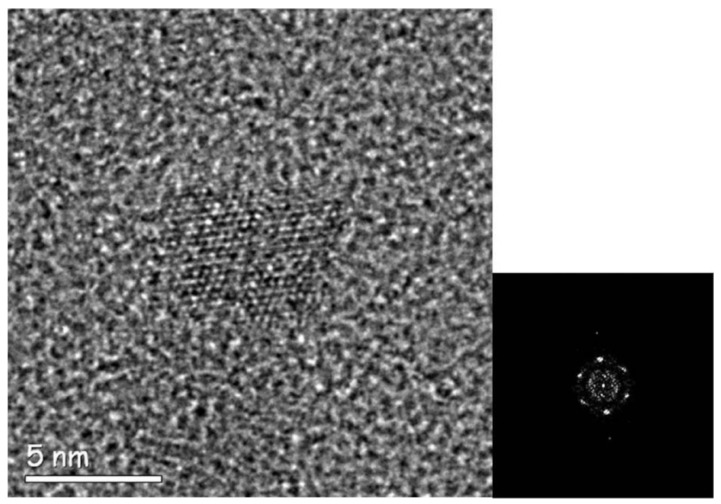
Low dose rate HRTEM image (a) and relevant diffractogram from a crystalline particle of Vinpocetine (b). The lattice spacing measured on the diffractogram is reported.
Figure 5
Figure 5
Left: Low dose rate HRTEM of a particle of vincamine. Right: The relevant high symmetry diffractogram (reprinted by courtesy from Hasa et al. [4]).
Figure 6
Figure 6
Left: Low dose rate HRTEM of a particle of vincamine. Right: The relevant high symmetry diffractogram. The lattice fringes in the central part of the particle and the spot splitting in the diffractogram point the presence of an extended structural defect in the crystal structure (reprinted by courtesy from Hasa et al. [4]).
Figure 7
Figure 7
In line-hologram on cocrystals of caffeine and glutaric acid as acquired in diffraction mode and exposed to 1.2 e Å−2.
Figure 8
Figure 8
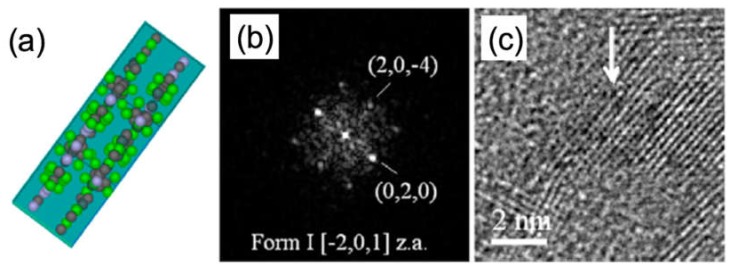
Caffeine-glutaric acid (CAF-GLA) co-crystal of polytype I [5]. The kind of polytype of the nanoparticle is univocally determined by comparing the structure of type I, viewed along the [−2, 0, 1] zone axis in (a), with the experimental diffractogram (b) and the HRTEM image (c). The arrow points the region from which the diffractogram was extracted (reprinted by courtesy from Hasa et al. [5]).
Figure 9
Figure 9
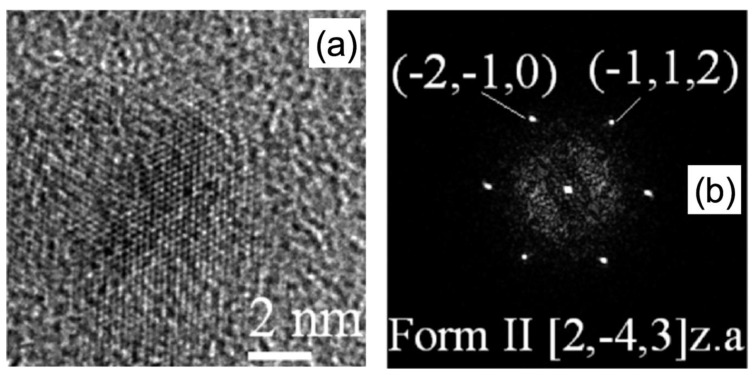
(a) HRTEM image of a caffeine (CAF) glutaric acid (GLA) polytype II [5] particle along with (b) the relevant diffractogram (reprinted by courtesy from Hasa et al. [5]).
Figure 10
Figure 10
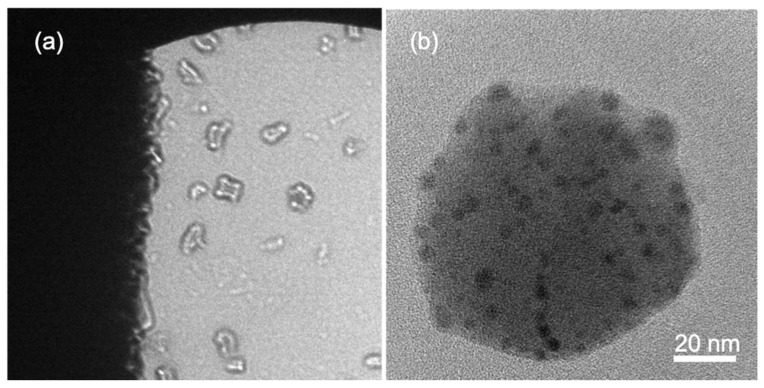
(a) In-line hologram of biologic particles. (b) Low-magnification HRTEM of one of the biologic nanoparticles; note the dark smaller nanoparticles within the big one.
Figure 11
Figure 11
Representative results on the small dark particles. (a) HRTEM image focused on one of the small and dark nanoparticles shown in Figure 10; (b) zoom inside the blue square of panel (a) (false color output); (c) Fourier transform relevant to the zoomed area in panel (b); (d) simulation, with the Miller indexes associated to some spots and the corresponding lattice spacing. Simulations show that the pattern of panel (c) is compatible with the ferrihydrate in the [4, 2, 1] zone axis.
Figure 12
Figure 12
(a) Characterization of creatinine particles; HRTEM image; (b) magnified view of the square region marked in (a); (c) Fourier transform of (b); (d): simulation of the diffraction pattern of creatinine in [1, −1, 0] zone axis with reported the lattice spacing relevant to the observed intensities. The yellow and pale-blue circles in the diffraction pattern simulation mark the correspondence with the circles around the experimental spots in panel (c).

References

    1. Van Aert S., Batenburg K.J., Rossell M.D., Erni R., Van Tandeloo G. Three-dimensional atomic imaging of crystalline nanoparticles. Nature. 2011;470:374–377. doi: 10.1038/nature09741. - DOI - PubMed
    1. Spence J.C.H. Experimental High-Resolution Electron Microscopy. 2nd ed. Oxford University Press Inc.; New York, NY, USA: 1988.
    1. Wisedchaisri G., Reichow S.L., Gonen T. Advances in structural and functional analysis of membrane proteins by electron crystallography. Structure. 2011;19:1381–1393. doi: 10.1016/j.str.2011.09.001. - DOI - PMC - PubMed
    1. Hasa D., Perissutti B., Cepek C., Bhardwaj S., Carlino E., Grassi M., Invernizzi S., Voinovich D. Drug salt formation via mechanochemistry: The case study of vincamine. Mol. Pharm. 2013;10:211–224. doi: 10.1021/mp300371f. - DOI - PubMed
    1. Hasa D., Carlino E., Jones W. Polymer-assisted grinding, a versatile method for polymorph control of cocrystallization. Cryst. Growth Des. 2016;16:1772–1779. doi: 10.1021/acs.cgd.6b00084. - DOI

LinkOut - more resources