Review
. 2020 Mar 21;17(6):2087.
doi: 10.3390/ijerph17062087.

Long-Term Recreational Football Training and Health in Aging

Affiliations
Review

Long-Term Recreational Football Training and Health in Aging

Esther Imperlini et al. Int J Environ Res Public Health. .

Abstract

This narrative review aims to critically analyze the effects of exercise on health in aging. Here we discuss the main clinical and biomolecular modifications induced by long-term recreational football training in older subjects. In particular, the effects induced by long-term recreational football training on cardiovascular, metabolic and musculo-skeletal fitness, together with the modifications in the muscle expression of hallmarks related to oxidative metabolism, DNA repair and senescence suppression pathways and protein quality control mechanisms will be provided. All these topics will be debated also in terms of preventing non-communicable metabolic diseases, in order to achieve successful aging over time.

Keywords: DNA repair; VO2max; aging; autophagy; exercise; health; long-term recreational football training; older; oxidative metabolism; senescence suppression.


Conflict of interest statement

The authors declare no conflict of interest.

Figures
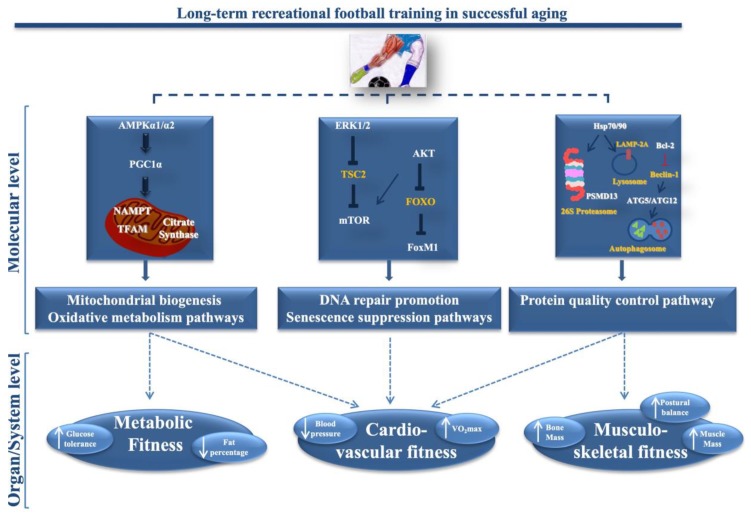
Figure 1
Figure 1
Long-term recreational football training in successful aging. Long-term recreational football training induces muscle molecular over-expression of key markers involved in the mitochondrial biogenesis and oxidative metabolism pathways (AMPKα1/α2, PGC1α, TFAM, NAMPT and citrate synthase activity), in DNA repair promotion and senescence suppression (ERK1/2, AKT, mTOR and FoxM1) and in the protein quality control pathway (HSP70/90, LAMP-2A, Bcl-2, ATG5-ATG12, PSMD13) and Systemic, Metabolic, Cardiovascular and Musculo-skeletal Fitness in long-term recreational football-trained older subjects. Abbreviations: AMPKα1/α2, Protein kinase, AMP-activated, α 1/α 2; PGC1α, Peroxisome proliferator-activated receptor-gamma coactivator-1α; TFAM, Mitochondrial transcription factor A; NAMPT, Nicotinamide phosphoribosyltransferase; ERK1/2, Extracellular signal-regulated protein kinases 1 and 2; TSC2, tuberous sclerosis complex 2; mTOR, the mammalian target of rapamycin; AKT, protein kinase B; FOXO, class O of Forkhead transcription factors; FoxM1, Forkhead box protein M1; HSP, Heat Shock Proteins; LAMP-2A, lysosomal membrane type 2A protein complex; Bcl-2, anti-apoptotic B-cell lymphoma-2 protein; ATG5-ATG12, Autophagy Factors 5 and 12; PSMD13, non-ATPase subunit of the 19S regulatory complex. Adapted from Mancini et al., 2017, 2019 [92,100] and from Krustrup & Parnell, 2019 [51].

References

    1. Tosato M., Zamboni V., Ferrini A., Cesari M. The aging process and potential interventions to extend life expectancy. Clin. Interv. Aging. 2007;2:401–412. - PMC - PubMed
    1. Neustadt J., Pieczenik S. Organ reserve and healthy aging. Integr. Med. 2008;7:50–52.
    1. Barzilai N., Huffman D.M., Muzumdar R.H., Bartke A. The critical role of metabolic pathways in aging. Diabetes. 2012;61:1315–1322. doi: 10.2337/db11-1300. - DOI - PMC - PubMed
    1. Morley J.E. Diabetes and aging: Epidemiologic overview. Clin. Geriatr. Med. 2008;24:395–405. doi: 10.1016/j.cger.2008.03.005. - DOI - PubMed
    1. Krustrup P., Aagaard P., Nybo L., Petersen J., Mohr M., Bangsbo J. Recreational football as a health promoting activity: A topical review. Scand. J. Med. Sci. Sports. 2010;20 doi: 10.1111/j.1600-0838.2010.01108.x. - DOI - PubMed

Publication types
